Janae and Robert Walters' Affair Is Exposed
I'm Still Here- What didn't kill me made me stronger and sharperThe exposure of Janae Morrison and Robert Walters’ affair becomes a contest over who will be believed: Walters uses his public standing to deny their relationship, while Janae preserves evidence that can overturn his account. The scandal first reaches the public through news coverage that frames her as both a drug user and a woman whose claims about a prominent man can be dismissed.
Public Exposure and Competing Accounts
Janae sees herself on WIVB News beside Councilman Robert Walters after coverage links an alleged affair with a drug bust. The report shows her naked with her nose in a cocaine jar and revisits her troubled past and addiction. Rather than presenting the relationship as a question requiring investigation, the coverage makes her history part of the case against her credibility.
Walters answers the allegations at a press conference. He describes his connection to Janae as business, centered on her artwork, and portrays himself as a humanitarian who came to the hotel to offer her alternatives. He denies sleeping with her, professes loyalty to his wife, Dr. Elizabeth Mourning-Walters, and claims he did not know Janae used drugs. He also says Janae tried to seduce him. His version places him in the role of rescuer and makes her responsible for the encounter.
The denial gains force from the contrast the media and community draw between their public images. Walters is presented as an admired man whose marriage to Dr. Elizabeth Mourning-Walters seems incompatible with an affair; Janae is reduced to her weight, addiction, and reputation. The resulting imbalance makes her private account difficult to credit even before the evidence is aired.
Janae’s Account and the Evidence She Kept
Janae’s private account gives the relationship a history that Walters’s public denial erases. She says he first approached her at an art event where she was trying to sell her work, then bought her art supplies, paid for art classes, and took her to New York to see work by artists of the Harlem Renaissance, including Aaron Douglas, Jacob Lawrence, Romare Bearden, Leslie Bolling, and Augusta Savage. She painted a portrait that hung in his office. According to Janae, Walters repeatedly told her that he loved big women, called her beautiful, and said he could not live without her. She recalls their relationship as an ongoing affair, including repeated sexual encounters and shared drug use—not a business connection or a single attempt by her to seduce him.
Janae says she did not initially know Walters was married. She discovered his marriage when he arrived at an art event with Dr. Elizabeth Mourning-Walters and ended the relationship, but he continued calling and texting, asked for forgiveness, and insisted that he wanted Janae in his life. The marriage’s public respectability complicated her position further: Dr. Elizabeth Mourning-Walters had befriended Janae, bought her clothes and shoes, and introduced her to her social circle. Janae acknowledges her own part in the betrayal, but describes Walters as the person who pursued her and then returned to her after she tried to leave.
As the public story turns against her, Janae’s account is not unsupported recollection. She has saved videos, text messages, emails, and love letters from Walters, preserving a record of their intimacy and his private declarations. One video shows him using cocaine; another records an intimate sexual encounter that starkly contradicts his carefully managed public image. When he stops answering her calls and messages, removes her as a Facebook friend, and changes his number, she goes to his apartment hoping to recover the relationship. Instead, he strikes her and hands her an envelope marked with $25,000. The preserved messages and recordings thus become both a personal archive of what they shared and the means by which Janae can challenge his denial.
Evidence Goes Public and Buffalo Turns Hostile
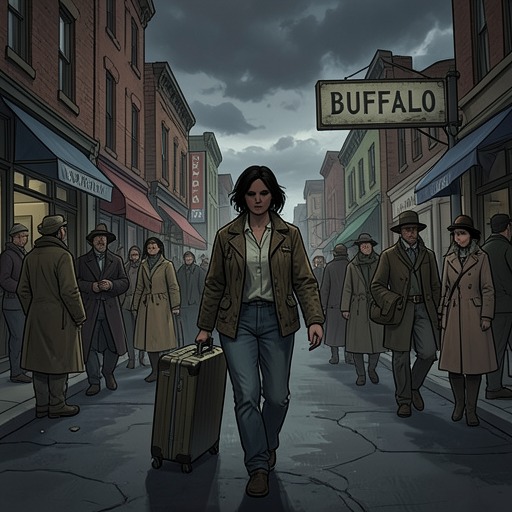
After Walters rejects Janae and forces her out of his apartment, she brings her evidence to Jessica Brown, an executive producer at YNN News. Janae gives her an SD card containing the recordings, texts, and emails documenting the affair and Walters’s private conduct. Brown recognizes the material as a major story, but her warning is not simply that Walters may be exposed: she believes Janae will remain vulnerable in Buffalo even if the evidence is genuine. She predicts that the city’s Black elite will close ranks around Dr. Elizabeth Mourning-Walters, leaving Janae unable to find work or sell her art, and advises her to start over on the West Coast. Brown returns the $25,000 envelope and gives Janae a bus ticket, turning the money Walters used after striking her into part of her means of escape.
The warning is reinforced by the public’s treatment of Janae. Recognized from the news coverage, she hears a woman reduce her to her weight and appearance and dismiss the possibility that Walters could have slept with her. The insult echoes the media’s existing frame: his stature and marriage make him seem credible, while her body, addiction, and past are used to make her seem inherently suspect. Janae’s evidence may expose Walters, but it does not undo the stigma through which the audience has already been taught to see her.
When the recordings air, they show Walters using cocaine and reveal an intimate sexual encounter, while the recorded declarations and messages contradict his public denial. The story changes from an allegation that can be dismissed as Janae’s word against a councilman’s into a scandal supported by material evidence. Yet disclosure does not bring safety or uncomplicated vindication. Janae receives threatening messages and a hostile voicemail from Dr. Elizabeth Mourning-Walters; she understands that she is neither wanted nor safe in Buffalo. The public exposure therefore reverses the balance of proof without reversing the balance of power: Walters’s private conduct is made visible, but Janae is the one compelled to leave.
Personal Cost and the Turn Toward California
The exposure also sharpens Janae’s private crisis. As the television broadcasts her image and the affair allegations, she cuts her skin with broken glass, describing self-inflicted pain as a way to erase tears and past wrongs. After a stranger publicly derides her appearance, she again turns to a razor, hoping the pain and blood can remove what she has come to regard as ugly within herself. The contrast is stark: the evidence gives her a means to challenge Walters’s public account, but the attention surrounding it intensifies the shame and hurt through which she sees herself.
Leaving Buffalo carries the scandal into the next movement of the story. On the way to California, Janae sketches Jensen Brick McCall on the bus and adds tears to his portrait despite seeing none on his face, projecting an emotion she recognizes from within herself. He notices her face on YNN News and recognizes her from the coverage. Their meeting begins not with an explanation of the affair but with an image: her drawing makes a private interpretation of sadness, while the broadcast has already made her a public figure. The scandal thus ends this phase by driving Janae from Buffalo and placing her beside a stranger whose own history will intersect with hers.