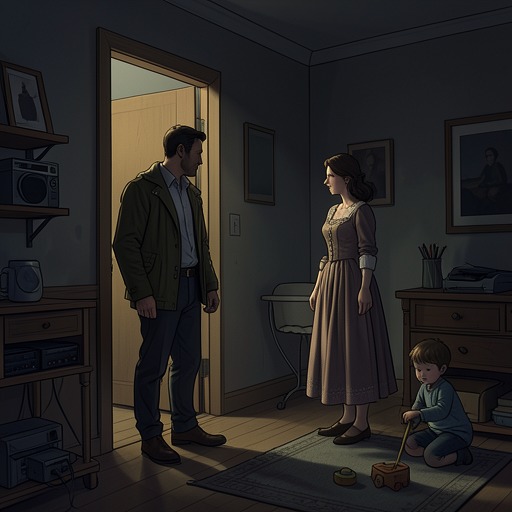
Jensen McCall—Grace relationship
I'm Still Here- What didn't kill me made me stronger and sharperThe relationship between Jensen McCall and Grace is both the foundation of Jensen’s survival and one of his most complicated attachments: Grace saves him as a newborn, raises and defends him, and gives him his name, while her choices around his birth mother leave a lasting wound. Their bond moves from rescue and protection into reversal, as the child Grace cared for becomes responsible for caring for her.
Rescue, Naming, and the Meaning of Motherhood
Grace’s connection to Jensen begins in the room where he is left to die after birth. She later tells him that he kept crying and moving, and that when she picked him up he grasped her fingertip. His eyes were wide open; he was on a table with eleven other babies who had died. Grace remembers a kick and a soft cry as the signs she could not ignore. She takes him with her, calling him her miracle baby. This is not merely the origin of an adoptive placement: in Jensen’s account, Grace’s decision is the event that makes his life possible.
He is given the name Jensen by Grace after being left without one. In the painful account he gives of his origins, he says he had been John Doe, and that his birth mother’s daughter had asked for him to be left on the table to die. That knowledge makes Grace’s act of taking him in more than an act of care; she becomes the person who gives identity and belonging where his birth circumstances offered neither. Jensen later describes a life marked by abandonment, foster homes, and being treated as an unwelcome guest. Against that history, Grace is the person who first claims him as her child.
Yet the language of motherhood is carefully bounded. Grace will not let Jensen call her Mom, because she believes doing so would disrespect his birth mother. He loves Grace as his mother, but grows up with a rule that makes the title itself unavailable. He once assumes the distinction may have to do with race: he is Black, while Grace is white. Their attachment is therefore intimate but not uncomplicated, shaped by a household where love is expressed through protection while the meaning of family remains constrained by Grace’s insistence on acknowledging the woman who gave birth to him.
Protection Inside a Hostile Home
Grace’s devotion is clearest in the way she stands between Jensen and her husband, Rick. Rick calls the boy a racist slur, and Grace answers by insisting that his name is Jensen. She continues to protect him despite the abuse this brings upon her. The conflict eventually ends with Rick leaving, saying that Grace’s choice of Jensen over him is an embarrassment. Her defense of her son has a cost within her marriage, but she does not withdraw it.
The contrast between the damaged house Jensen later revisits and the continuing force of his memories makes that protection tangible. The shingles have fallen, the pale-blue paint is chipped, and the windows are broken; nevertheless, the house still holds memories of Grace. For Jensen, it is not simply a former address. It is the place where someone chose him when he had been left for dead, and where he was defended against a man who refused to recognize him as a person deserving of his name.
Illness and the Reversal of Care
After Rick leaves, Grace’s condition declines. Jensen notices her spending more time in her room and repeatedly going to the pharmacy. Breakfast can mean ten pills and a glass of wine before work. She becomes dependent on Vicodin and Percocet, and Jensen sometimes finds her passed out on the couch. The child who had been saved and defended begins, at nine years old, to look after her, bringing her tea and toast.
Grace eventually loses her hospital job. Her substance use worsens: she smokes water, a cigarette dipped in embalming fluid. When Jensen asks why, she says it is to forget her wrongdoings. He later learns that she is haunted by the babies she helped kill. Their cries persist in her dreams and while she is awake; she recalls rows of babies still alive as they take their last breaths, and the mothers who said to let them die. Grace had saved Jensen, but she had not saved the others. That painful contrast helps explain the guilt she carries without erasing the care she gave him.
The reversal between them is central to their history. Grace once lifted Jensen from a table and made a home for him; as a boy, he feeds and tends to her while she is impaired. The relationship is not presented as an uncomplicated debt that Jensen must repay. Rather, care passes between them under radically different circumstances: her early protection gives him a life, and his childhood attention becomes one of the ways he responds to her later vulnerability.
Birth-Mother Secrets and Lasting Ambivalence
Grace’s protection also shapes Jensen’s relationship with his birth mother. Grace later tells the birth mother that her son is fine, happy, and healthy, and remembers that the birth mother sometimes called to ask about him. She even recalls a visit to Syracuse when Jensen was performing in a school play and reciting Martin Luther King’s “I have a dream” speech. The birth mother had begged to be part of his life, but Grace refused, saying Jensen was her son.
Jensen remembers the incident differently from the safety implied by Grace’s brief report. In third grade, he saw his birth mother in a black dress and pearls arguing with Grace. Grace told her to leave, then told Jensen that the woman was a former coworker. When the truth emerges, Jensen confronts the loss not only of a relationship he never had, but of Grace’s decision to hide the chance that one might have existed. Grace’s actions can be understood as an attempt to protect the child she had raised, yet for Jensen the protection also becomes a barrier and a lie. His attachment to Grace must hold both facts at once: she chose him and defended him, and she made a consequential choice on his behalf without telling him.
The Bond’s Enduring Significance
Jensen’s memories of extreme loneliness give Grace’s role particular weight. On his high-school graduation night, no one is there to celebrate his achievement. He buys a gun, stands behind a building, and nearly shoots himself; when rain begins, he buries the gun instead. The account does not identify Grace as the reason no one attended, but it shows how persistent the experience of being alone remains in his life, despite having once been saved and loved within her home.
The relationship therefore resists a simple division between rescuer and wrongdoer. Grace’s decision to save Jensen, give him a name, and defend him from Rick is foundational; her refusal to let his birth mother enter his life, and her concealment of the past, also cause real hurt. Jensen’s story presents their mother-and-son bond as an attachment built through concrete acts of choosing and caregiving, but burdened by the unanswered question of who gets to define a child’s family. Grace gives him a home and a beginning; the truth about that beginning forces him to reconsider what her love protected him from—and what it kept from him.