Jensen's birth certificate
I'm Still Here- What didn't kill me made me stronger and sharperJensen's birth certificate is not merely a record of birth; it is the document through which an endangered infant is given a name, a legal identity, and a future. Created after Grace McCall refuses to let the surviving baby die, it stands against the death certificate that had first consigned him to disappearance. Its decisive significance is therefore double: it rescues Jensen from institutional erasure while preserving the contradiction that his life began under a falsified account.
Creation and Naming
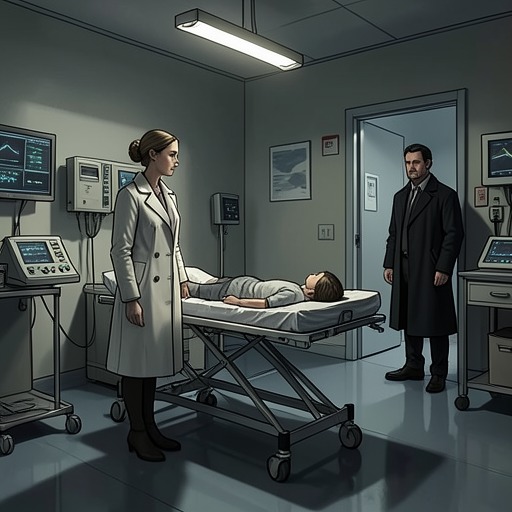
Grace McCall creates the certificate after finding that the premature infant has survived the clinic's decision to let him die. She wraps him in her coat, places him in a duffel bag, and takes him home rather than watching him draw his last breath. She names him Jensen Brick McCall and explains that Jensen carries the meaning of Hebrew John, associated with divine favor. The name is presented as a declaration that the child's survival has purpose: Grace believes he will become powerful and touch lives for the better.
The certificate is made alongside Jensen's death certificate. Grace says that she creates his birth certificate just as she created the death certificate and gives it to Regina for registration. Regina's reply makes the document's bureaucratic contradiction explicit: the mother has come to retrieve the child, yet the child now has both a death certificate and a birth certificate. The certificate therefore records more than an administrative fact. It is a deliberate intervention by Grace, who converts a vulnerable body marked for death into a person who can be carried into a new family and history.
Legal Record and Buried Truth
The document's meaning changes when Jensen confronts Gloria Simpson Picoult. He hands her the death certificate, and she becomes fixated on the name John Doe 3524 and the medical code identifying a pregnancy termination at twenty-six weeks. Her name appears in bold on the record, making the hidden connection between the abandoned infant and his birth mother impossible to evade. Jensen is alive before her at six feet five, while the paperwork insists that the child connected to her was dead.
Jensen's birth certificate is thus part of a larger evidence chain involving official records, names, medical language, and testimony. The death certificate supplies the institutional version of his disappearance; the birth certificate supplies the counter-record that allows Jensen Brick McCall to exist socially and legally. The contrast exposes how documents can both conceal and reveal truth: a certificate appears objective, but here its authority depends on the choices of the people who create, register, and interpret it.
Identity, Evidence, and Consequence
The certificate gives Jensen an identity before he can speak for himself, but it does not resolve the emotional injury caused by his abandonment. Years later, he travels from Syracuse, New York, to California seeking an explanation from Gloria, not affection or an embrace. He tells her that Grace had reported his survival and that Gloria had instructed the clinic to let him die. The document cannot supply the answer he wants, but it helps make the question unavoidable by placing birth, death, and maternal responsibility within a traceable record.
The book repeatedly surrounds personal truth with documentary evidence. Janae Morrison preserves videos, texts, emails, and love letters to expose Robert Walters; Jensen works with Detective Dartes for weeks, providing recordings and details in exchange for immunity and a bus ticket out of Syracuse; a hospital's policy turns a suicide attempt into an admission, evaluation, insurance, and discharge record. Against this background, Jensen's birth certificate belongs to the same world of contested proof. It is a material object that can establish a name even when a family refuses recognition, and it shows how survival may require both care and paperwork.
Narrative Significance
As an object, Jensen's birth certificate embodies the struggle between assigned identity and lived identity. Jensen's life is repeatedly defined by records that contradict one another: he is treated as dead, then registered as born, while the truth of his existence remains physically undeniable. The certificate's power comes from this tension. It does not erase the violence that preceded it, but it interrupts that violence by giving the child a name under which he can be protected, raised, and later recognized.
Its deepest function is ethical rather than merely legal. Grace's act turns the certificate into a promise that the infant will not be abandoned to an impersonal order of death. Jensen later inherits that promise in altered form: he seeks truth, confronts Gloria, and refuses to let the document's official language replace the reality of what happened. The certificate marks the beginning of a reconstructed life, while its proximity to the death certificate keeps the story's central fact visible—that Jensen's existence is both an administrative creation and a survival that the authorities had failed to honor.