Jesus Take the Wheel
I'm Still Here- What didn't kill me made me stronger and sharperJesus Take the Wheel is both a country song and a small but revealing point of connection in the novel: Reba Clara Bell Gilbert sings it in a Texas bus-depot bathroom, then identifies it as her favorite and the song she hopes to perform on America's Got Talent. Its appearance brings her musical ambition into a scene marked by Janae Morrison’s concealed cocaine use, while its religious invocation resonates with the book’s wider language of prayer, purpose, and survival.
The Song in the Depot
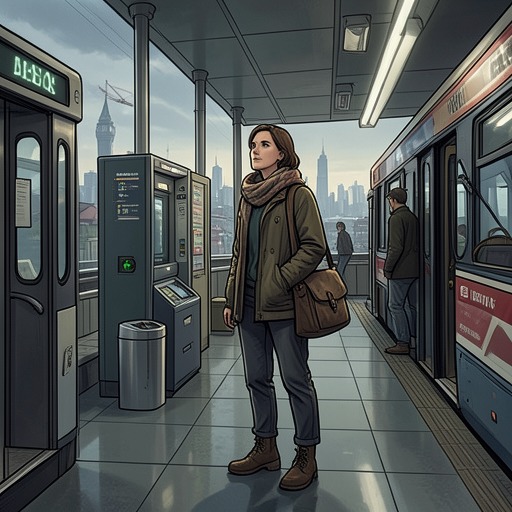
Janae Morrison has gone into the depot bathroom after a painful conversation about a parent’s love. She searches her purse, finds an envelope containing cocaine, and sniffs some. As she wipes her hands, a tall woman in a cowboy hat, with long blond braids and two suitcases, washes at the sink and begins singing Jesus Take the Wheel. The clean bathroom, with the scent of Pine-Sol and bleach, becomes the setting for this unexpected encounter.
The song first reaches Janae as a performance rather than an explanation: she hears the singer’s country-style voice, compliments it, and learns that the woman sometimes breaks into song. The brief exchange interrupts Janae’s private, risky act without resolving it. Music provides a moment of contact between strangers, but the scene keeps both realities present: Reba’s open enthusiasm and Janae’s attempt to manage distress through drugs.
Reba’s Musical Ambition
Reba Clara Bell Gilbert calls Jesus Take the Wheel her all-time favorite and says she plans to sing it on America's Got Talent. She dreams of becoming a country-western singer, an ambition she presents without apology. When Janae remarks on the rarity of a Black woman wanting to sing country, Reba names Dona Mason and Rissi Palmer and insists that she, too, can reach the top of the Billboard chart. Her exchange turns the song from background music into a declaration of the future she imagines for herself.
The scene also makes Reba’s self-introduction part of that ambition. She says she was named after Reba McEntire, whom she loves. The name, the chosen genre, the song, and the television competition all belong to the same picture of a life she wants to claim: one in which she is heard as a singer, not merely noticed as a stranger in a station bathroom.
Faith and the Novel’s Wider Motif
The song’s title invokes surrender to divine guidance, a resonance rather than a claim that the novel supplies or discusses its lyrics. Elsewhere, Grace McCall whispers a prayer asking God to let one baby live; Jensen Brick McCall is repeatedly told that God chose him for a purpose; and Ginger Pearl thanks the Lord after finding a photograph she thought she had lost. These episodes give Reba’s favorite song a context in which faith is expressed through pleas, interpretations of survival, and gratitude.
That context does not make the depot scene a simple illustration of religious certainty. Reba’s stated dream is concrete and personal: she wants to sing country music for an audience. The song’s title places that aspiration beside a language of trust in forces beyond oneself, while Janae’s cocaine use shows a different response to vulnerability. The moment’s significance lies in this juxtaposition: a song of spiritual reliance accompanies a brief encounter in which hope, performance, and private struggle share the same space.
Narrative Function
Jesus Take the Wheel gives Reba an immediate and memorable entrance through an action that expresses her character before her introduction is complete. She is singing, then explaining her ambition, naming artists who have made a place in country music, and imagining her own success. The song makes that ambition audible and lets Janae respond to it, creating a point of contact at a moment when Janae is concealing her relapse.
Its importance is local rather than a recurring plot device: the evidence places the song in this depot encounter, not as a refrain repeatedly heard throughout the novel. Yet the brief performance gathers several of the book’s concerns into one scene—the desire for a purpose, the work of imagining a future, and the possibility of connection amid pain. Reba’s song does not solve Janae’s crisis; it opens a human exchange within it.