Kidney
I'm Still Here- What didn't kill me made me stronger and sharperThe kidney in the novel is both a failing organ and the focus of an intimate moral conflict. Gloria’s end-stage renal disease makes her need for treatment a recurring fact of daily life; her request that Jensen Brick McCall give her a kidney forces him to confront what he owes a mother who abandoned him. His eventual donation reverses his refusal, but the change is not presented as a simple cure for their history: it comes amid a broader process of apology, recognition, and family reconstruction.
Illness and Its Daily Evidence
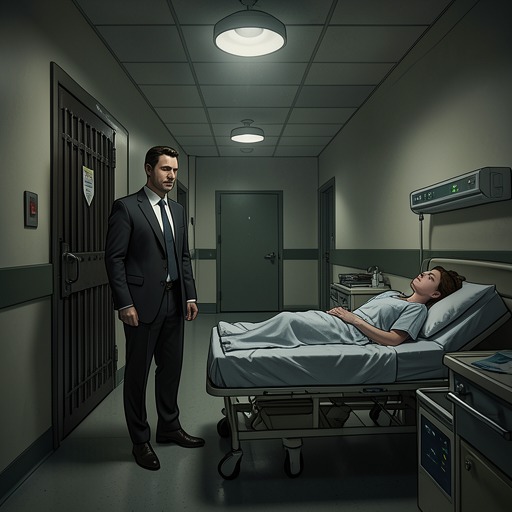
Gloria’s illness is first made concrete through a medical alert bracelet that Jensen notices while they are speaking. It identifies her condition as end-stage renal disease, a stark clinical phrase set against the unresolved, personal question between them: whether he can recognize her as his mother, and whether she can recognize him as her son. When he asks whether she receives dialysis, she answers that she goes three times a week. The exchange makes the kidney’s importance more than a future possibility; treatment is already part of her regular life.
The condition recurs through signs of Gloria’s ongoing care. Janae Morrison calls Jensen’s attention to Gloria’s markedly swollen legs and says Gloria should take her water pill and blood-pressure medicine. Jensen responds that he had noticed the swelling, although he initially asks what Janae expects him to do. Later, Gloria says she needs to leave to take her medicine and confirms that dialysis is scheduled for the following day. These details keep her illness present between the major confrontations: medication, visible symptoms, and the next dialysis appointment shape the practical circumstances in which the family’s emotional disputes unfold.
The Request and Jensen’s Refusal
The kidney becomes an explicit test of kinship when Jensen learns that Gloria has asked him to donate one. Janae checks that she has understood correctly, and Jensen confirms that his mother made the request. When Janae asks whether he will do it, he answers that Gloria will not acknowledge him as her son, so he sees no reason to give her a kidney. His refusal is not framed as a medical judgment or a dispute about the mechanics of donation. It arises from the wound at the center of their relationship: the person asking him for bodily help is, in his view, the person who denied their bond.
That refusal also exists alongside pressure to forgive. In another conversation, someone tells Jensen that wanting to find Gloria and help her is not wrong, and that her having wronged him does not mean he should refuse to forgive her. Elsewhere, a speaker admits that asking him to give Gloria a kidney was wrong, while insisting that the request was not the only reason for wanting him in their life. The scenes distinguish two questions that might otherwise be collapsed: whether Jensen can forgive Gloria, and whether he should make an extraordinary bodily sacrifice for her. For Jensen, the second cannot be detached from the first. An appeal to family obligation is insufficient while he feels excluded from the family itself.
Care Beyond the Demand
The novel places the kidney request within a wider pattern of illness and care, but does not equate the conditions involved. Gloria’s renal disease is a continuing medical reality; Janae’s self-harm and suicide attempt lead to a separate encounter with hospital policy. The hospital explains that Janae would ordinarily be admitted for three days of mental-health evaluation, but that lack of insurance and the hospital’s refusal to participate in Medicaid leave it with no choice but to release her. Staff offer her free intensive dialectical behavior therapy, combining group and individual counseling, if she agrees to the program’s contract. This scene does not concern kidney treatment, but it reinforces the book’s attention to how care is mediated by both personal relationships and institutional limits.
Gloria’s physical vulnerability becomes more urgent later, when she suffers a massive heart attack and needs triple-bypass surgery. The account does not state that her heart attack was caused by her kidney disease, and the two conditions remain distinct in the narrative. Their proximity nevertheless deepens the family’s sense of time and responsibility: Jensen is faced not with an abstract past injury but with a mother whose health is visibly precarious. The kidney request belongs to that continuing landscape of illness, even as the novel keeps the emotional history behind it in view.
Donation and Reconstructed Kinship
At the Christmas Day family gathering one year later, Jensen says that he has given Gloria his kidney so she can watch his brother and sister grow up. The donation has happened, and its stated purpose reaches beyond the exchange between mother and son: it gives Gloria the prospect of being present in the lives of her younger children. The account does not describe the operation or provide medical details about the transplant. Instead, it places the gift in the family’s shared future, among the ordinary pleasures of a meal and the teasing and card-playing around the table.
The reunion also marks a reversal in how Jensen names the relationship. The woman he once regarded as his murderer is now his mother, and he describes her as someone who understands why he survived. His kidney donation does not erase the abandonment that shaped his anger, nor does the narrative treat bodily sacrifice as proof that the past no longer hurts. Its significance lies in the changed action: the son who had reasoned that Gloria’s denial of him gave him no reason to help her ultimately chooses to give. In that ending, the kidney is at once part of Gloria’s medical story and a concrete act through which a severed family bond is remade.