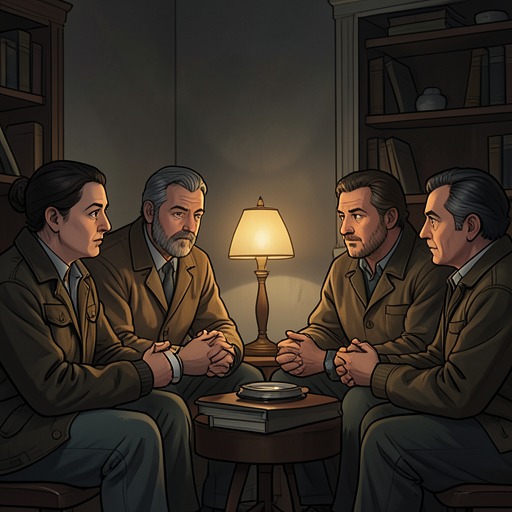
Life Imprisonment of the Mind
I'm Still Here- What didn't kill me made me stronger and sharperLife Imprisonment of the Mind is the expression Jensen Brick McCall uses for a punishment that continues inside the survivor after the immediate danger has passed. He describes guilt over his silence and the deaths of Chyna and Mortez Payne as a form of incarceration without a key; the phrase gives shape both to his sense of lasting responsibility and to his struggle to make survival serve a purpose beyond remorse.
Meaning and Image
The expression is stated as a maxim: “Life imprisonment of the mind is the worst form of incarceration no key can set you free.” Its contrast is stark. Physical imprisonment has a visible boundary and, at least in the image, a key; mental imprisonment persists through memory, self-judgment, and the inability to undo what has happened. Jensen’s wording therefore shifts attention from confinement imposed by another person to a sentence he carries within himself.
The surrounding image makes that inward punishment concrete. Jensen stands in his neighborhood on dirty ice, with melted patches and deep puddles around his feet, while other people make their way toward warm homes. Although he is in familiar surroundings, he says he has no home and has never known his blood family. His birth and death certificates testify that he survived at least once, but survival alone has not freed him from grief or isolation. The passage places bodily survival beside emotional homelessness, sharpening the distinction between being alive and feeling released.
Guilt and Complicity
Jensen connects the phrase to his belief that he allowed harm through silence. He recalls that Grace McCall bought drugs from his friends and that he kept quiet because he feared losing her. He then indicts himself for failing to act as Chyna and her son died, describing his silence as the greatest crime committed by a free man. The language is deliberately severe: freedom in the outside world does not cancel the inward sentence he believes his inaction has earned.
His self-accusation gives the metaphor moral force, but it also shows how grief can become totalizing. Jensen says he carries the deaths with him, turning remembrance into a continuous burden rather than a single past event. The expression does not present a legal verdict or establish that he caused the deaths; it records the punishment he imposes on himself for what he believes he failed to prevent. That distinction matters: the mind’s prison is built from his interpretation of his responsibility as well as from the losses themselves.
From Remorse to Purpose
The phrase belongs to a larger account of survival as a search for meaning. Jensen says his life began when he left Syracuse, not when he was left for dead, and describes finding his “murderer” as part of a quest that ultimately led him to find himself. He hopes that telling his story will help another young man who is trying to understand why he remains alive when death seemed near. In this framing, narration becomes an answer to isolation: the experience that once confined him may be offered as testimony to someone else.
That effort to redirect guilt appears in his response to a new danger. After learning that Janae Morrison has been targeted, Jensen considers whether she is someone he can help rather than treating the assignment against her as merely another task. His stated desire to save a woman from ruining her life echoes his regret over having failed to intervene before. The parallel does not erase his earlier responsibility; it gives him a chance to act differently. The language of imprisonment thus sits beside a developing ethic of protection, in which action may interrupt the repetition of old harm.
Recognition and Release
Jensen’s encounter with his birth mother brings the metaphor into a different kind of reckoning. He describes her as both his mother and his murderer because, as he understands his birth story, she tried to end his life before he was born and later told the clinic to let him die. When he finally embraces her, he recognizes that love is winning within him and that he can understand why she left him. He separates from her after gaining an explanation and an opportunity for contact, without claiming certainty about whether she will continue to embrace or erase him. The moment offers a measure of healing, not a neat cancellation of the past.
The later family scene gives that change a concrete consequence. On Christmas Day, Jensen and Janae become parents to Grace Pearl McCall; Jensen says that he now has a family and describes his birth mother as his mother. He has also donated a kidney so she can watch her younger children grow up. The earlier language of a mother who tried to take his life is not simply discarded: the relationship has changed through explanation, reconciliation, and care. Against the image of an unopenable prison, the ending presents connection as a real, limited form of release—one built through choices and sustained relationships, rather than through forgetting what happened.