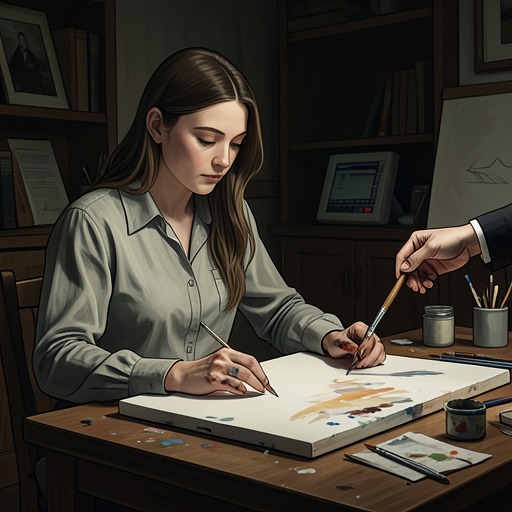
Portrait of Delia as an Angel
I'm Still Here- What didn't kill me made me stronger and sharperPortrait of Delia as an Angel is Janae Morrison’s painted tribute to Delia, the daughter of her therapist, Inya. Made as the payment Inya requests for treatment and ultimately given as a gift, it brings together two forms of care: Janae’s developing recovery and Inya’s effort to honor a child whose death remains bound to her own past. Its unveiling, on the fifth anniversary of Delia’s death, makes the painting an act of remembrance as well as an image of the love and healing its maker wants it to carry.
Commission and Context
When Inya agrees to take Janae Morrison as a client, she sets terms that make the work more than a routine appointment. She requires complete honesty, insists that Janae must genuinely want help, and asks her to paint a portrait of Inya’s daughter as payment. The request gives Janae’s art a practical role in their relationship: it is the agreed exchange for treatment, and a task that connects her creative ability to another person’s history of loss.
That history emerges when Janae assumes Inya has enjoyed a privileged, stable life. Inya corrects her: she grew up in the projects in Watts, used Sherm and crack from age eighteen to thirty, and married a drug dealer. During one crack binge, she fell asleep; a man who had come looking for her ex murdered her nine-year-old daughter while she slept. Inya describes herself as a mother whose addiction and absence preceded the killing, and says that after attempts to take her own life and a stay in a psychiatric ward, she got clean, went to college, and devoted herself to helping others stay alive. The portrait is commissioned within this disclosure, so its subject is not an abstract emblem of grief: Delia is the child Inya lost, and the painting answers a history Inya has entrusted to her client.
The Image and Its Meaning
Janae makes Delia an angel associated with forgiveness, restoration, and love. The figure’s spread wings are meant to suggest that Delia is healing souls. This imagery does not undo the circumstances of her death; instead, it gives Inya a way to remember her daughter through innocence and care rather than only through the night she was killed. Janae’s interpretation also makes the work a memorial shaped by the living: she cannot bring Delia back, but she can make an image that honors what Inya says was lost.
The angel motif connects the portrait’s private subject to the work Inya has chosen after her daughter’s death. She has dedicated her life to helping others, and Janae’s painting imagines Delia as continuing to heal people. That meaning is specific to the relationship between mother and daughter as Inya describes it, while also reflecting the therapeutic relationship in which the portrait is made. Art becomes both the requested fee and a form of homage, joining a client’s skill to her therapist’s enduring grief.
Presentation on the Anniversary
The portrait is on an easel in Inya’s office when Janae visits on the fifth anniversary of Delia’s death. Before the unveiling, Inya speaks about wanting to share ordinary experiences with her daughter again: buying her a strawberry-and-cream cake, getting her a cell phone, and having manicures and pedicures together. She also acknowledges that she cannot bring Delia back. The scene places the painting beside the irreparable absence it commemorates, rather than presenting it as a substitute for the daughter or a cure for grief.
Inya distinguishes the temporary relief of smoking crack or breaking things from what she considers a lasting response: giving love, paying homage to Delia, and not returning to addiction. Janae then tells her she has been clean for three months, is in love with Jensen Brick McCall, and is glad that Mama Pearl is doing well. She also reports that Mariah Carey has commissioned a family painting. These updates situate the portrait within Janae’s changing life: the gift comes from an artist building a future while addressing the history and pain that treatment has brought into the open.
Janae reveals that the painting is both Inya’s gift and her payment for saving Janae’s life. When Inya removes the covering, she puts a hand over her mouth and breaks into tears. She runs her hand over the image and kisses it. Her response leads into an apology to Delia for having slept while her daughter was killed, and a promise to help other young women so they do not suffer the same consequences. The portrait therefore provokes not only grief but an expressed commitment: Inya addresses her daughter through the image, and renews the purpose she has drawn from her loss.
Role in Janae’s Recovery
The portrait gives Janae’s artistic work a concrete place in her recovery. Inya had made the painting part of the conditions for remaining her client; Janae completes it and offers it as a gift, turning the original therapeutic agreement into a personal act of gratitude. The exchange does not erase the strict terms of their relationship or the pain behind the commission. Instead, the finished work shows what Janae has made from that relationship: an image intended to honor Delia and acknowledge the person who helped her.
The painting also holds together two different measures of progress. Inya continues to miss her daughter and to feel guilt about the circumstances of her death; Janae is still accountable for maintaining her sobriety and avoiding self-harm. Yet the unveiling gives both women a moment in which art can express what recovery does not mean: neither loss nor past harm disappears. The portrait’s significance lies in how it turns remembrance into a present act of love, while linking Janae’s creative capacity to Inya’s promise to help others.