The McCall Family Christmas Reunion
I'm Still Here- What didn't kill me made me stronger and sharperThe McCall Family Christmas Reunion is the novel’s closing family gathering, where a Christmas birth, an embrace, and a group photograph bring Jensen Brick McCall’s long history of abandonment and loss to a provisional resolution. One year after the preceding events, Jensen sits at the head of a family table with Janae Morrison, their newborn daughter, his mother, and other relatives. The scene makes survival visible not as solitary endurance but as a family assembled across old wounds.
A Family Gathered at Christmas
One year later, on Christmas Day, Janae gives birth to Grace Pearl McCall. Jensen names Janae as his wife and best friend, and describes the arrival of their daughter as the moment he has a family. The gathering takes place around a table, with Jensen at its head; its ordinary domestic setting gives weight to a life that once seemed defined by being unwanted and alone.
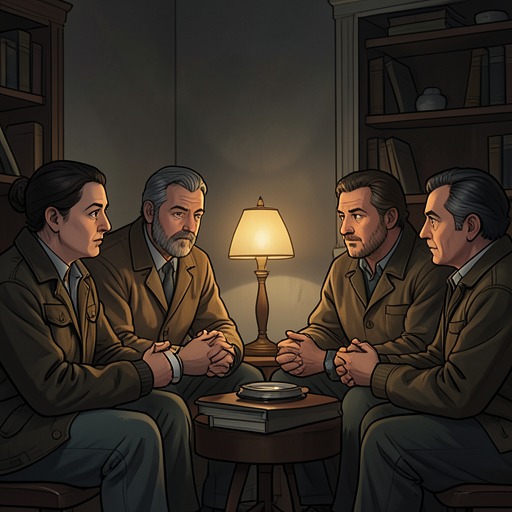
The reunion is lively rather than ceremonious. Jensen is called outside to help his stepfather and an uncle, while Carl’s barbecue is part of the meal. Thomas jokes that their mother drove Carl crazy, and she answers by raising her middle finger at him. She then boasts about her husband’s love and challenges her brother to a game of spades. The teasing and bickering present kinship as an everyday practice, not a flawless arrangement.
Repaired Bonds and New Generations
Jensen’s mother embraces him while Janae gets the camera ready. Ginger Pearl holds her great-granddaughter and rocks her in her arms, continuing her custom of placing a small crystal around each new grandchild’s neck. The gestures connect generations in the same room: the newborn is welcomed by the grandmother and great-grandmother, while Jensen is physically embraced by the mother whose rejection once shaped his life.
The reunion also reflects the scale of that earlier rupture. Jensen was born alive after a failed late-term abortion, and his birth mother, Gloria Simpson Picoult, had expressed fear that her baby might be dark-skinned. Later, Janae describes the enduring harm of colorism and the burdens placed on dark-skinned women. Against that history, the Christmas gathering does not erase the past; it places the previously rejected child and his mother within a family that now includes his wife and daughter.
Survival Made into Belonging
Jensen says that he gave his mother a kidney so she could watch his brother and sister grow up. The donation gives their reconciliation a concrete consequence: the relationship once marked by an attempt to let him die has become one in which he helps preserve her life and her place in the family. In Jensen’s account, his mother now understands why he survived, turning the reunion into an answer to the question that has driven his search for purpose.
The family gathers around Ginger Pearl for a photograph, smiling together. Jensen calls this family his own, while acknowledging that it is not perfect. That qualification matters: the ending offers neither an immaculate past nor a claim that every hurt has vanished. Instead, the final image makes a more grounded promise—Jensen has people who love him, a daughter whose life begins within that circle, and a place at the table he once could not expect to have.
Narrative Significance
The Christmas reunion completes the book’s movement from abandonment toward chosen and repaired family ties. Its closing details—the barbecue, the card-game challenge, the embrace, and the family selfie—give the resolution a domestic scale. The story’s repeated language of survival is answered not by a grand public triumph but by the sight of several generations gathered together. Jensen’s declaration that he is still here becomes inseparable from the family that surrounds him.