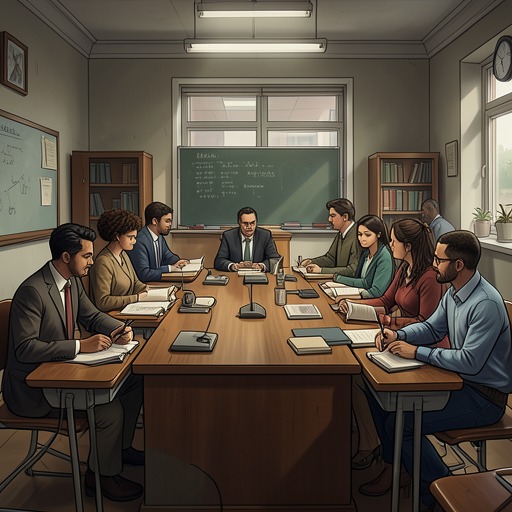
Austin and Dr. Simms's teacher-mentor relationship
I'm Still HereAustin and Dr. Simms's teacher-mentor relationship joined rigorous study of Black history to a practical education in how to read power and speak in spaces that often doubted Black students. Dr. Simms taught Austin to question the stories and language that made racial injustice seem natural; his care for students made room for their voices, while his warning that “Ain’t no friends here” prepared her for the limits of white goodwill. His influence continued to sound in her memory long after college.
A teacher and student in a white institution
Dr. Simms taught African American and Mexican American history at the college Austin attended. He was the second Black teacher in her life, arriving at a moment when she had begun to recognize how her education and her work around racial reconciliation could still center white people. She had devoted herself to explaining white privilege, ignorance, and shame, and to becoming a voice white audiences could hear. Dr. Simms offered a different center: the intellectual force and life-changing significance of Black history and culture.
His presence was distinctive. Brown, bald, and bespectacled, he wore Phat Farm clothes and carried a small leather pouch across his chest. He stood no taller than five foot seven, but his command of the classroom could intimidate students. Many white students avoided his courses; Austin understood that Black students regarded taking at least one of them as essential. His authority did not depend on distance from students. He combined substantial historical knowledge and lived experience with gentleness, humor, and a demand that the class think deeply.
Learning to read history and the present
Dr. Simms began each class by writing new terms on the chalkboard, sometimes misspelling one. In a lesson on slavery, the list might include chattel, the Middle Passage, slave codes, rebellion, and Dred Scott. He developed the terms through narrative, so that historical concepts became events students could imagine witnessing rather than vocabulary to recite and forget. His method made history active: the past had people, choices, violence, and consequences.
He also treated students’ contributions as part of the lesson. Speaking softly and repeating key points, he asked students what they thought and drew quieter or hesitant speakers into discussion by twirling two fingers and urging them to speak so those in the back could hear. He incorporated ideas whether they were profound or ordinary. The invitation was generous, but not passive; students were expected to offer their thinking and examine difficult material for themselves.
That expectation extended beyond history class. Dr. Simms taught Austin to be suspicious of the language used to describe America and to examine how news reports framed race. He asked why a broadcast showed Black faces when discussing criminals, how a camera angle changed the apparent size of a crowd, and why a story about immigration focused on immigrants of color. He brought in both the English-language Chicago Tribune and the Spanish-language Hoy, then asked students to compare their accounts of the same topic and notice what one paper omitted or included.
He applied the same scrutiny to patriotic language. Refusing to call the Constitution’s drafters the Founding Fathers, he said, “Those aren’t my Fathers!” The point was not simply a provocative phrase: it made students consider whom the familiar national story included and whom it excluded. After his class, Austin and her peers could no longer consume news or films without noticing their framing, or read literature without looking for its angle. They joked that Dr. Simms had ruined their lives; the joke registered how thoroughly his teaching had changed their attention.
Emotional connection and the warning
For Dr. Simms, critical study also required emotional connection. When he taught about Martin Luther King Jr.’s assassination, tears filled his eyes, as if he were hearing the announcement again. After showing a documentary about Cesar Chavez, he wept so hard that he dismissed class. He wanted students to sit with the pain, horror, and absurdity of racist history, and to recognize the humanity of people who resisted it. His teaching linked knowledge to feeling and historical understanding to the possibility that students, too, might carry forward a legacy of resistance.
One piece of advice stayed with Austin above the others: “Ain’t no friends here.” Dr. Simms would say it while discussing, among other subjects, Abraham Lincoln’s actual views on race and the mainstream media’s uneven coverage of social movements. The words sounded surprising from a gentle teacher who relied on knowledge and humor with critics and rarely raised his voice. Yet Austin understood that he meant them. The warning was not presented as a denial of every individual kindness; it taught her not to confuse a person’s gentleness, an institution’s progressive claims, or a moment of apparent harmony with an end to racial power.
A lesson carried beyond college
During the rest of her undergraduate years, Austin recalled Dr. Simms’s words when white people dismissed Black students’ concerns, made racist comments in the cafeteria, or treated the presence of Black football players in a residence-hall lobby as frightening. His phrase became a recurring interpretive lens for everyday incidents: it helped her recognize that an individual encounter could not be separated from the racial assumptions surrounding it.
Dr. Simms was part of a small group of faculty and staff, including Professor McMath, who helped Austin define what it meant to be a Black student in white spaces. They supported her in demanding what she wanted, finding her voice, responding to racist white people, and seeking comfort in Black history and community. Their mentorship challenged what whiteness had taught her about her personhood, vocation, and place in the world. For Austin, Dr. Simms’s classroom thus offered both intellectual tools and a protected setting in which to practice using them.
The lesson followed her into later life. After the 2015 killing of Black worshippers in Charleston, alone with her grief, Austin heard Dr. Simms’s warning again: “Ain’t no friends here.” She had wanted to believe that some forms of racial violence had become unthinkable; instead, she felt the force of having underestimated white supremacy. In that moment, the remembered words connected her private disappointment to the history Dr. Simms had taught her to confront. His mentorship endured not as reassurance that the world would change, but as preparation to recognize its continuities, speak about them, and keep acting.