Black Is Not Monolithic
I'm Still HereBlack Is Not Monolithic is the narrator’s insistence that Black identity is expansive rather than a single standard of speech, behavior, or cultural knowledge. Grounded in her childhood friendship with Tiffani and sharpened by experiences in predominantly white classrooms and workplaces, the idea rejects two linked demands: that she conform to an expected version of Blackness, and that she explain or represent Black people for others. Its alternative is self-definition: a person can embrace Black culture without surrendering individuality, and can refuse white approval as the measure of belonging.
Learning Blackness Through Friendship
After her parents’ divorce, the narrator spent summers in Cleveland feeling caught between racial worlds. She was too white for Black people and too Black for white people, and the isolation was draining enough that she sometimes pretended to be sick to get away from other students. She did not know how to manage the possibility of losing a sense of Blackness while never feeling that she fitted in.
That changed when she befriended Tiffani, who lived four houses from her mother. The two girls were the same age, but otherwise very different: Tiffani was short, confident, playful, loud, and outspoken, while the narrator was tall, quiet, and intent on blending in. Tiffani became a teacher and a friend, introducing her to music, dances, Ebonics, pop culture, and the freedom of playing outdoors with neighborhood children until the streetlights came on. She also vouched for the narrator’s Blackness, helping her believe in it herself.
The lessons did not require the narrator to become Tiffani. She learned the Butterfly dance and nearly won a contest, but could still prefer reading while other children played kickball. She could use Ebonics without mastering the most popular slang, which never sounded natural in her voice, and she did not see Candyman until adulthood. These differences were not evidence that she had failed to belong. Tiffani’s example made room for both girls: Blackness could be nerdy or cool, and neither had to become the other.
The friendship gave the narrator a way to understand Blackness without treating it as a checklist. Her speech had sounded like a hybrid of her white classmates and her Black parents, but neighborhood life showed her that this was not the only valuable way to communicate. Textbooks and white expectations did not contain every way of speaking, thinking, or being. The freedom she found did not depend on white affirmation or on everyone sharing the same tastes and habits.
Difference, Voice, and the Classroom
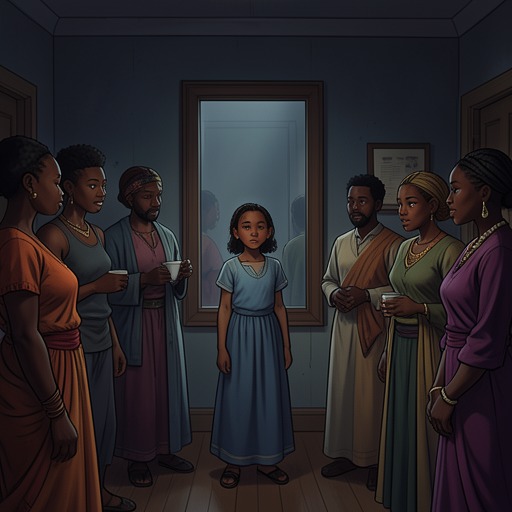
The narrator’s experience of difference also shaped how she understood race in school. When she encountered Paul Laurence Dunbar’s poem about wearing a mask in Mr. Slivinski’s class, she felt its connection to the different demands of being the only Black girl in a classroom and being surrounded by Blackness at lunch or in gospel choir. As the class discussion approached, she folded herself into her chair, trying to make her body smaller. The poem had named something intimate, but she did not want to be made responsible for explaining it to an all-white class.
She recognized that Black students are often treated as classroom authorities on race, despite having no mandate to speak for all Black people. In that moment, she did not want to remove the mask or give classmates access to a vulnerable part of her experience. Mr. Slivinski did not call on her. Instead, he let the white students interpret the poem and challenged their responses without making her a substitute teacher. His restraint let the subject be discussed without turning her into its representative; it also earned her trust by showing that a classroom could address race without overriding her choice to remain silent.
The same insistence on self-definition informed the narrator’s academic choices. In a predominantly white education, she often chose Black authors for book reports and Black history for papers because otherwise she could not count on seeing herself in the curriculum. Assignments could force a choice between the answer a teacher expected and the account she believed was true. She sometimes stated that Christopher Columbus had sailed across the ocean in 1492 but arrived on land that was already inhabited; at other times, she framed the claim as what the textbook said. She enjoyed being more right than her teachers, even when it cost her half a letter grade. Black identity here is not only a question of personal style: it also involves contesting whose history counts as knowledge.
The Cost of Being Made a Spokesperson
As an adult, the narrator describes a related pressure in professional settings. White colleagues may question or minimize a Black woman’s reading of racial dynamics, while expecting her to supply explanations about Black life. Her account of being a Black girl becomes a source of steadiness against that denial: she remembers Black survival and the recovery of records, the stories passed down by her grandmother, and the cast-iron pot and Bible preserved by older generations. She also celebrates Black creativity in language, including the shared call-and-response of conversation that outsiders may mistake for interruption. These inheritances affirm a collective history without making Black experience uniform.
At work, the demand to explain can take the form of being asked to report on racism and then being doubted when she does. The narrator describes raising incidents with a person who had promised to be safe, only to be told that she may have misunderstood or should approach the offender with more patience. When she shifts from individual incidents to white leadership, hiring, and organizational culture, criticism turns toward her as divisive, negative, or toxic. The expectation is that she identify bad individuals without naming the system that shapes the conditions around them. Her account makes clear why being treated as an individual matters: rejecting a stereotype is not the same as denying structural patterns.
The practical strategies Black women develop at work also depend on solidarity rather than a single authorized way to respond. The narrator describes helping one another write emails likely to be scrutinized for tone, saving praise in inbox folders as protection against contrary reports to supervisors, and finding a trusted person with whom lunch requires no explanation. Secret Facebook groups provide space to process microaggressions and consider how to respond. These measures cannot stop every consequence, but they help women support one another in environments where their judgments may be challenged and their employment may be precarious.
From Personal Affirmation to Institutional Critique
The narrator’s understanding of Black identity carries a structural consequence: representation cannot be reduced to counting Black people in a photograph or adding their stories while leaving authority unchanged. In organizations, people of color may be expected to repair the harms of shallow diversity efforts, challenge hiring decisions, and speak up when marginalized voices are missing. The narrator argues that Black women should help shape an organization’s direction and vision, not simply be present as evidence of its inclusion. Difference is not a decorative addition to a fixed institution; meaningful participation requires influence.
She applies the same distinction to conversations about racial reconciliation. Dialogue can contribute to change when it leads to action, shifts power, and pursues justice for people who are marginalized. But when listening to pain becomes the endpoint, or when white participants make tone and graciousness the central concern, conversation can delay rather than advance repair. The narrator’s refusal to speak for every Black person is therefore compatible with naming shared institutional patterns: individual voices need not be interchangeable for those patterns to be real.
Black Is Not Monolithic joins the narrator’s childhood freedom to choose what felt right with her later refusal to let white organizations define the terms of Black participation. Tiffani’s friendship taught her that Blackness could hold people who were unlike one another; the classroom taught her that silence could be a legitimate boundary; and professional life showed the cost of treating a Black woman’s experience as either a racial spokesperson’s duty or a personal grievance to be dismissed. Across these settings, the phrase marks a claim to both connection and difference: belonging does not require sameness, and recognition does not require surrendering the right to speak only for oneself.