Cleveland
I'm Still HereCleveland is the setting where Austin’s childhood understanding of race shifts from lessons about navigating white spaces to the harder, more intimate work of finding her place among other Black people. During summers with her mother, she encounters unfamiliar cultural codes, feels exposed by the habits she has absorbed elsewhere, and eventually finds a friend whose confidence helps her claim a more spacious sense of Black identity.
Setting and Family Life
When Austin was ten, her parents divorced, and she and her little brother began spending summers in Cleveland with their mother. The city was only two hours from Toledo, where Austin had grown up in a mostly white setting, but the move into a neighborhood where everyone around her was Black felt like crossing into another world. Cleveland was the first place she had walked into a public sphere where most people looked like her; the change brought both exhilaration and fear.
Cleveland also appears in Austin’s memory of a Christmas weekend when she was eleven or twelve. Her extended family gathered at her grandmother’s home, with adults seated at one table and children at another, separated by a short open bookshelf filled with vintage bells her grandmother had collected over decades. From her folding chair, Austin watched her mother, Karen, debate her uncles about whether integration had actually helped Black Americans. One uncle answered by asking what the alternative to integration would have been. The scene gives Austin an early view of disagreement within her family about the meaning and consequences of integration, rather than a single settled account of it.
A New Cultural World
In Cleveland, Austin was unfamiliar with the rhythms of the neighborhood and the summer day camp her mother enrolled her in. The children’s world included dance competitions, talent shows, and line dances beyond the Electric Slide; that summer, the Tootsie Roll seemed to take over. At camp she had to learn to play Spades, rather than the Bible-recitation games she knew from elsewhere, and she was unaccustomed to how freely children and adults cursed.
The gaps in her knowledge became especially visible on the bus ride to the community pool. When the song Weak by SWV came on, the other children sang along while Austin, who had never heard it, tried to lip-synch without being noticed. She spent the rest of the summer listening to a Black radio station to catch up, but music was only one part of what she did not yet know: she also lacked the context for talk about Bobby Brown and Whitney Houston, and did not understand why the other girls dared her to say Candyman five times in a bathroom mirror. When they screamed after the fifth repetition, she screamed too, unsure what they feared. Her own fear was that the others would discover how unfamiliar this world was to her.
That uncertainty became personal when other Black children called Austin an Oreo and questioned why she talked white. She knew the answer lay in the mostly white school and community where she had spent most of her life, but she did not yet know how to explain that history to them. She had been trying to conceal the white culture she had absorbed; in Cleveland, she felt that it showed in her speech and gave her away. Her desire to fit in collided with the recognition that pretending could not erase the differences others already noticed.
Tiffani and Belonging
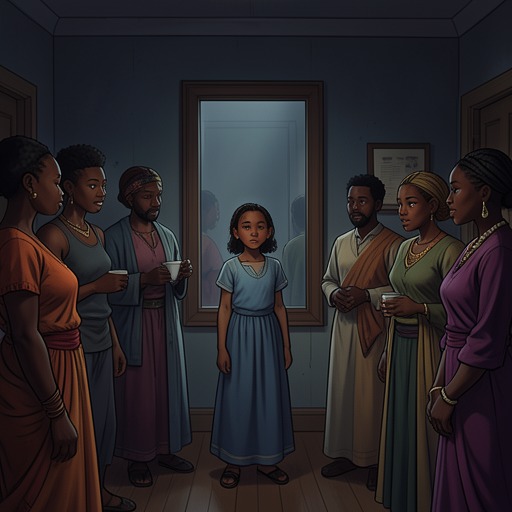
The effort to keep up could be exhausting. Sometimes Austin pretended to be sick, sat at a table far from the other children, and lowered her head until a counselor came to check on her. She felt caught between worlds: unable to fit into whiteness, yet afraid of losing Blackness. Cleveland sharpened that tension, but it also became the place where she found a relationship that loosened its hold.
Tiffani lived four houses from Austin’s mother. The girls were the same age, but Austin describes their temperaments as opposites: Tiffani was short, lively, self-assured, and playful, while Austin was tall, quiet, and working hard to blend in. Tiffani introduced her to music and dances, taught her about Ebonics and popular culture, and brought her into play with neighborhood children that lasted until the streetlights came on. She danced and played with Austin, and, crucially, vouched for her. Tiffani’s acceptance helped Austin believe in her own Blackness.
Their friendship did not require Austin to imitate Tiffani or abandon what she already liked. She learned the Butterfly and nearly won a dance contest, yet could still prefer reading while the others played neighborhood kickball. She took up some Ebonics without mastering every popular phrase, and the Candyman dare remained something she did not understand until adulthood. In Cleveland, belonging came not from passing every test of cultural knowledge but from having room to participate without being reduced to a single way of being Black.
Significance in Austin’s Story
Cleveland marks a turning point in Austin’s relationship to Black identity. Earlier, she had been one of only a handful of Black students in a predominantly white school; summers in Cleveland made her feel newly unfamiliar and visible among Black peers. The shift exposed how much of her sense of ease depended on knowing the norms around her, but it also challenged the idea that she had to choose between the identity she had formed and the Black culture she was learning.
Through family argument, neighborhood life, and Tiffani’s friendship, Cleveland becomes more than a contrast to Toledo. It is where Austin encounters difference within Black life and begins to understand that Blackness can make space for her without requiring her to become someone else. The city’s significance lies in that double experience: first the strain of feeling out of place, and then the relief of discovering that belonging can widen rather than erase an individual identity.