Dr. Simms
I'm Still HereDr. Simms is a teacher of African American and Mexican American history whose influence reaches far beyond the classroom: he teaches the memoir’s narrator to scrutinize how America tells its stories, to feel the human weight of Black history, and to speak up in white spaces without surrendering her sense of self. His classroom joins intellectual rigor to emotional honesty, while his recurring warning, “Ain’t no friends here,” gives the narrator a hard-edged lesson in recognizing racism even when it appears among people who seem familiar or kind.
Identity and Place in the Memoir
The narrator encounters Dr. Simms after recognizing how much her own teaching and learning have centered white people: their privilege, ignorance, shame, and willingness to support racial justice. In that context, Dr. Simms offers a different center of gravity. He believes in the power of Black history and Black culture, and in their capacity to change students’ lives. The narrator presents his arrival as a turning point away from the pressure to become a voice white people could hear and toward a deeper account of what Black students need to know and be able to do.
Dr. Simms is described as brown, bald, and bespectacled, dressed in Phat Farm, with a small leather pouch strapped across his chest like a messenger bag. He stands no taller than five feet seven, yet carries a gravitas many students find intimidating. His physical presence is paired with an intellectual command grounded, in the narrator’s account, by a wealth of real-life experience. Many white students avoid his classes, while the narrator knows no Black student who would graduate without taking at least one. This contrast makes his classroom a place where Black students seek knowledge that the wider school experience does not reliably provide.
Teaching History as an Encounter
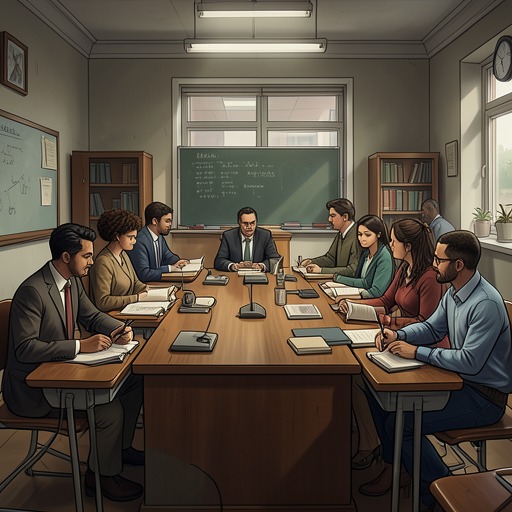
Dr. Simms begins each class by writing new terms on the chalkboard, usually misspelling one. Students tease him that his brilliance leaves no room in his brain for spelling. The small, recurring joke makes his classroom vivid without diminishing its seriousness: the terms become the start of lessons designed to make the past feel encountered rather than merely memorized. In a unit on slavery in America, for example, the board lists “chattel,” “Middle Passage,” “slave codes,” “rebellion,” and “Dred Scott,” among other phrases. Dr. Simms defines each term through narrative, making students feel as though they have witnessed the events being studied.
His manner is soft and repetitive, a way of making sure students understand the point rather than simply hearing it once. He also insists that they contribute their own thinking. He asks students what they think, and when someone speaks too quietly or hesitantly, he twirls his index and middle fingers together in the air and urges them to speak up so the class can hear. He incorporates students’ ideas into the lecture whether their insights are profound or middling. Gentleness, in his classroom, does not mean lowered expectations: he encourages participation while still requiring students to think deeply.
Reading Language, News, and Power
Dr. Simms teaches his students to be suspicious of the language of America. That method extends from historical lessons to contemporary news, where he asks students to notice whose faces appear in coverage, how a camera angle can make a crowd seem larger or smaller, and why a story about immigrants focuses only on immigrants of color. The questions train students to treat media not as a transparent account of events but as a series of choices that shape what viewers see and understand.
He makes those choices visible by bringing multiple newspapers into class. Students compare English-language coverage in the Chicago Tribune with stories in Hoy, a Spanish-language paper headquartered in the same city, and examine what one account leaves out or the other includes. The exercise gives comparison a practical purpose: students learn to look for omissions and differences in emphasis, rather than assuming that a single account offers the whole story.
He applies the same scrutiny to familiar patriotic language. When discussing the drafters of the Constitution, Dr. Simms refuses to call them the Founding Fathers, saying, “Those aren’t my Fathers!” His matter-of-fact refusal opens a question for the students: whether the nation’s inherited language of belonging can be assumed to include everyone. The narrator recalls that Dr. Simms made students joke that he had ruined their lives: after his class, they could no longer watch the news casually, take movies at face value, or read literature without looking for its angle. The joke registers the permanence of his teaching. Critical attention follows them out of class and changes what they are able to overlook.
Emotion, Resistance, and the Warning
For Dr. Simms, learning history requires more than reciting names and dates. When he speaks about Martin Luther King Jr.’s assassination, his eyes fill with tears, as if he is hearing the announcement again. After showing a documentary about Cesar Chavez’s work, he weeps so intensely that he has to dismiss class. These moments reveal a teacher who will not separate historical knowledge from grief, horror, or the effort to humanize those who resist a racist system. He wants students to remain with the pain and absurdity of that history, and to recognize themselves as capable of carrying forward a legacy of resistance.
His advice that stays with the narrator most is the blunt phrase “Ain’t no friends here.” She remembers hearing it in lectures about Abraham Lincoln’s actual views on race and about the mainstream media’s uneven coverage of social movements. It makes her laugh because Dr. Simms is gentle, soft-spoken, and reliant on knowledge and humor when critics challenge him. He does not ordinarily raise his voice; the narrator recalls him calling “Friends! Friends!” when passionate discussion becomes impossible to follow. Against that gentleness, the warning sounds at first like an overgeneralization, but the students know he is serious. Their history books and college campus already offer examples; its full reach becomes clearer over time.
Influence Beyond the Classroom
During the rest of her undergraduate years, the narrator hears Dr. Simms’s phrase again whenever white people act in racist ways: when a campus newspaper says Black students who are unhappy should leave, when she overhears racist comments in the cafeteria, and when she repeatedly has to explain to a residence director that a lobby does not become “scary” simply because Black football players are sitting there. In these situations, his warning is not an instruction to abandon learning or community; in the memoir, it functions as a reminder not to let familiarity, institutional belonging, or apparent goodwill erase the evidence of racism.
Dr. Simms is part of a small group of faculty and staff, including Professor McMath, who help the narrator define what it means to be a Black student in white spaces. They help her demand what she wants, make it safer to explore her own voice, and encourage her to seek comfort in Black history and the healing of Black community. Their influence also helps her reconsider what whiteness has taught her about her personhood, vocation, and place in the world. The narrator ends this account as school gives way to the “real world,” recognizing that Dr. Simms was right even when she did not want him to be. His legacy is thus both practical and intellectual: he equips her to question public narratives, claim room for her own thought, and meet the racism she encounters without mistaking it for friendship.