Racialized fear in Black life
I'm Still HereRacialized fear in Black life is more than the anticipation of physical danger: it is the work of reading unequal risks, trying to keep loved ones safe, and deciding when speaking honestly may bring further harm. In the narrator’s account, the fear first takes shape around her cousin Dalin’s armed robbery and possible retaliation, then recurs in family routines, classrooms, workplaces, and the historical structures that make Black vulnerability seem ordinary. The Ritual of Fear names a condition that cannot be wished away, but whose weight Black people meet through care, mutual support, and insistence on being believed.
A Cousin’s Danger and the Rules of Risk
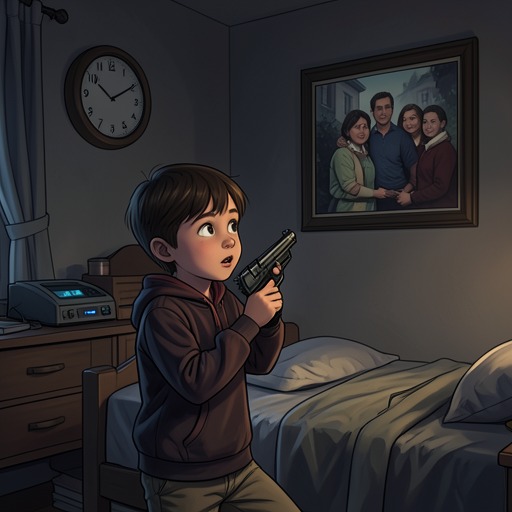
The narrator’s clearest early encounter with this fear comes after Dalin and his friends are held up at gunpoint. They had just left a store after he bought new sneakers; because his group carried no weapons, he surrendered the bright white shoes. At home, when their grandmother asked what he planned to do, Dalin said he was looking for a gun so he could get them back. The shoes mattered, but the narrator understood his anger as larger than the loss of a purchase: the robbery had made his safety and control feel disposable. His knuckles cracked as he spoke, and his face held anger and sadness together.
The episode changed how the narrator understood the difference between their lives. She knew that going to the police was not a viable option for Dalin. In her own world, by contrast, she would not have known where to find a gun or whom to ask. His circumstances had previously been familiar to her mostly through headlines; now she believed his account of the world he inhabited and feared that he would go back outside and not return. Their uncles intervened, and Dalin did not go back into the night. That intervention prevented an immediate escalation, but did not end the fear the episode taught her.
As the narrator grew older, the fear expanded beyond Dalin. She worried that her father might not return safely from work trips through rural Ohio, that her brother’s intellect would not prevent someone from treating him as a criminal, and that her husband might be mistaken for someone else. She also feared being unable to protect her young son once he was no longer hidden within her body, and feared state violation of her own body. These are distinct anxieties, but they share a common uncertainty: a loved one’s ordinary movement through public life may be read by someone with power as a threat or a reason to use force.
Safety as a Family Practice
The narrator describes fear as something that can become debilitating even when no immediate incident is occurring. While writing, she imagines her husband being stopped and frisked during a four-hour round trip across Michigan to visit his parents. She tries not to picture his anger rising or his words making the encounter more dangerous, and tries not to pass that anxiety on to him. Before he leaves, she hugs him and asks him to promise he will come back. He assures her he will be fine and says he will call when he arrives; she nods, smiles, and pretends to feel reassured.
Their calls are part of a recurring safety routine. The narrator phones Tommie when she arrives somewhere and again when she leaves. White friends notice the calls, and she sees their amused looks. They may interpret the habit as a sign that the couple is inseparable or that Tommie is demanding; the narrator understands it instead as a way to check that each of them is safe. What can look like a private quirk from outside is, for them, a practical response to the risks they anticipate in public life.
The chapter widens this private routine into a shared condition. Black parents, siblings, couples, and communities fear white people’s reactions, including the clutching of purses in elevators and the locking of car doors as Black people pass. They fear police who presume danger when they have the wrong suspect or an unarmed person. They fear that appearing guilty will bring the consequences of guilt, and that a child’s public mistake or imperfect behavior could have deadly consequences. The narrator stresses that even when children are rude, disrespectful, or reckless, their families still want them to live and reach another day. The repeated work of trying to ensure that they do is the continuing ritual.
Silence, Speech, and the Cost of Being Disbelieved
Fear also shapes whether a Black child feels safe enough to speak about race. In Mr. Slivinski’s classroom, the narrator reads Paul Laurence Dunbar’s poem “We Wear the Mask” and wonders how often she hides parts of herself around white people, including friends. When discussion is about to begin, she folds into her chair and tries to make herself smaller. She anticipates being asked to explain the poem to an all-white class and does not want to become its spokesperson. The poem’s account of masking feels personally true, but that recognition does not make her experience available for others to claim.
The narrator describes this as a common bind for Black students in mostly white classrooms: teachers and classmates may expect them to serve as experts on race, while the students themselves may not know whether the discussion is safe or whether they have the right to speak for others. She does not want to take off the mask. Mr. Slivinski does not call on her; she listens as white students try to interpret the poem and sees him challenge their responses without making her the substitute teacher. His restraint earns her trust. The scene shows that confronting racial silence need not require placing the burden of explanation on the Black student in the room.
A related cost appears in the narrator’s account of schoolwork. When assignments presented a white-centered view of history, she had to choose between an answer likely to please the teacher and one that affirmed Black history. She sometimes corrected the claim that Christopher Columbus had discovered already inhabited land; at other times, she framed an answer as what the textbook stated. Her parents left those decisions to her, including the choice between a better grade and affirming Blackness. Even the possibility of losing half a letter grade made truth-telling a calculation of risk. Her experience illustrates that the pressure is not always a direct threat: it can also be the accumulated cost of challenging what an institution treats as unquestionable.
Institutional Invalidation and Collective Protection
In professional settings, the narrator describes a pattern in which Black women’s perceptions of racism are questioned, minimized, or denied. Organizations may present themselves as safe places to report inappropriate remarks, recount past missteps that have supposedly been addressed, and point to diversity initiatives. Yet stereotypes soon surface in comments about a Black woman’s hair, praise for being surprisingly articulate, requests to sound more Black, or assumptions that she can speak for Black people on topics such as single motherhood and crime. When she reports such encounters, her designated safe person may suggest that she misunderstood or that the speaker meant no harm. The burden then shifts to her to be more patient and extend compassion.
When the narrator moves from individual incidents to the structures that produce them—white leadership, white boardrooms, and hiring practices that reproduce white culture—she encounters another penalty. She had been expected to identify a few bad apples, not to question the system. Raising the systemic issue earns her labels such as divisive, negative, and toxic; other warnings describe her as too sensitive, too angry, or too inflexible. She is not seeking to get individuals in trouble, she explains, but to clarify what it means to live in a Black body inside an organization that does not recognize its own whiteness. The repeated denial makes the prospect of speaking up a further source of strain.
Because leaving a job is not as simple as exchanging one workplace for another without losing pay or benefits, Black women develop practical forms of protection. They help one another compose emails that will be scrutinized for tone, save messages praising their work as insurance against contrary assessments, find a trusted person to share lunch with, and use private online groups to process microaggressions and plan responses. Such strategies cannot prevent every consequence, but they slow the isolation and give people a place to compare experiences without having to explain why those experiences matter. The narrator also insists that she cannot simply leave and expect another organization to be free of the same patterns.
Historical Continuity and the Work of Memory
The narrator places present-day fear against a history she argues has been deliberately obscured. She links slavery and mass incarceration to purposeful systems rather than accidental outcomes, and describes national accounts built from comforting myths and broken timelines. The Middle Passage, the wealth extracted from enslaved labor in both the South and the North, and generations born and dying enslaved remain incompletely acknowledged. In her account, refusing to tell this history also means refusing to reckon with the conditions that make Black life vulnerable now.
She connects that refusal to the aftermath of slavery. Rather than confronting slavery’s role in the Civil War, public accounts often substitute the more palatable explanation of states’ rights. The end of slavery was bitterly resented, she argues, and the rise of Jim Crow laws carried forward the belief in Black inferiority. Jim Crow was not merely a matter of separate drinking fountains: it meant humiliation and violence, low wages, denied services, dispossession, blocked wealth-building, and little legal recourse. The narrator also rejects accounts of the U.S. Civil Rights Movement that celebrate its victories while softening the opposition and bloodshed that preceded them. The people who defended segregation did not simply disappear, and the structures and habits that sustain it have not disappeared either.
This historical argument gives the fear its institutional scale. In the narrator’s view, an honest account would have to name the nation’s commitment to violent and exploitative White supremacy and recognize the consequences across systems, including housing, education, health, and criminal justice. Dialogue alone cannot make that reckoning: when conversations about racism end with white listeners hearing people of color’s pain, without action or a redistribution of power, listening becomes a stopping point rather than a beginning. Against denial, the narrator places testimony and memory. She recalls the records preserved by her family—census documents, photographs, certificates, and inscriptions—as well as her grandmother’s cast-iron pot and great-grandmother’s Bible. Those objects and stories help restore a history that was stolen or minimized and counter the doubt that repeated disbelief can create. In this way, racialized fear is both an account of danger and a record of how people continue to protect one another, speak from experience, and insist that survival and historical truth matter.