“There’s only one question to resolve”
I'm Thinking of Ending ThingsThere’s only one question to resolve is a repeated formulation that promises a single, decisive answer but never identifies what must be answered. It appears in the narrator’s account of the Caller’s voice messages and, in a slightly altered version, in a report of recurring graffiti. Across both appearances, the question is less a solution than an insistence: it narrows attention toward an answer while leaving its subject unknown.
Form and Wording
The formulation is compact and declarative. In the message the narrator hears, it is followed not by an explanation but by a sequence of statements of fear, uncertainty, and urgency: “There’s only one question to resolve. I’m scared. I feel a little crazy. I’m not lucid. The assumptions are right. I can feel my fear growing. Now is the time for the answer. Just one question. One question to answer.” The repeated narrowing from one question to one answer makes the thought sound like a rule the speaker is trying to impose on a confused situation. Yet the message supplies no question in interrogative form and no answer. Its certainty about the need to resolve something contrasts with its silence about what resolution would involve.
The wording also changes between appearances. The message uses “There’s only one question to resolve,” while the reported graffiti reads, “There’s only one question we need to resolve.” The graffiti’s “we” makes the matter sound shared, whereas the voice message’s phrasing leaves the participants less clearly defined. Neither version names the question. This difference opens a small but consequential uncertainty: the recurring idea has a recognizable core, but it does not arrive as a perfectly fixed slogan in every context.
The Voice Messages
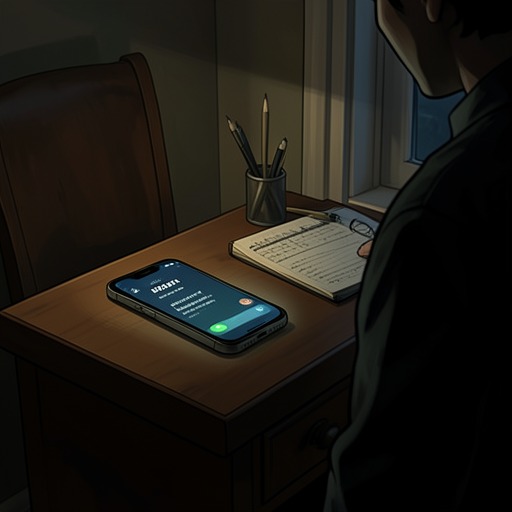
For the narrator, the question belongs to an unsettling pattern of contact. The Caller leaves voice messages that are not obviously threatening; the narrator hears sadness, and perhaps frustration, in the voice. The words seem nonsensical, but not like babble, and the message returns word for word. The repetition gives the phrase the quality of a refrain, while its unexplained insistence makes it difficult to dismiss as meaningless.
The narrator listens to the saved message repeatedly, including while Jake is driving and not paying attention. The repeated act of listening does not clarify what the question means. Instead, the surrounding account emphasizes the narrator’s fear and uncertainty: the narrator says they are not lucid and feels fear growing as the time for an answer seems to approach. The phrase thus works in two directions at once. It offers an apparent structure—one question, one answer—while the narrator’s experience of listening becomes less secure rather than more resolved.
A later message changes the pattern without replacing its repeated core. The narrator recognizes the familiar wording, but says that this time something new comes at the end. That addition makes the message feel different and more frightening; the narrator cannot sleep that night and regrets not stopping the calls sooner or telling Jake. The added ending identifies the narrator’s appearance in intimate detail and says, “You shouldn’t bite your nails.” The earlier question’s withheld subject therefore sits within a contact that has become personally specific. The contrast between the message’s abstract promise of an answer and its direct knowledge of the narrator intensifies its menace without revealing what the question itself is.
The Graffiti Account
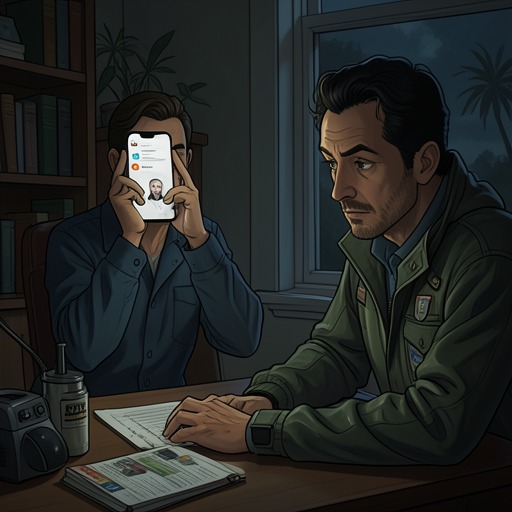
A separate exchange describes writing that appeared repeatedly as graffiti. The speaker says the strange feature was that the same thing was written every time: a single sentence. The sentence is reported as “There’s only one question we need to resolve.” When asked what the question is, the speaker answers that they have no idea. The exchange reproduces the central structure of the voice messages: an identical or near-identical formulation returns, insists that a question matters, and leaves its content undisclosed.
The graffiti account does not, on the evidence given, establish who wrote it or explain its connection to the Caller. Its importance lies in the echo, not in a confirmed identity between the writer and the voice. By presenting the phrase in another medium and with another pronoun, the narrative broadens the pattern while preserving uncertainty about its source. The reported sentence is visible and public in form, unlike a saved voice message, but it offers no more explanation. Repetition makes the phrase recognizable; it does not make it legible.
Suspense and Uncertainty
The phrase operates as a promise of closure that continually postpones closure. Its repeated insistence that there is only one question seems to reduce a confusing situation to a manageable problem. But neither the narrator nor the speaker of the graffiti account can state what that question is. The gap between the claim that an answer is due and the absence of an identifiable question is the concept’s central tension.
Its recurrence also connects different kinds of evidence without settling how they fit together. The voice message is heard and replayed in the narrator’s immediate experience; the graffiti is recounted in conversation as something written repeatedly. The shared wording invites comparison, but the slight verbal difference and missing explanation prevent certainty. Rather than resolving the mystery, the phrase marks where explanation ought to be. It organizes fear around an answer that remains out of reach, making the search for the question itself part of the suspense.