Are you good or are you bad
I'm Thinking of Ending ThingsAre you good or are you bad? is a moral question that changes meaning each time it returns. First, Ms. Veal uses it to intimidate the narrator as a child, making goodness sound like a condition for safety and belonging. Later, the narrator recalls it while frightened and alone, then hears its logic reverberate through a crisis of identity and choice. By the end, the question is explicitly judged wrong: its simple division between good and bad cannot resolve the decision that actually matters.
The question as a childhood threat
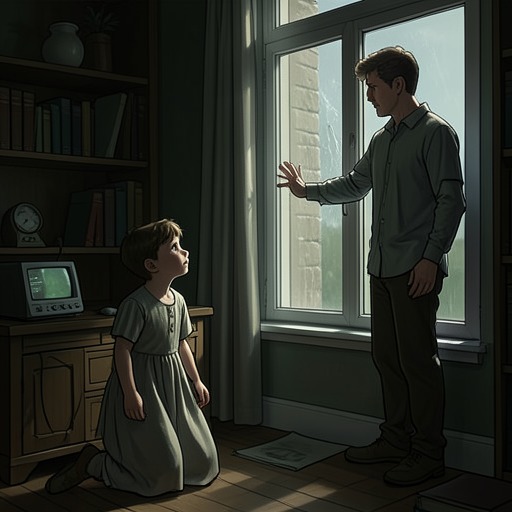
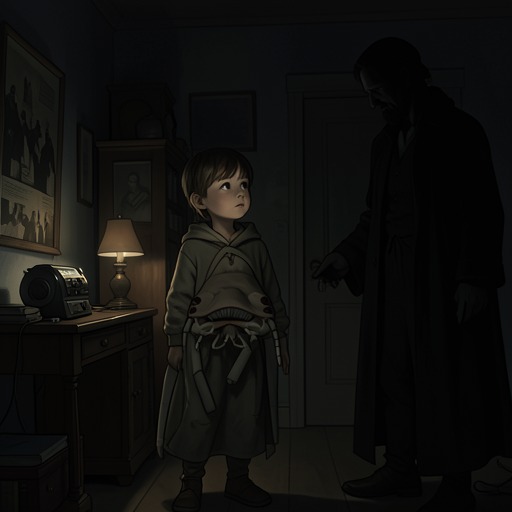
The question enters the narrator’s life during an ordinary visit that turns menacing. Home sick from school, the child is in the kitchen in pajamas, feverish and eating toast, while the narrator’s mother makes tea and Ms. Veal brings oatmeal cookies. After the adults chat, the mother leaves the room, and Ms. Veal stops what she is doing to look at the child. Playing with a strand of hair, she asks, “Are you good or are you bad?”
Ms. Veal immediately supplies a rule that gives the question its coercive force: “If you give up, you’re bad.” Goodness is made conditional on not giving up, though the child has no way to know what giving up means in this exchange. Ms. Veal then turns the rule into a bargain with unnerving stakes: “If you’re good, you can have a cookie. If you’re bad, then maybe you’ll have to come live with me instead of living here in this house with your parents.” The cookie offers a small reward, while the proposed removal from home transforms an abstract judgment into a threat to the child’s security.
The narrator does not understand what Ms. Veal is asking and cannot answer. The child recalls that no adult, especially a stranger, had spoken to them that way before, and describes being petrified. Ms. Veal’s follow-up—that the child should not be so shy and has to get over it—does not relieve the pressure; it treats the child’s frightened silence as another failing. The scene establishes the question not as a genuine inquiry into character, but as a demand imposed by an adult who controls the terms and consequences.
Repetition without an answer
The words persist beyond the visit. When the question recurs, the narrator places it beside a conviction about thought: “Thoughts are the only reality.” Thoughts cannot be faked or bluffed, the narrator insists, and this realization has remained troubling for years. Against that claim of inward certainty, the repeated moral test produces no certainty at all. The narrator says, “What scares me most now is that I don’t know the answer.” The fear has shifted: the child once could not answer because the question was bewildering and threatening; the later narrator is disturbed by the possibility that no stable answer is available.
The question is also embedded in a scene of isolation and disorientation. The narrator stays behind a bench for what might be an hour or much longer, with a hip and knee numb from the contorted position. Time becomes difficult to measure while the narrator is alone, and “Hey, Good Lookin’” plays over and over until its sudden stop shocks the narrator awake. Jake’s hat has been used as a pillow. In this setting, the return of Ms. Veal’s question links childhood intimidation to a present in which duration, safety, and self-understanding have all become uncertain; it does not provide a rule for escape or reassurance.
The question at the point of identity
Near the end, the question returns in a changed form as the narrator unfolds the portrait of Jake that Jake’s mother gave them. The face in the painting appears distorted, blurry, and fragmented, yet the narrator recognizes it as their own and as Jake. The words that follow—“Are you good? Are you?”—reduce the old binary question to an urgent, unfinished appeal. In the same moment, the picture makes the boundary between the two identities difficult to hold apart. The question can no longer be assigned simply to an outside judge and a separate person being judged; it accompanies the narrator’s recognition of a face that is both Jake’s and theirs.
The portrait scene also places judgment beside choice. The narrator asks whether there is grace in doing the right thing and in making a choice, without settling what that right action is. This is a different emphasis from Ms. Veal’s childhood test: the old question offered a verdict from someone else, whereas the later scene turns toward the weight of choosing. The echoed wording preserves the demand for judgment but offers no external authority capable of answering it.
Rejection and the harder question
The closing reconsideration names the failure directly: “Are you good or bad? It was the wrong question. It was always the wrong question. No one can answer that.” The narrator adds that The Caller knew this from the beginning. The phrase’s final role is therefore not to sort the narrator into a moral category, but to expose how inadequate that sorting is. Even its childhood premise—that goodness can be proven by refusing to give up—cannot settle what the narrator must decide.
The surrounding reflection identifies the actual stakes as whether to continue or not. The narrator considers what life means when a person has tried to endure alone and asks what remains when there is no one else. The text does not provide a simple answer to that decision; it says that the question is the same one and that the choice is up to them all. The movement from Ms. Veal’s imposed test to this unresolved choice gives the repeated phrase its force: a demand for moral classification gives way to a question of existence that cannot be answered by calling someone good or bad.
Across its returns, the expression marks a progression from intimidation, through persistent fear and fractured self-recognition, to explicit rejection. Its repetition does not clarify the narrator’s moral status. Instead, each recurrence reveals the limits of the binary and sharpens the difference between being judged and having to choose. The phrase remains memorable precisely because its apparent simplicity cannot contain the question the story finally places before the narrator.