Basement Painting and Drawings
I'm Thinking of Ending ThingsThe Basement Painting and Drawings transform a hidden corner of Jake's Parents' Farm into a visual pattern the narrator can inspect but not explain. A portrait of the basement places a long-haired, long-nailed figure where the furnace should be, while a smaller child recurs across drawings in different positions and forms. The images make the basement more than a setting: they give material shape to the story's tension between what can be observed and what can only be approached through symbols.
Discovery in the Basement
The narrator finds the work at the far end of a low, dark basement, near the furnace and a water tank. The room itself seems barely like a room: its walls are dirt and bedrock, its air is dank and uncirculated, and the narrator imagines it flooding in spring. An old piece of equipment is unusable; there is no table, pool table, or table-tennis setup to soften the impression of an unpleasant, isolated space. These details make the discovery feel less like entering an art studio than stumbling into a concealed part of the farmhouse.
A small white oscillating fan, running despite the winter cold, first draws the narrator's attention. Near the furnace stands a painting on an easel. The narrator wonders whether the fan is meant to dry the paint, but sees no brushes, paint, other art supplies, or chair. The practical explanation therefore remains tentative, and the circumstances of making the images remain obscure. The narrator assumes Jake's mother may be the artist, then questions that assumption: she is taller than the narrator, and the low beams would force even the narrator to bend. The paintings' presence is clear; their maker and purpose are not.
The Portrait and Its Variations
The easel painting represents a room that the narrator recognizes as the basement. Its heavy, wild brushstrokes coexist with specific details: the stairs, the concrete slab, and the shelves can all be made out. The furnace, however, is absent. In its place stands a figure with long hair and a plain, nondescript face, slightly bent, with long arms and fingernails that look almost like claws. The painting does not establish whether this figure is a woman or a man; the narrator describes it more generally as an entity or individual. Its identity is left unresolved, while its position in the room is unmistakable.
The missing furnace creates a pointed substitution. The rest of the basement is recognizable, but the ordinary fixture that should occupy this place has been displaced by a humanlike presence. The narrator notices that the nails seem wet, almost dripping, and that they appear to be growing longer and sharper even though they are not. This distinction keeps the image balanced between what is actually depicted and the threatening impression it produces. The painting makes the familiar room strange without supplying an explanation for the figure.
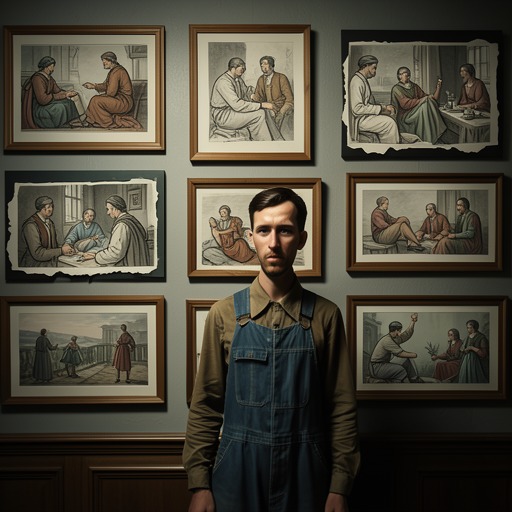
At the bottom corner is a second, much smaller person, perhaps a child. The narrator then finds a small, dirty bookcase beside the painting, full of old papers and drawings. The pages are thick, and each drawing shows the basement again, with a different person replacing the furnace. Some figures have short hair, others long; one has horns. Some have breasts, some penises, and some both. Across these variations, the long nails and a similar knowing, paralyzed expression remain. The series changes the figure's outward form but preserves a recognizable set of features, making repetition—not a single fixed identity—the images' organizing principle.
The Recurring Child
The child appears in every drawing, usually in a corner but sometimes on the ground, looking up at the larger figure. In two especially disturbing variations, the relationship becomes physically impossible or fused: in one, the child is inside the woman's stomach; in another, the woman has two heads, one of them the child's. The drawings do not explain who the child is, what connects the child to the larger figure, or whether the images depict events, fantasies, or symbolic arrangements. Their force comes from the recurrence of the child alongside the changing adult figure, and from the increasingly intimate, unsettling forms that connection takes.
Because the child is not confined to one position, the drawings resist a simple sequence or narrative. Sometimes the child observes the figure; sometimes the child is placed beneath it or incorporated into it. The images therefore offer repeated visual relationships without clarifying their meaning. Their accumulated differences invite interpretation, but the narrator has no key that would settle it. The basement setting, the recurring figure, and the child form a pattern that can be recognized without being decoded.
Symbol and Uncertainty
The discovery recalls a conversation Jake had on the drive that evening. He had discussed the role of examples in philosophy and argued that understanding involves both certainty and rational deduction and a more abstract mode of thought. He described symbols and allegory as important ways people discern meaning, value, and significance, alongside mathematics and science. The narrator had been only half listening while looking out at the passing fields, but the painting brings the argument back with unexpected clarity. The images thus meet a question already raised by Jake: whether reason alone can account for how people understand the world.
The connection does not make the drawings' meaning certain. Instead, it frames the narrator's response to them: the images may be approached as symbols, but their ambiguity remains. Their repeated basement setting joins the drawings to the physical room where the narrator stands, while their shifting bodies refuse a stable, literal explanation. As the narrator looks again, the fan continues to creak back and forth. Upstairs, footsteps are followed by the sound of Jake's parents arguing. The contrast between the hidden images below and the audible conflict above ties the discovery to the farmhouse's family space without establishing that the pictures explain the argument or reveal who made them. The Basement Painting and Drawings matter precisely at that boundary: they sharpen the sense that the room holds significance while withholding a definitive account of what it signifies.