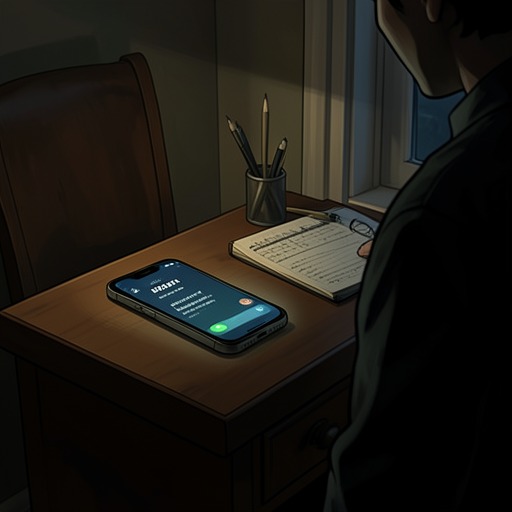
Caller’s Voicemail Messages
I'm Thinking of Ending ThingsCaller’s Voicemail Messages are the narrator’s saved record of an increasingly disturbing series of calls from her own number. At first, the messages offer no clear explanation: The Caller sounds sad and frustrated, repeats the same cryptic words, and refuses conversation. Later, a message adds intimate details about the narrator, changing the calls from an inexplicable nuisance into a threat whose reach appears to extend into the spaces around her.
First Calls and the Saved Record
After the narrator identifies an initial call as a likely wrong number, The Caller apologizes in a scratchy, effeminate voice and hangs up. The next day, she finds two missed calls from that same number, both placed during the night while she was asleep. The number is her own. She checks the missed-calls list again, nearly unable to recognize what she is seeing, and confirms that the calls really do appear there. The mismatch between the familiar number and the unknown caller becomes the messages’ defining disturbance: the phone records an impossible-seeming source without explaining it.
Three or four days later, The Caller leaves the first voicemail. The narrator keeps the messages, eventually noting that she has seven and wondering whether she has held onto them because she might tell Jake. She listens to the first one repeatedly, trying to find something familiar in it, but cannot. The messages are not plainly aggressive or threatening; she hears sadness, perhaps frustration, and words that seem nonsensical without sounding like babble. Most unsettlingly, the words remain the same, word for word. Their repetition gives the messages the shape of a fixed refrain rather than an exchange.
The Refrain and Its Escalation
The recurring message insists that there is only one question to resolve, then circles through fear, uncertainty, and the need for an answer. The narrator listens to this formulation over and over, including while Jake is driving and not paying attention. Its insistence makes the recording both a source of fear and an unresolved puzzle: the message declares an answer necessary but does not disclose what the question is. The narrator describes herself as frightened and not lucid, while feeling that her fear is growing. Repetition does not make the words clearer; it makes their pressure harder to escape.
The pattern intensifies when The Caller makes twelve calls in one night, leaving no message, with every missed call again appearing to come from the narrator’s number. Although she considers that something should be done, she sees no obvious recourse: The Caller has made no explicit threat and has said nothing violent or harmful. When she tries to answer, he hangs up; he appears to want to leave messages, not converse. That one-way communication preserves the mystery while denying the narrator the ordinary means of testing or correcting it.
The decisive change comes when a later message repeats the familiar passage but adds something at the end. The narrator says this last message changes things and is the worst of them; afterward she cannot sleep and regrets not having stopped the calls or told Jake sooner. The added words claim knowledge of the narrator’s physical appearance, naming her feet, hands, skin, head, hair, and heart, and end with a remark about her nail-biting. The detail is specific enough to make the voice feel close, yet the messages still do not explain who The Caller is or how he knows these things. The voicemail’s shift from abstract, repetitive distress to personal knowledge supplies a new reason for fear without resolving the original enigma.
Sounds Beyond the Words
The saved messages are part of a larger pattern in which sound is heard before its source can be confidently identified. In another episode, the narrator notices faint music outside only after seeing a man at her window; she cannot tell whether it is recorded music or humming. The uncertain source and delayed recognition echo the calls’ combination of audible evidence and incomplete explanation, though the music is not established as coming from The Caller.
Later, while travelling with Jake, the narrator’s phone rings again and displays her own number. She puts it away, then checks it after a beep and finds two new messages. The first contains noises rather than speech, including running water; the second has more running water, footsteps, and what sounds like hinges and a closing door. She concludes that it must be The Caller, but the sounds themselves do not independently identify him. She hides the messages from Jake, saying they are unimportant and hoping to sound casual. The recordings therefore carry two kinds of uncertainty at once: uncertainty about what their sounds indicate, and the narrator’s deliberate concealment of what she has heard.
Narrative Function
As a saved and replayed object, the voicemail makes repetition part of the story’s form. The same words return with almost no variation, while the surrounding circumstances change: calls accumulate, the narrator’s number appears as their source, silence gives way to environmental noises, and finally the refrain acquires a personal, bodily detail. The small addition at the end matters precisely because the message has trained the narrator to expect sameness. A familiar sequence becomes newly frightening when its final beat changes.
The recordings also set the limits of what the narrator can know. A caller can be heard, a number can be checked, and noises can be replayed, but none of those acts supplies a reliable account of who is calling or from where. Even the apparent evidence of footsteps, water, and a door remains filtered through the narrator’s interpretation. The voicemails thus function not only as clues but as a recurring test of trust in perception: each replay promises recognition, yet leaves the central question unresolved.