Doug
I'm Thinking of Ending ThingsDoug, the narrator’s driving instructor when she was sixteen, appears in a remembered lesson that barely becomes a driving lesson at all. A rain-soaked meeting, an unexpected book quotation, and a series of stories about students turn the encounter into an intimate exchange about age, puzzles, loneliness, and confidence. The memory ends with the narrator leaning into the car and asking him to close his eyes; what follows is left unstated, while Jake’s shocked reaction makes the moment feel consequential.
Identity and Introduction
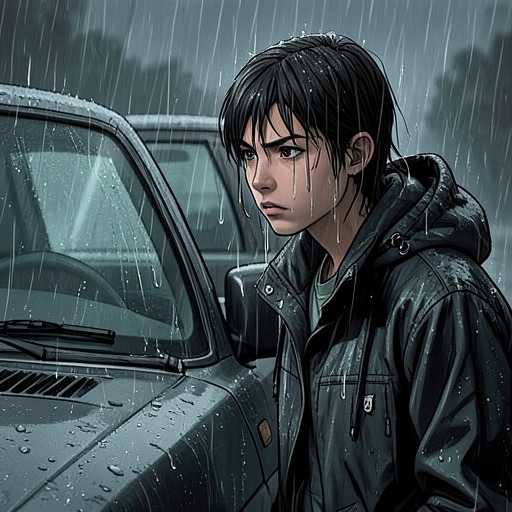
The narrator first encounters Doug at the house where she has been told to arrive for her lesson. She has been sheltering her head with newspaper taken from an empty bus seat, and waits in the rain after following instructions to arrive at ten thirty without ringing the bell. When the door opens, a man she has never met looks up at the sky and apologizes in a way that suggests he hopes she has not waited long. He looks as though he has been awake for days: dark bags beneath his eyes, stubble, and bedhead. He introduces himself, hands her the keys, and shuts the door. The key chain bears a large letter J, a small, unexplained detail in an encounter already marked by uncertainty.
In the car, Doug wears a black baseball cap embroidered with the word Nucleus. The narrator notices his long, narrow, dirty nails and thinks his hands look more like those of an artist or writer than a driving instructor’s. His physical presence is not that of a brisk, self-assured teacher: he seems shy and almost nervous, and his knee bobs while they sit together. These details complicate his tired first appearance. He is not simply withdrawn; in conversation, he becomes attentive to ideas and to the person beside him.
A Lesson Delayed by Rain
The lesson begins with the narrator carefully repeating the routine she has practiced with her father: sliding the seat forward, adjusting the rearview mirror three times, checking the parking brake, and placing her hands at ten and two. Doug does not immediately evaluate her technique. Instead, he says, “I never like the rain,” and explains that the weather throws things off. Guided by hand signals, she pulls into a coffee-shop parking lot. He offers her coffee or tea; she declines, and they sit with the engine running, the windows kept from fogging, and the wipers moving slowly.
Their pause lengthens into more than twenty minutes without any real driving. Doug asks her age, guesses seventeen or eighteen, and learns she is sixteen. His response, “That’s pretty old,” leads him to reflect that age is a strange and inaccurate measure of maturity. The exchange shifts the lesson away from the practical test of driving and toward questions of how a person is judged and understood. Doug eventually opens the glove box, takes out a small book, and asks whether she knows anything about Jung. She says she does not really, though the narrator admits this is not entirely true.
Books, Candy, and Puzzles
Doug finds a passage in the book and reads about existence as a question that life addresses to a person, and about the need to communicate an answer rather than remain dependent on the world’s response. The narrator later says she has the passage memorized. His choice to read it during a stalled driving lesson is characteristic of the encounter: the practical activity has given way to a reflective conversation, and the delay becomes an occasion for exchanging ideas.
Candy gives that conversation another form. Doug tells the narrator that one of his students brought him sweets from a trip to Asia. At first, the candy seems to have no taste; then she notices an unexpected tang and begins to like it. Doug unfolds a wrapper and points out its awkwardly translated English lines: “You are the new man. How delicious cannot forget, special taste. Return the turn flavor.” He says he sometimes unwraps the candies not to eat them, but to read the verses and think about them. Although he does not consider himself a poetry man, he finds them as good as poems, and describes puzzles as real cures for rainy days and loneliness, each person having to solve their own.
The candy story also shows Doug’s habit of turning an ordinary object into a prompt for interpretation. The wrapper’s imperfect language does not deter him; its strangeness is part of what holds his attention. When he tells the narrator that another student was hopeless at driving yet someone whose conversations he eagerly anticipated, he makes clear that a lesson can matter to him even when its stated objective is not being achieved. He describes long, mutual discussions in which the student sometimes said things that astonished him. His account presents listening and intellectual exchange as a separate, more rewarding measure of teaching.
The Former Student and the Unfinished Ending
Doug also recounts a former student who announced that she was “the best kisser in the world.” He says she was convinced that this ability made her more powerful than money or intelligence and placed her at the center of the universe. He admits that it feels strange to tell this story and that he has not told anyone else the detail. The anecdote introduces a striking contrast with the driving lesson: Doug can describe a student who cannot manage the practical skill he teaches, yet remembers her certainty and the force with which she expressed it. His stories repeatedly locate significance in what cannot be measured by driving technique.
For the remainder of the narrator’s lesson, Doug is twitchy and seems uninterested in driving, offering only basic advice while looking through the windshield. Because it is still raining, he drives her home. She says she will keep practicing with her father, and Doug agrees that this is a good idea. After she goes inside, she returns about a minute later and finds him still in the car, now squeezed into the driver’s seat with the seat and mirror still positioned for her. She asks him to lower the window, leans in before it has fully descended, places a hand on his shoulder, and tells him to close his eyes. The remembered account breaks off at that point. As the narrator tells the story, Jake reacts with unusual animation, shocked and nearly angry; the scene therefore ends not with an explained outcome but with the disclosure’s effect on its listener.
Narrative Role
Doug exists in the account as both a particular man and the center of a story the narrator chooses to tell Jake while he drives. That framing matters: the reader encounters the driving instructor through the narrator’s recollection, which moves from the rain and the car to the conversations that displaced instruction, then toward a deliberately unfinished personal gesture. Doug’s own stories similarly move from concrete objects and student behavior into reflections on maturity, loneliness, and self-belief.
The contrast between his role and his attention gives the episode its shape. A driving instructor is expected to teach control of a car, yet Doug’s most memorable contributions are the Jung passage, the candy wrapper, and the account of a student whose conversation mattered more than her driving. He does give basic advice, and he takes the narrator home, but the lesson’s lasting force comes from what is said—and from what the narrator leaves unsaid at its end.