Fragmented identity
I'm Thinking of Ending ThingsFragmented identity is the story’s final explanation for the unstable boundary between Jake and The narrator: the first-person voice moves among “she,” “he,” “we,” and “me” until it can no longer sustain two separate people. The recognition gathers force through concrete clues—the portrait Jake’s mother gave them, Jake’s shoes in the locker room, and the remembered encounter at the Pub—while leaving the distinction between a literal revelation and a mind’s attempt to make meaning deliberately unsettled.
Recognition Through the Portrait
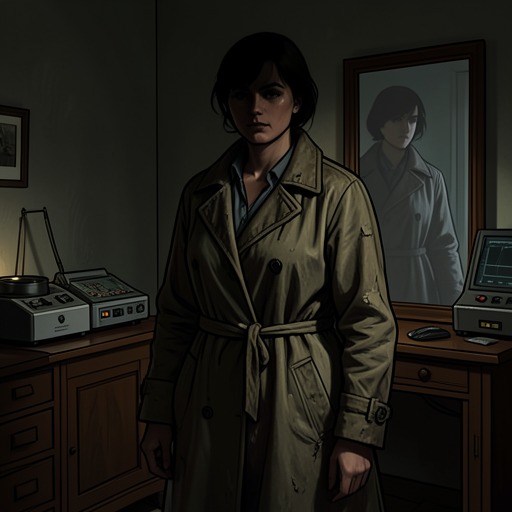
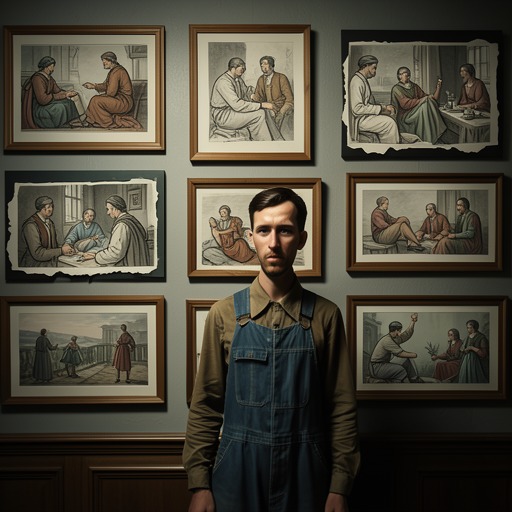
The immediate trigger is Jake’s Portrait Painting, which The narrator remembers carrying in a pocket. It had been given by Jake’s mother as a surprise, and The narrator imagines hanging it beside the other pictures. Unfolding it slowly becomes an act of reluctant recognition: the face looks back, and The narrator sees not simply Jake but a self-image described as distorted, blurry, and fragmented. Paint on the hands makes the image feel connected to the act of making, though the passage does not explain who applied it or when.
The recognition sharpens into an explicit identification. The face is described as The narrator’s own, recognizable as a self-portrait, and then named as Jake. The portrait therefore does more than supply a likeness; it makes the divided identity visible in a single object. The face belongs to the person looking and to the person depicted. Its blurred, broken appearance does not resolve the contradiction so much as preserve it: the selves are distinguishable enough to be named, yet joined in the same image.
The painting’s movement from pocket to imagined wall also gives the recognition a material form. It has been carried close, concealed from sight, and is now unfolded because it must be faced. The narrator first resists looking, then cannot avoid it. The change is not a calm explanation of identity but a confrontation mediated by an object entrusted to them by Jake’s mother. What had seemed a portrait of another person becomes evidence that the boundary between the viewer and the subject may never have been secure.
Clues in the School
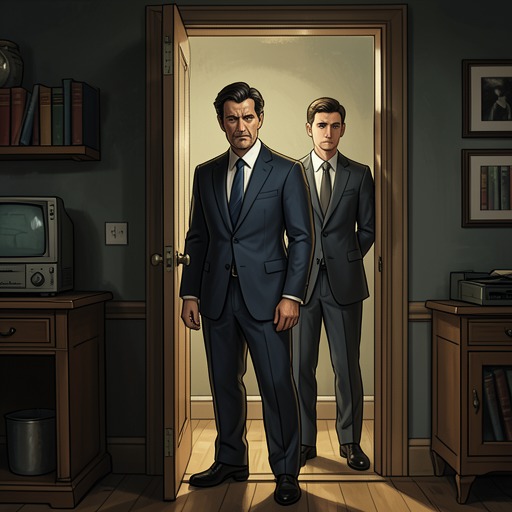
The same collapse reorders what happened inside the school. The narrator recalls seeing photographs and concludes that the custodian is no longer there. The narration then insists that it is The narrator who is in the school now, with Jake, alone. From the car, The narrator says they never saw the man in the school; only Jake saw him. The man’s apparent role in drawing The narrator inside is consequently recast: Jake wanted them to follow and to be trapped together, with no way out.
Jake’s shoes provide the most tangible correction to the earlier account. They are found in the locker room, where Jake took them off and left them in the gym before putting on rubber boots. The narrator takes this as proof that Jake was the man all along. The footwear changes the meaning of the pursuit: what seemed to be an encounter with an outside figure becomes an act staged by the person The narrator believed was accompanying them. The revelation ties identity to disguise and action, while the shoes left behind preserve a physical trace of the person beneath it.
These discoveries do not arrive as detached facts. Recognition breaks through in tears, and the plural voice repeatedly gathers the selves together: Jake, The narrator, and “all of us” are in the school. That plural phrasing can sound like companionship, but it also registers the loss of a stable division between the two. Their being together is inseparable from being unable to distinguish who is present as an independent person.
Rewritten Family History
The school revelations also unsettle Jake’s account of his family. The narrator reconsiders the story that Jake’s brother was the troubled one and thinks it was made up. The passage then makes a harsher assertion: there is no brother, though there should have been. Jake’s parents, too, are understood to have died long ago. These statements belong to The narrator’s moment of reconstruction; the text gives no independent confirmation that would separate remembered fact from the account being formed under pressure.
The family story had offered an explanation for Jake’s distress by placing the trouble in Jake’s brother. Once that explanation fails, The narrator relocates the trouble to Jake himself and rereads Jake’s father’s happiness at the visit as a response to someone having been kind to Jake. This is not simply the addition of new biographical information. It changes the emotional logic of the earlier family scenes, making the story The narrator had been told look like a protective displacement of Jake’s own condition. At the same time, the account’s instability cautions against treating every late realization as an uncomplicated, externally verified fact.
Pronouns, Memory, and Thought
The passage makes its fracture audible before it explains it. At a remembered evening at the Pub, the narration moves from Jake listening to his team talk to the girl sitting beside him, then compresses its changing positions into “She. He. We. Me.” The sequence does not settle on one speaker or one stable point of view. Instead, each pronoun briefly names a position from which the same encounter can be remembered, until the shifts themselves become a statement about identity.
The remembered details are intimate and specific. Jake listens without speaking, takes small sips of beer, and intermittently sniffs the back of his hand, a habit associated with concentration and relaxation. Getting out of his room and being among other people is presented as difficult and significant. The girl beside him is comfortable, talkative, and kind; she smiles, and he smiles back. Her words, “You guys are doing pretty well,” are remembered as the first thing she said to Jake and to “us.” The shared pronoun retrospectively folds the two identities into the beginning of their connection, rather than treating their unity as a discovery confined to the school.
Jake’s reflection that a thought can be closer to reality than an action supplies a principle for interpreting the disguise. Actions can be performed and can mislead; a thought, in this account, cannot be faked. The narrator connects that idea to Jake’s knowledge that they were thinking of ending the relationship, despite never telling him. The text presents his knowledge as something he somehow possessed, linking inward thought to the otherwise puzzling force that draws the two figures together. Identity is thus not established by appearances alone: the shoes and boots expose a performed role, while the unspoken thought becomes evidence of a deeper connection.
Meaning and Unresolved Boundaries
The narration explicitly turns toward allegory and metaphor, arguing that experience is not the only way people accept or reject significance; examples also shape understanding. This self-conscious reflection invites the reader to treat the school, the portrait, the clothing, and the remembered Pub scene as connected signs. It does not, however, reduce them to a single solved code. The interpretation emerges through their recurrence and reversal: a portrait of Jake becomes The narrator’s self-portrait, a pursuer becomes Jake, and an account of a brother becomes an account of Jake’s own trouble.
The result is a divided identity whose resolution is also a further division. The narrator can say that it is Jake and that they are together, but the sequence “She. He. We. Me.” keeps each position audible rather than erasing it. Fragmented identity names both the revelation and its form: a self assembled through conflicting images, shifting pronouns, concealed actions, and remembered scenes. The final recognition makes the story’s earlier instability newly legible while preserving uncertainty about where one consciousness ends and the other begins.