Jake
I'm Thinking of Ending ThingsJake is introduced as The narrator’s boyfriend and the companion on a first visit to his parents. At the novel’s end, that apparently shared life breaks apart: The narrator recognizes Jake as the school custodian, sees Jake’s face as their own in a portrait, and understands the two figures as parts of one divided identity. Jake’s character is therefore defined both by the intimate relationship initially narrated and by the revelation that its apparent boundaries cannot be trusted.
Identity and Background
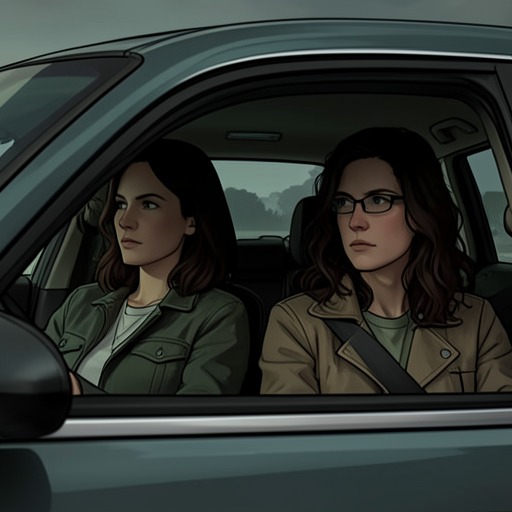
At the start of the visit, Jake and The narrator have been together for roughly seven weeks. The narrator describes their connection as rare and intense, but also feels unexpectedly nostalgic rather than excited about their first trip together. Jake says his mother has been tired, and, five minutes from the house, thanks The narrator for coming. His ease in these early exchanges gives the relationship an ordinary surface that the later revelations overturn.
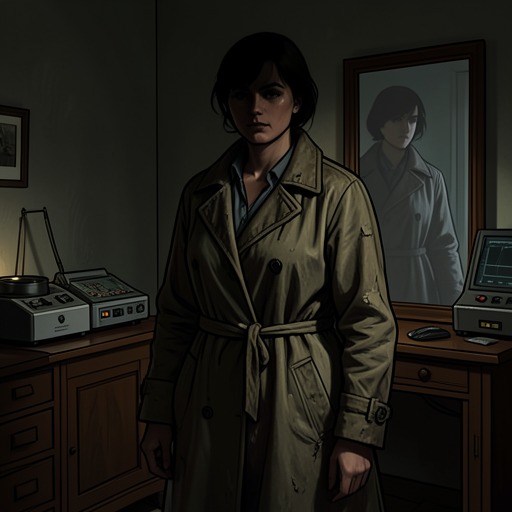
Jake’s account of himself includes a photograph he keeps on his laboratory desk: a picture of him at five, with curly blond hair and chubby cheeks. He values it because it is still him, even though his adult body is physically different and, as he explains it, the cells represented in the image have since been replaced. The photograph makes personal continuity a concrete problem rather than an abstraction. Jake can recognize the child as himself while questioning what, physically, connects that child to the present person.
That question anticipates the novel’s final collapse of identity. The narrator unfolds a portrait painted by Jake’s mother and sees a face that is blurred, fragmented, and recognizable as both Jake and The narrator. The recognition does not simply reveal that one character has been mistaken for another; it makes the apparent separation between them part of the story’s instability.
The Relationship and the Story They Share
Jake initially occupies the role of The narrator’s attentive boyfriend. During their drive, The narrator remembers details of an earlier encounter and worries that the account may be tedious or overfull. Jake encourages the story to continue, arguing that memory is reconstructed and edited. When The narrator asks him to explain, he describes memories and stories as things retold and revised, distinct from reality, which happens only once. His reflections give their conversation intimacy: The narrator says that such remarks make Jake especially attractive.
The couple’s exchanges also establish how the story tests what it means to know another person. Jake’s ideas about memory are not merely philosophical conversation. The narrative later exposes the family history and romantic past around which The narrator’s account has been built as unreliable or imagined. His insistence that memories change each time they are recalled becomes a principle for reading the relationship itself: its vivid details do not guarantee that it happened as first presented.
Jake’s talk of a childhood photograph also connects bodily change to the prospect of losing a relationship. He compares the continual alteration of physical structures with relationships that change, tire, and age. Near the house, he tells The narrator that things are known to be real when they can be lost. The thought carries a different weight once the novel reveals that the apparent couple may be a divided self confronting its own disappearance.
Family and the Account of His Brother
On the return journey, The narrator asks Jake about a photograph of a blond girl seen in his room. The question opens into Jake’s account of his younger brother. He says that his brother had always been solitary and unable to relate to others, then began following Jake around. Jake presents the behavior as odd but not dangerous, and says he eventually had to cut his brother out of his life. He describes him as a genius, deeply unhappy, and lonely, and says the situation changed the family’s dynamics.
The account initially gives The narrator a new way to understand Jake and his parents. The narrator feels that the explanation has altered their view of the family and presses Jake to say more. The later recognition reverses that apparent disclosure: The narrator concludes that the story of the troubled brother was made up and that there was no brother. In the same passage, the narration recognizes that Jake’s parents had died long ago. These are not presented as a calm, externally verified family history; they emerge within the revelation that the account itself has fractured.
The family story thus works in two directions. At first, it supplies a sympathetic explanation for Jake’s estrangement and for his parents’ response to the visit. At the end, its invented quality makes it evidence of how a life can be furnished with explanatory characters and relationships. The narrator’s earlier feeling of understanding Jake is not simply discarded; it becomes part of the painful gap between a persuasive story and the reality the ending makes visible.
The School, the Photographs, and the Recognition
At the school, Jake is said to see a man watching The narrator and Jake. He insists that the man was leering and that he knows the type, interpreting a small movement of the man’s hand as evidence of his intent. The narrator asks how Jake can be certain. The exchange presents Jake as protective and angry, but the final account changes the status of the supposed watcher: The narrator realizes that Jake was the one directing them into the school and that only Jake had seen the man there.
Photographs in a room at the school provide a material trace of the identity concealed by that story. Among pictures of an unsmiling older man and woman, The narrator finds several photographs of a man who appears unaware of the camera or reluctant to be photographed. In one, the top of his head is cut off; in another, he leans away from a desk and covers his face with his left hand. The pictures are faded and blotchy. The narrator recognizes the man as the figure Jake saw and the figure encountered in the hall, while finding his eyes familiar without yet understanding why.
The later recognition supplies the answer: the custodian is no longer there, and the man in the photographs is Jake. The narrator also recalls Jake’s shoes in the locker room, removed and left behind when he put on rubber boots. That concrete detail overturns the apparent pursuit. The custodian’s disguise and the imagined search for him have led The narrator through a school that Jake wanted them to enter, where they could be alone together with no way out.
The portrait from Jake’s mother completes the visual pattern. When The narrator unfolds it, Jake’s painted face appears distorted and divided, but still unmistakable. The narrator sees the face as their own and understands the painting as an image containing all of them. Photographs, shoes, boots, and portrait have different evidentiary force, yet converge on the same reversal: the person who seemed to be pursuing Jake, the person called Jake, and the person narrating are no longer separable figures.
The Ending and Narrative Significance
After the recognition, the narration shifts into plural forms, gathering Jake and The narrator into an isolated collective self. It revisits Jake’s earlier statement that a thought may be closer to truth than an action because actions can be performed or disguised. This idea makes the ending’s distinction between the relationship imagined in action and the relationship sustained in thought especially stark. The narrator understands that Jake somehow knew about the thought of ending the relationship, though it had not been spoken aloud, and interprets his actions as a response to not wanting to be alone.
The novel then returns to the first meeting at the Pub. Jake had gone there with a group but remained quiet, listening to the conversation and taking small sips of beer. As he concentrated or relaxed, he absently sniffed the back of his hand. For someone who found this kind of social setting difficult, simply getting there was significant. He spoke with a girl, wrote his number on a napkin, and wanted to give it to her but did not. He never met her again. The possibility that a phone call or another meeting could have led to a relationship remains explicitly unresolved; the narration says the missed chance was not the girl’s burden. This brief encounter becomes the seed of the elaborate shared life that Jake thinks and writes into being.
In the final scene, Jake lifts the lower part of his mask and gives The narrator a metal hanger, saying that he is thinking of ending things and asking for help. The narrator straightens the hanger, bends it so that its pointed ends face the same direction, and uses it to inflict fatal wounds. The act is described as a choice made in the name of helping Jake, but it is also the culmination of the novel’s merging pronouns and divided identity. Jake is beyond help, and the story offers no recovered separate life after his death.
Jake’s role is inseparable from the novel’s questions about memory, identity, and loneliness. The apparently ordinary boyfriend becomes a figure whose history is reconstructed from stories, objects, and images, then folded into the consciousness that narrated him. The ending does not resolve every hypothetical possibility surrounding the girl at the Pub or the life that might have followed. Instead, it makes the lost possibility itself part of Jake’s final account: a relationship that never took shape in shared reality, yet became powerful enough in thought to structure an entire story.