Jake's Portrait Painting
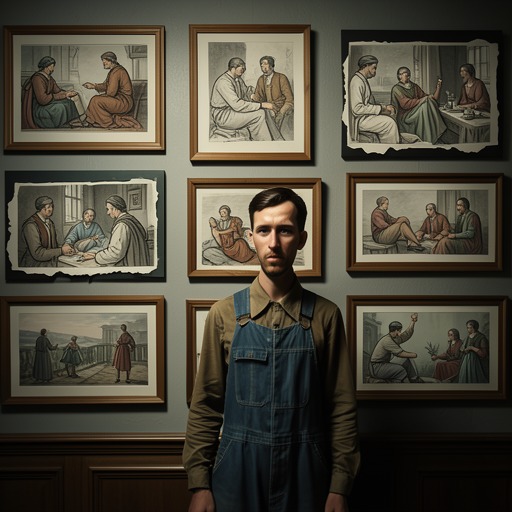
I'm Thinking of Ending ThingsJake's Portrait Painting is a personal gift from Jake's mother to the narrator, offered after dinner and deliberately kept unseen until the narrator arrives at an unspecified destination. Its significance lies not only in its subject, Jake, but in the way the gift is presented: a folded paper, a delayed reveal, and a correction that it belongs to the narrator alone. The painting is identified but not shown in this scene, leaving its image and maker unstated while giving the object the weight of a private link between mother, son, and recipient.
Identity and Form
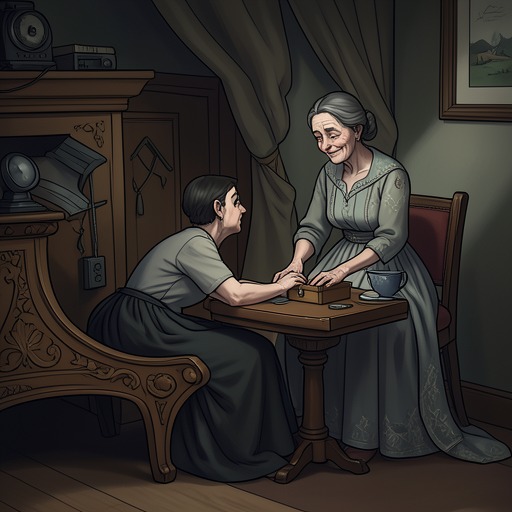
Jake's mother gives the narrator a small piece of paper, folded several times and small enough to fit in a pocket. She says she decided that night the narrator should have it, while also explaining that it had been in the works for quite some time. The exchange establishes a physical token before it establishes what the token represents: the narrator begins to unfold it, but Jake's mother stops the attempt.
The mother identifies the gift first as a painting and then, more specifically, as a portrait of Jake. The passage does not show the image or establish who painted it. Although the narrator asks whether it is one of Jake's mother's paintings, she does not answer that question in the supplied scene. The object is therefore defined by its announced subject and personal purpose, not by a description of its appearance or a confirmed account of its creation.
The Delayed Reveal
Jake's mother tells the narrator not to open the folded paper there, insisting, “You’re not ready yet!” When the narrator asks where the gift should be opened, she does not specify a place; instead, she says, “It’s a surprise. For you. Open it when you arrive.” The promised arrival gives the gift a future moment of disclosure, but the mother's silence leaves the destination unresolved.
That postponement makes the portrait present as an expectation rather than a visible likeness. The narrator has the object in hand but cannot yet know what the image looks like. The scene thus separates receiving the gift from seeing it: the folded paper can be carried away, while the portrait's contents remain withheld. Nothing in the passage confirms when or whether the narrator later opens it.
Jake, His Mother, and the Recipient
The portrait is framed by Jake's mother's recollection of making art with her son. She says that she and Jake used to draw and paint together for hours when he was younger, and that he loved art. This memory gives the gift a history reaching back to their shared childhood activity, though it does not identify the portrait itself as one of their joint works or establish its painter.
The mother's emphasis on ownership distinguishes the gift from a keepsake offered to the couple. When the narrator thanks her and says they will both appreciate it, she corrects that assumption: “It’s for you. Only for you. It’s a portrait,” she says. “Of Jake.” The exchange makes the narrator the sole intended recipient and Jake the portrait's subject. Afterward, the narrator thinks of the gift alongside the evening's other unresolved matters, including the conversation with Jake's father and the visit to the basement, but is too tired to raise them during the drive. The portrait therefore closes the visit with a personal promise whose image, destination, and eventual reception remain outside the scene.