Jake’s relationship with his parents
I'm Thinking of Ending ThingsJake’s relationship with his parents appears at once close enough for everyday communication and burdened by a history that the family does not explain all at once. During The narrator’s visit, his parents welcome her warmly and say they are grateful she is there, while Jake speaks of having cut his brother out of his life. The contrast makes the visit more than an introduction: it shows a family trying to make room for connection while still living with the consequences of earlier estrangement.
Contact and Expectations
When The narrator asks whether Jake’s parents knew they were coming and had invited them, Jake answers that they communicate. The brief assurance establishes that he is not presenting the visit as a surprise or a breach between them. Yet the simple answer cannot account for the intensity of his parents’ welcome. At dinner, Jake’s mother says that he never brings his girlfriends around and that she is glad The narrator has come; Jake’s father adds that the house is too quiet when the parents are alone. Their enthusiasm makes the visit seem exceptional to them, even though Jake describes communication as an ordinary part of family life.
The parents’ expectations also reach beyond a single evening. Jake’s father says they had been looking forward to meeting The narrator for a long time and had begun to think Jake would never bring her home. He describes her presence as good for Jake and says the family is hopeful. Jake’s mother similarly welcomes the prospect of their staying overnight, noting that Jake has never slept well and that food will be available in the morning. Her invitation to remain is both practical and affectionate; it also suggests that the parents understand the visit as an opportunity for Jake, not merely a social courtesy.
The narrator cannot tell what the parents mean when they express gratitude for what she is doing. She responds politely, but privately wonders what role they believe she has taken on. Their confidence that she and Jake are a good match, and that Jake needs her, arrives before The narrator has settled her own feelings about the relationship. The exchange therefore reveals the parents’ hopes more clearly than it establishes what Jake has told them or what he himself expects.
The Uneasy Visit
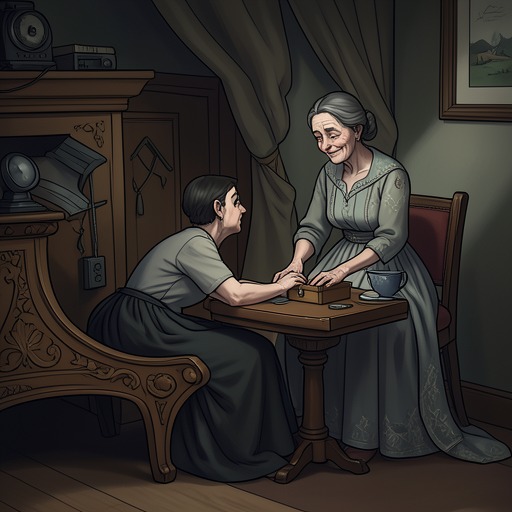
The warmth of the welcome does not make the evening comfortable. The narrator finds the house and the trip older and less engaging than expected; conversation is dominated by the parents’ accounts of themselves and interrupted by long silences. In those pauses, ordinary sounds—the cutlery, music, ticking clock, and fire—become conspicuous. The mismatch matters to Jake’s relationship with his parents because The narrator had assumed that Jake’s skill as a conversationalist reflected the kind of intellectual exchange she might find at home. Instead, she encounters parents she considers poor conversationalists and a family gathering that feels awkward rather than intimate.
The domestic details reinforce the gap between anticipated ease and actual strain. Jake’s mother asks him to take out the compost because the bin is full and Jake’s father’s back is still sore; Jake agrees without protest. The request presents him as a participating member of the household, responsible for an ordinary chore, even as The narrator feels out of place in the family’s routines. She notices that the parents talk mostly about themselves and that the hoped-for discussion of work, politics, philosophy, or art does not materialize. Her discomfort is not evidence that the parents reject her: they continue to include her and press the invitation to stay. Rather, their hospitality and the visit’s awkwardness occupy the same room without resolving one another.
Family Strain and Disclosure
The father’s private conversation with The narrator gives the evening a more serious context. He apologizes for the tension and asks her to understand that Jake’s mother is not crazy. He explains that her smiling is an involuntary reaction that can leave her face hurting, and describes her as fragile. The narrator says she had not particularly noticed the smiling. The father’s explanation makes the mother’s behavior legible to a guest while also revealing his familiarity with it: what once upset him, he says, has become something he is used to. His tenderness and apology suggest care, but the disclosure does not erase the strain The narrator has felt during the visit.
Jake later describes a crisis involving his brother, which he says changed the family dynamic. A few years earlier, the brother began following him, despite Jake asking him to stop. Jake characterizes his brother as solitary, unhappy, and unable to relate easily to others; he says he eventually had to cut him out of his life. His account combines sympathy with separation: he believes his brother can be rehabilitated and regards him as a genius, but also describes the brother’s needs as things Jake could not provide. The family’s present relationships are thus shaped by an earlier problem that Jake calls no longer a big deal, even as he acknowledges its lasting effect on the family.
The brother’s difficulties were not limited to following Jake. Jake says his brother had been on track to become a full professor but could not manage the social demands of the workplace. Although he liked people, interacting with coworkers and making small talk provoked anxiety; he left the work and needed a job where he could avoid presentations and blend into the walls. Jake describes the brother’s later behavior as intrusive, including orders and ultimatums that felt like a voice in his head and subtle sabotage of Jake’s life. These details complicate the parents’ cheerful welcome: beneath their wish to have Jake bring someone home lies a family history of loneliness, dependence, and boundaries that proved difficult to maintain.
Affection, Distance, and the Meaning of Home
Jake’s relationship with his parents is not presented as simple hostility or reconciliation. He brings The narrator home, agrees to help with a household chore, and speaks candidly about painful family matters. His father is attentive to Jake’s wellbeing and openly hopeful about the effect of The narrator’s presence; his mother expresses pleasure that Jake has brought a girlfriend. At the same time, the parents’ welcome seems to carry expectations that The narrator has not agreed to fulfill, and Jake’s account of cutting off his brother shows that care within this family has limits.
For The narrator, hearing Jake’s explanation changes the emotional register of the visit. She feels more understanding toward his parents and Jake, and closer to him because he has shared something difficult. That moment does not settle her uncertainty about the relationship: she still wonders whether to end it. Instead, the family history gives her a more complicated basis for judgment. Jake’s home is both the place where his parents welcome her and the setting through which she begins to see how much loneliness, fragile care, and unresolved separation lie behind that welcome.