Ms. Veal
I'm Thinking of Ending ThingsMs. Veal is a figure from the narrator’s childhood whose brief, unsettling encounter with a seven-year-old becomes a lasting point of reference for fear, uncertainty, and the limits of knowing other people. First encountered through her calls to the narrator’s mother, she enters the child’s life as a familiar name but an unknown person; years later, her remembered question about goodness and badness returns within the narrator’s account of a shared story at the school.
Identity and Introduction
The narrator had heard Ms. Veal’s name for years before meeting her. Ms. Veal called the narrator’s mother frequently to describe the troubles in her life, and the calls could continue for hours. The narrator sometimes answered the telephone and felt uneasy as soon as she heard Ms. Veal’s voice. When the narrator tried listening in after her mother took another phone, the mother would soon tell the caller she could hang up. This establishes Ms. Veal first as a presence mediated by adult conversation: recognizable by voice and repetition, but not yet understood by the child.
When they meet, Ms. Veal has a cast on her right hand. The narrator remembers her mother describing a recurring succession of ailments, including a bandage on her wrist or a brace on her knee. Her curly reddish-brown hair and sharply aged face match the child’s impression of the voice she had imagined. These particulars belong to the narrator’s retrospective account: Ms. Veal is presented not through an independent account of her motives or character, but through what the child noticed and what the mother had said.
The visit has an ordinary domestic purpose. Ms. Veal comes to collect bacon fat kept in the family’s freezer, which she uses to make Yorkshire pudding, although she does not cook bacon herself. The women sometimes meet or visit one another to pass it along. On the day the narrator remembers, the narrator is home sick from school; the mother makes tea, Ms. Veal brings oatmeal cookies, and the exchange takes place before the two women sit together. That routine setting matters to the memory: the encounter is not introduced as an exceptional crisis, but as a household visit that becomes frightening for the child.
The Childhood Encounter
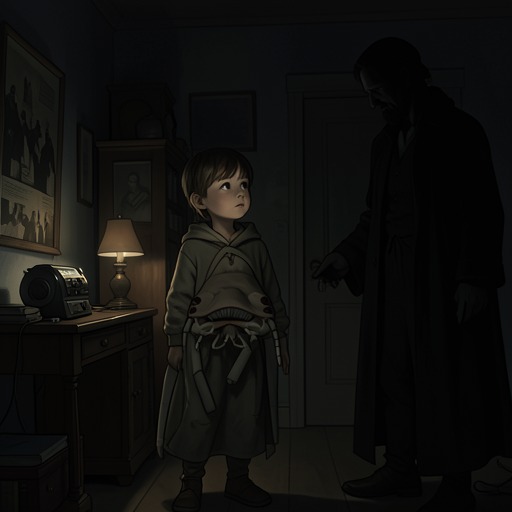
Ms. Veal does not greet or look at the narrator while the mother is present. The narrator is in pajamas, feverish, and eating toast, and does not want to sit at the table with her. When the mother leaves the room, the child is alone with Ms. Veal. The narrator recalls being barely able to move when Ms. Veal stops what she is doing and looks at the child. The account makes the change in the room’s social arrangement decisive: the adult who had been part of a conversation between the women now addresses the child directly, without the mother there.
Ms. Veal asks the narrator to judge whether the child is good or bad, and connects giving up with being bad. She then offers a cookie as the reward for being good and raises the possibility that a bad child might have to leave the family home and live with her instead. The narrator does not understand the question, cannot answer at first, and is frightened by the prospect. Ms. Veal also tells the child not to be so shy and to get over it. The child eventually says that she is good, blushing and looking past Ms. Veal; the narrator later emphasizes that she did not want a cookie and did not know what Ms. Veal meant.
Ms. Veal’s questions turn the visit’s ordinary hospitality into an examination whose terms the child cannot make sense of. The narrator remembers being asked what the mother had said about Ms. Veal, and remembers Ms. Veal smiling. When the mother returns, Ms. Veal gives no indication that the conversation has occurred and resumes transferring fat between the jars. The contrast between the private exchange and the resumed domestic routine leaves the child with an experience that the adults’ outward behavior does not acknowledge.
The Memory and Its Consequences
That night, the narrator’s mother becomes ill with what the narrator understands as food poisoning. The narrator hears her vomiting and crying and remains awake. The mother later attributes the illness to a fluke stomach problem, but the narrator is convinced that Ms. Veal’s cookies caused it. The narrator reasons that the mother and child ate the same dinner, that the child was not sick, and that the mother had eaten a cookie while the child had not; the mother is back to herself by morning, though dehydrated. The account preserves the distinction between the mother’s explanation and the narrator’s certainty. It does not establish that the cookies caused the illness; it shows how the child incorporates the episode into a fearful interpretation of Ms. Veal.
The narrator explicitly describes the encounter as a youthful realization that other people’s thoughts and motives cannot be known completely. The child’s question about whether Ms. Veal is good or bad cannot be answered with confidence, just as Ms. Veal’s question demands a judgment the child does not know how to make. For the narrator, the episode becomes evidence not that every relationship is false, but that relationships form under conditions of incomplete knowledge: people cannot be entirely sure who another person is or what that person thinks. The narrator also distinguishes inner thought from outward conduct, observing that people may think what they want even though there are limits on what they can do and say.
The memory’s significance therefore exceeds the immediate fear of being judged or sent away. Ms. Veal is the person who poses the binary question, but the narrator’s later understanding turns that question back on the limits of judgment itself. The child’s inability to answer is not resolved by a final discovery about Ms. Veal’s intentions. Instead, the incident remains attached to uncertainty: the narrator retains a strong conviction about the cookies while also recognizing that people’s motives are never fully available to one another.
Return of the Question
Much later, the narrator invokes Ms. Veal while speaking in a plural voice at the school. The account gathers events involving the narrator, Jake’s parents, girls at the Rural Dairy Queen, and Ms. Veal into a single shared story, and says that the group had to try putting her with them to see what could happen. It calls the story hers to tell, while also placing her within a collective narrative. The passage does not describe Ms. Veal physically present at the school; her return is through memory and storytelling.
As the sounds of approaching footsteps continue in that scene, the narrator’s plural voice asks what remains possible when there is no one else and turns toward a choice about whether to continue. In that context, the old question of being good or bad is explicitly rejected as the wrong question, one no one can answer. The Caller is said to have known this from the beginning, and the narrator says that everyone needed Ms. Veal’s help to answer the one question that remained. The remembered childhood encounter thus changes its place in the story: what once seemed like a frightening demand for a child’s moral self-definition becomes part of a larger reckoning with isolation, connection, and the decision to go on.
Ms. Veal’s role is defined less by how much is known about her life than by the persistence of the question she leaves behind. She first appears through telephone calls and a practical exchange between adults, then becomes the center of a private childhood encounter, and finally is brought into the narrator’s collective account at the school. Across those appearances, the story does not disclose what Ms. Veal intended when she spoke to the child. That silence preserves the uncertainty the narrator associates with knowing another person, even as the group turns to her memory for help in approaching a different, more consequential question.