Pigs
I'm Thinking of Ending ThingsThe Pigs are the last two animals once kept in an abandoned pen at Jake's Parents' Farm, and their fate gives the farm visit one of its most troubling turns. Jake's account moves from a familiar explanation of farm work to the discovery that the animals had been eaten alive by maggots. For the narrator, their deaths are first understandable as a release from suffering, then unsettling evidence for a more frightening possibility: that death may not end pain.
Place on the Farm
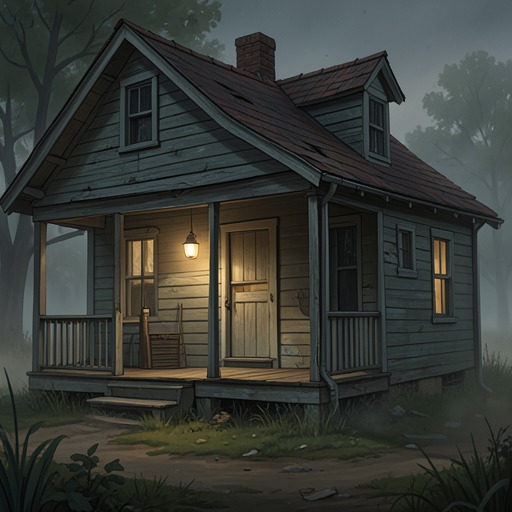
When Jake leads the narrator toward the pen, he explains that the farm no longer has pigs because they were too much work. The enclosure remains, however, looking abandoned and apparently untouched for several years. Its emptiness makes the animals' absence part of the scene: the pen persists after the farm has stopped keeping pigs, a remnant of a kind of work that Jake's family did not continue.
The last two Pigs were old and no longer moving around much. Jake says they had to be put down. The narrator asks whether the family ever replaced them with piglets, and Jake explains that sometimes farms do, but his family never did; pigs cost money and required substantial work. Their disappearance is therefore not followed by a new generation in the same enclosure. The practical decision not to replace them leaves the pen empty and closes this small part of the farm's animal life.
The Discovery in the Pen
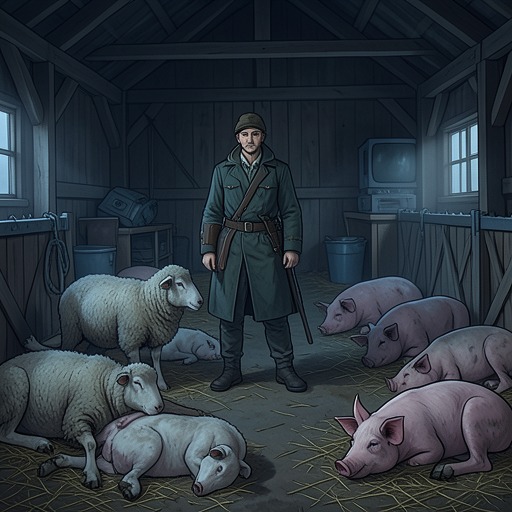
Jake's account explains why the Pigs were put down. His parents had not gone inside the pen to check them for several days, though they continued to toss food in. The animals lay in the same corner day after day. When Jake's father finally went in for a closer look, he could see that they were in discomfort and tried to move them.
Lifting the first Pig nearly made him fall backward. Its belly was swarming with thousands of maggots, which Jake describes as resembling moving rice across the underside of the animal. The second Pig was in even worse condition. From a distance, the pair had seemed content and relaxed; close inspection disclosed a severe bodily crisis that their outward stillness had concealed. The difference between those views is central to the account: apparent calm did not mean the animals were well, and their condition could not be understood by looking from outside the pen.
Illness, Neglect, and Euthanasia
Jake offers a probable explanation rather than a confirmed diagnosis. The Pigs were old, and he thinks their immune systems were likely weakened. An infection and rot may have followed a small cut, after which flies could have entered the wound. He also notes the filthy conditions in which pigs live. These are Jake's explanations of how the infestation might have begun; the account does not establish precisely what caused the wound or how the illness developed.
The delay before Jake's father examined them matters to the story of their suffering. Food had been tossed into the pen, but the animals' condition remained unnoticed until he entered it and tried to move them. Once he saw what was happening, putting them down was, in Jake's telling, the only choice. Their death is presented neither as an accident nor as a casual act of farm routine, but as a final response to suffering the family could no longer relieve in any other way.
The Narrator's Response
The narrator reacts with horror, then acknowledges that the Pigs had to be put down and released from what they were enduring. The thought that ending their lives could be merciful gives the decision a grim clarity: their continued existence in that condition seemed worse than its final end. Yet the image does not settle into reassurance. The narrator contrasts the Pigs with the frozen lambs seen earlier, whose stillness could seem almost restful. There is nothing comparably peaceful in the Pigs' imagined suffering.
That contrast turns the farm story into a fear about the limits of death as an escape. The narrator wonders whether suffering might continue after death, imagining the maggots feeding on and being felt by the dead. This is a fearful possibility raised by the narrator, not a fact established by the events. The Pigs' ordeal supplies its force: their bodies looked calm from afar while a terrible process went unseen, leaving the narrator unable to trust appearances or assume that death guarantees relief.
Narrative Significance
The Pigs are not merely an example of the unpleasant work Jake associates with farm life. The account gives them a concrete history—aging, reduced movement, days in the same corner, a hidden infestation, and a final decision made after closer inspection—while also showing how the narrator interprets their suffering. Their condition becomes a measure of the distance between observing an animal and knowing what it is experiencing. The farm's ordinary rhythms, including feeding and managing livestock, coexist here with pain that routine failed to reveal promptly.
Their story also complicates the narrator's initial acceptance of euthanasia as mercy. Putting the Pigs down appears necessary, but the relief the narrator imagines is immediately shadowed by uncertainty about whether suffering can truly be ended. The empty pen and the animals' irreversible fate leave that uncertainty without resolution: the family no longer keeps pigs, and the narrator is left with an image that makes death seem both a possible release and an unknowable threshold.