Sheep
I'm Thinking of Ending ThingsSheep at Jake's Parents' Farm are more than part of the farm's routine: the lambs link an ordinary practice of animal care to the narrator's childhood fears about bodily loss, and later become the focus of an encounter with death. The account moves between the animals as a group in their barn and two individual carcasses outside it. That change of setting and condition gives the Sheep a striking place in the narrator's reflections on life, attachment, and what can be lost without destroying a whole.
Life and Care at the Farm
The narrator recalls that Jake's family raised Sheep and that, a day or two after a lamb was born, Jake's father placed tight rubber bands around its tail. The bands stopped the flow of blood, and after several days the tail fell away. Jake described the procedure as painless, with the lambs unaware of what was happening. The detail belongs to practical farm life, but it also supplies the material for a child's unsettling line of thought: the narrator had found severed lamb tails in the fields and wondered whether the same process could happen to a human limb.
The fear took the form of specific, ordinary possibilities. A sleeve or sock might be too tight; a foot might be gone by morning after sleeping in socks. From that imagined loss, the narrator asked how much of a being could fall away before something important was missing, and why the lamb's tail did not count as essential. The questions do not establish that the narrator thought the animals were harmed by the procedure; the account explicitly presents the lambs as unaware and the process as painless. Instead, the lambs' bodies give shape to an uncertainty about the boundaries of identity and the difference between losing a part and losing what makes a creature itself.
The Sheep in the Barn
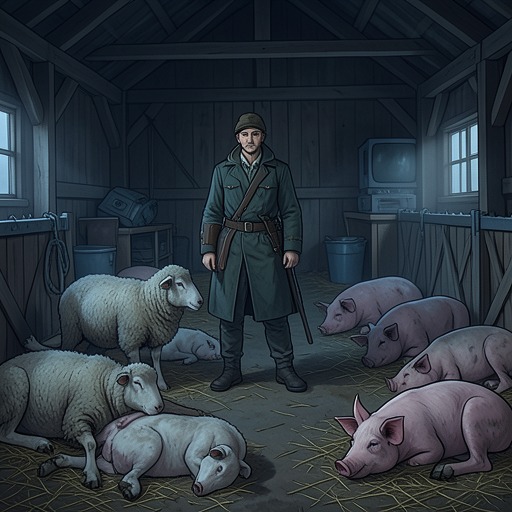
During a winter visit to Jake's Parents' Farm, Jake takes the narrator on what he calls an abridged tour, including the old barn. He says the Sheep are inside and that his father probably fed them grain about an hour earlier. Most lie down while a few chew. The barn is dim, with thin plywood walls, cedar pillars, and a sheet-metal roof; cracks and holes mark its walls. The narrator finds the place dreary, while Jake explains that the animals are chewing cud, semidigested food they bring up and chew again. The scene is presented through this difference in attention: Jake offers familiar facts about livestock and their habits, while the narrator registers the cold, the building's condition, and the animals' vacant stillness.
The barn visit makes the Sheep part of an ongoing, ordinary farm rhythm. They have been fed, are resting or chewing, and occupy a structure that the narrator sees as bleak rather than welcoming. Yet the account does not give them individual names or imagined thoughts. Their presence is first collective and observational; the narrative's shift toward two particular animals occurs only after Jake leads the narrator outside. That movement changes the Sheep from a quiet group within the farm's routine into the occasion for a more direct encounter with death.
The Carcasses and Their Aftermath
Against the barn wall lie two dead lambs, stacked together. The narrator had not expected to see them. Their bodies show no blood or apparent decay, and at first their form seems almost like an inanimate material rather than something once alive. The narrator wants to keep looking and also wants to move farther away. The reaction is not simply disgust or fear: seeing the lambs makes death newly concrete, distinct from the narrator's previous experience of them only as food.
The narrator considers degrees of being alive, being in love, being committed, and being sure, then contrasts uncertainty and discouragement with the finality of the dead lambs. The comparison draws on the animals without making their deaths equivalent to a human emotional state. In the narrator's account, these lambs are not merely inactive, ill, or giving up; they are dead. Their resemblance to living, healthy lambs makes the difference harder to settle by appearance alone. The bodies seem familiar in form, yet the narrator understands that their condition has changed completely.
Jake walks ahead, apparently eager to get inside and eat, and initially does not answer the narrator's question about what will happen to the dead lambs. The narrator asks again whether they will remain there or be buried. Jake says they will probably be burned in a bonfire when the weather warms in spring; for now, they are frozen. The answer gives the carcasses a provisional place in the farm's seasonal routine: they remain beside the barn until a later disposal. As the narrator catches up and looks back, the two shapes appear at a distance as one solid, inanimate mass, like a bag of grain. The change in scale reduces the lambs to a single form in the landscape, but it does not undo the narrator's recognition of them as once-living animals.
Narrative Significance
The Sheep connect two moments in the narrator's thinking. In childhood, discarded tails prompt fears about the body's vulnerability and questions about which parts are necessary. At the farm, the two dead lambs turn those abstract questions toward the boundary between life and death. The earlier concern is about what can fall away while the creature continues; the later scene confronts a condition in which the creature no longer lives, despite retaining a form that resembles the living.
The contrast also depends on the animals' place within human routines. Jake's father feeds them and carries out the tail-banding practice; Jake explains their chewing and describes the likely burning of the dead lambs. For the narrator, however, farm procedures do not make the lambs emotionally interchangeable with their uses or their remains. Their presence interrupts the tour and prompts questions Jake does not seem inclined to pursue. The scene gives the Sheep a role beyond background livestock, while keeping the account anchored in what the narrator sees and wonders rather than claiming access to the animals' inner experience.