Symbols and allegory as ways of understanding
I'm Thinking of Ending ThingsSymbols and allegory as ways of understanding is Jake’s account of how people discern meaning and value through more than rational proof. He describes symbolic thought as part of ordinary cognition, not an alternative to reason, and the idea acquires an unsettling visual counterpart when the narrator encounters a basement painting and a series of drawings. Those images do not explain themselves; they give form to a room, a child, and a changing figure whose significance remains open. The scene thus puts Jake’s theory into practice while preserving the uncertainty that makes interpretation necessary.
Jake’s account of understanding
During the drive, while the narrator watches bare trees pass outside the window, Jake explains why philosophy uses examples. In his account, understanding draws on certainty and rational deduction but also on abstraction; neither side alone fully describes how people make sense of the world. He presents their integration as a feature of how minds function and interact, joining logic and reason to something closer to feeling or spirit.
Jake resists limiting this claim to a particular intellectual tradition. He says that the role of symbols is a common thread across Western and Eastern thought, and presents it as universal. He broadens the term beyond simple signs to include allegory and elaborate metaphor: people recognize significance and validity not only through experience, but also through symbolic forms. These forms, he argues, participate in judgments about existence, value, and what is worthwhile, alongside mathematics and science.
His position is notable because he identifies himself as a scientist while arguing that rationality cannot provide a complete account of how people understand the world. He also hears the obviousness of his own explanation as he gives it and recognizes that it may sound trite. That qualification does not cancel the claim; instead, it makes the explanation self-conscious. Jake is trying to describe a familiar but difficult-to-formalize part of thought, and admits that the idea can sound plain even as he finds it interesting.
The theory returns in the basement
The narrator initially listens to Jake only half attentively. Later, in the basement, the painting brings the conversation back with unexpected clarity. This delayed recollection links an abstract discussion during the drive to an image encountered in a concrete and unsettling setting. Rather than having Jake interpret the picture for the narrator, the narrative lets the narrator look again and remember his account of how symbols carry meaning.
The painting depicts a room that appears to be the basement itself: its stairs, concrete floor, and shelves are recognizable, but the furnace has been replaced by a long-haired individual with long arms and fingernails that resemble claws. A much smaller person, perhaps a child, appears in a lower corner. The substitution makes the picture more than a straightforward rendering of the room. It preserves the space’s recognizable features while altering one central element, asking the viewer to relate the ordinary basement to a figure that does not belong to its everyday arrangement.
The scene does not supply a definitive key to that alteration. The figure’s identity is uncertain, and the small person is only tentatively identified as a child. The narrator’s attention to those uncertainties matters: the image prompts interpretation, but the act of looking does not produce certainty. In this respect, the painting dramatizes Jake’s distinction between what can be recognized through concrete details and what must be approached through abstraction.
Repetition, variation, and the child
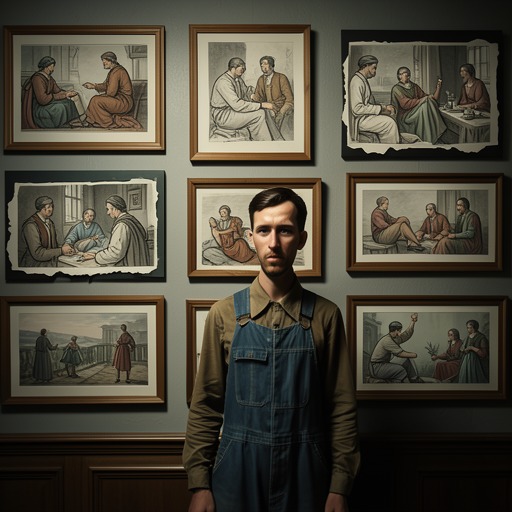
Beside the painting, a small, dirty bookcase holds old papers and drawings. The narrator finds that they repeatedly depict the same basement, each time with a different person in place of the furnace. The figures vary in hair, bodily features, and even the presence of horns; some have breasts, some have penises, and some have both. Yet they share long nails and a knowing, paralyzed expression. Repetition establishes a pattern, while variation prevents the person replacing the furnace from resolving into one stable identity.
The child recurs across the drawings as well. Usually placed in a corner, the child sometimes appears elsewhere, including on the ground looking up at the larger figure. Other images make the relation more disturbing: in one, the child is inside the woman’s stomach; in another, the woman has two heads, one of them the child’s. These are distinct arrangements, not a single explanatory sequence. Their recurrence invites the viewer to connect them, but their differences keep that connection unsettled.
Read alongside Jake’s account, the drawings show how repeated visual details can organize meaning without functioning as a simple code. The basement, the substituted figure, the child, and the recurring nails form a system of correspondences; the changing bodies and placements complicate any one-to-one interpretation. The pictures invite the kind of symbolic recognition Jake describes, but do not establish what the figure or child must represent. The evidence supports attention to the pattern and its variations, not a final decoding.
Meaning without a final key
The concept’s force comes from the difference between Jake’s general explanation and the basement images’ particular opacity. Jake says symbols help people work through decisions and understand existence; the paintings and drawings show a viewer confronted with forms that demand attention before they yield any settled account. The narrator’s recalled conversation supplies a way to think about the images, but not a verdict about their origin or meaning. The narrator assumes Jake’s mother may be the painter, yet that remains an assumption rather than a confirmed fact.
The sequence also makes interpretation an event in the narrative. The painting first catches the narrator’s attention through the question of why it is in the basement; closer looking reveals the replaced furnace and the smaller figure. The drawings then multiply the image rather than clarify it, providing variations that deepen the pattern and its uncertainty. Jake’s theory helps connect this visual recurrence to a broader account of human understanding, while the images resist being reduced to an illustration of his words.
Symbols and allegory as ways of understanding therefore names both an idea Jake articulates and a method the scene places before the reader. Meaning emerges through an interplay of recognizable particulars and speculative connection: the room is identifiable, but its substituted figure is not; the child repeatedly appears, but in changing positions and forms. The scene supports symbolic interpretation as a complement to rational observation, while leaving the content of that interpretation unresolved.