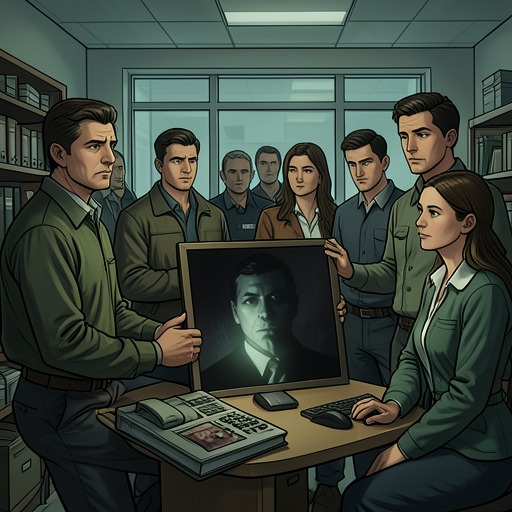
The Death of a Man at the Workplace
I'm Thinking of Ending ThingsThe Death of a Man at the Workplace is initially presented as a communal mystery: a man has died in a place where other people worked, yet those around him can only assemble fragments about what happened. The closed closet containing his body becomes the starkest fact in a cloud of speculation. Much later, The narrator recognizes that the man was Jake, turning the conversations about an unnamed death into a belated account of Jake’s suicide and the isolation surrounding it.
Background and Immediate Shock
The first responses establish the death through its effect on people who knew of it rather than through a witnessed scene. One person cannot understand how something like this could happen; another says that nothing so horrible has happened in the area. Others describe a sleepless night, difficulty getting comfortable and eating, and a wife who nearly became sick on hearing the news. Their language conveys shock, but it does not explain what led to the death. The question of whether the man was depressed or ill remains unanswered, and the conversation stresses that an act of this kind could not have been done on a whim.
The news also interrupts ordinary life. At one dinner party, the call about the death ruins the evening for everyone present; the person who received it remembers every word of the call. Another person had been away when the news arrived and called immediately. These sharply specific recollections show how the death enters other people’s memories through the moment they learned of it. Their accounts preserve the shock of receiving the news, not a complete explanation of the dead man’s state of mind.
The Workplace and the Unsettled Evidence
Reports about the workplace provide clues but no settled reconstruction. Some rooms, people hear, were vandalized. A follow-up account specifies red paint on the floor and water damage, and mentions that a chain had been put on the door. The discussion asks why he died there, but the details do not yield an answer. They establish damage and a barrier, not who caused either or what purpose the chain served.
The man’s access to the building makes his presence possible even though he was not scheduled to be there: he had keys and could enter. Planned varnishing offers a possible explanation for a strong smell, but the work had taken place at the beginning of the holidays so that the varnish could dry. That timing complicates rather than resolves the speculation. A breathing apparatus, described as an old gas mask, was reportedly found near the body; nobody knows whether it still worked. The people discussing the death explicitly acknowledge that much of what happened inside remains unknown and that the person who could have explained it is gone.
The body’s location gives the reports their most concrete and disturbing image. It was found in a small closet, large enough for shirts, jackets, and boots, but not much else. The door was closed, and the body was crumpled inside. The cramped setting makes the death feel physically confined, while the closed door also limits what observers can know. The account supplies no confirmed cause of death, and the gas mask does not settle it. The closet therefore becomes both a literal place where the body was found and the boundary of the available explanation.
From Rumor to Recognition
At first, the people around the death speak as witnesses to its aftermath, not as people able to account for the dead man’s decisions. They ask whether he had coworkers and emphasize that he was not isolated at work in the simple sense: other people were around all the time. In their view, he could have reached out and talked to someone. Their grief and anger are joined to the painful conviction that the death did not have to happen this way. Yet physical proximity to coworkers is not the same as dependable connection, and the scene offers no evidence that anyone understood his needs or knew what he was planning.
The later recognition changes the identity of the dead man and the meaning of the earlier reports. In the school, The narrator understands that Jake had staged the pursuit by the supposed custodian to draw The narrator inside. Jake’s shoes, left in the locker room after he changed into rubber boots, confirm that the figure being followed was Jake himself. The man discussed as a dead workplace employee is thus not an unrelated figure: the story’s final recognition makes the death inseparable from Jake. What had circulated as rumor about a man with keys, a workplace, and a closed closet becomes part of the narrator’s recognition of Jake’s role in the school events.
Isolation and the Meaning of the Death
The recognition also overturns the account that Jake’s brother was the troubled family member. The narrator concludes that the story about the brother was made up: there was no brother, though there should have been. Jake’s parents, whose approval and pleasure at the visit had helped shape the earlier account of Jake, are also understood to have died long ago. The apparent family and its troubled member had offered an explanation for distress that the later revelation withdraws. The death is therefore surrounded not just by missing physical evidence, but by a personal history whose apparent facts cannot be trusted.
The story sets the workplace conversations’ bewilderment against its final emphasis on the conditions of enduring life. It rejects the easy inference that having coworkers nearby means a person is not alone. The narrator reflects that endurance depends on closeness with others, and that without such connection life becomes a struggle simply to keep going. This does not provide a single medical explanation for Jake’s death; instead, it exposes the distance between the onlookers’ belief that he could have asked for help and the narrator’s later recognition that help never came. The unanswered questions surrounding the closet, the old gas mask, and the damaged rooms remain unresolved, while the identity of the dead man and the depth of his isolation become the story’s most consequential disclosures.