The Narrator Confronts the Caller
I'm Thinking of Ending ThingsThe Narrator Confronts the Caller after repeated calls from her own number become too frightening and personal to dismiss. She answers intending to make the calls stop, but the brief exchange reverses the apparent direction of the pursuit: when she asks why he is calling, The Caller replies that she called him. The scene ends not with an explanation but with The narrator hanging up, shaken and unsure what to make of the answer.
Escalation Before the Answer
The confrontation follows a pattern of calls that has already altered The narrator’s sense of safety. The Caller often calls in the middle of the night, and missed calls have appeared around 3:00 a.m.; each one displays The narrator’s own number. On one occasion, while she and Jake are watching a movie in bed, she silently hands Jake the phone. He answers, describes the caller as an old woman who dialed the wrong number, and seems unconcerned. The pair return to the movie, but The narrator does not sleep well that night. The contrast is important: the same call that Jake can treat as an ordinary mistake continues to trouble her.
The calls also bring consequences beyond lost sleep. The narrator reports nightmares and waking in a panic, feeling that someone is in her apartment, close by and watching. For a few seconds she cannot move; when she fully wakes, she goes to the bathroom, runs the sink, and finds her heart pounding and her clothes soaked with sweat. These episodes make the calls feel present even when no conversation is taking place. One night The Caller calls twelve times while she sleeps and leaves no message. The number of missed calls gives the silence its own pressure: there is no explanation to answer, only repeated evidence that the contact has continued.
Immediately before deciding to answer, The narrator receives a message that makes the intrusion more intimate. The Caller says he knows what she looks like and names her feet, hands, skin, head, hair, and heart; he also tells her she should not bite her nails. The message moves from the fact of being called to the disturbing suggestion of being known and watched. The narrator’s nail biting is longstanding, dating to fifth grade, a detail that makes the comment feel specific even as she later dismisses the connection as a fluke.
The Exchange
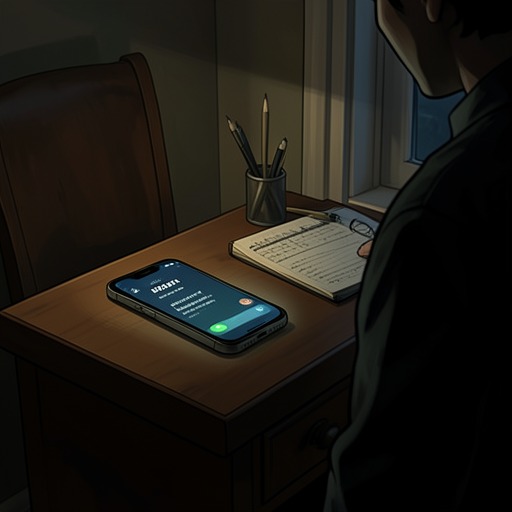
The narrator resolves to answer the next call and tell The Caller to stop, even if he says nothing in return. The decision is modest but deliberate: rather than waiting for the calls to end, she intends to address the person making them. When the phone rings, she asks, “Why are you calling me? How did you get my number? You can’t keep doing this,” and the narration makes clear that she is both angry and scared.
Her questions lay out the explanation she expects to need: The Caller is contacting her, he has somehow obtained her number, and the repeated calls must be stopped. Yet she is already less certain that this is random. She thinks it no longer feels like an accidental dial, believes it will not stop on its own, and wonders what The Caller wants from her and why he has chosen her. Those are her conclusions and fears, not answers supplied by the scene. The confrontation gives her a chance to demand an explanation, but it does not establish The Caller’s motive or how the calls are occurring.
The reply is abrupt: “This is about you. I can’t help you!” The narrator is yelling when she hears it. The Caller’s wording is both personal and unhelpful: he says the matter concerns her, but says he cannot help. The exchange then turns on a short correction. When she responds, “What?” The Caller says, “But you called me.” In a conversation that began with her asking why he keeps calling, this answer changes the apparent roles of pursuer and recipient without clarifying what has happened.
After the Call
The narrator hangs up and throws down her phone. Her chest is heaving. The physical reaction records the cost of the encounter more directly than any explanation could: answering has not settled the fear, and the unexpected reply leaves her with no stable account of who initiated the contact. The call ends, but the central uncertainty remains active.
Afterward, The narrator acknowledges the coincidence between The Caller’s remark about her nails and a habit she has had since childhood. She knows she has bitten her nails since fifth grade and calls the apparent connection a stupid fluke. That qualification matters. The comment has felt unnervingly specific, but she does not treat it as proof that The Caller knows her history. The scene holds those responses together: the fear produced by apparent familiarity and the attempt to explain that familiarity away.
Reversal and Significance
The confrontation is structured around an expectation and its reversal. The narrator answers in order to tell The Caller to stop; instead, he says that she called him. His response does not verify that she did, and the scene offers no independent confirmation of his claim. It does, however, unsettle the narrator’s understanding of the repeated calls. The contact can no longer be described within the conversation as a simple one-way pursuit without accounting for The Caller’s contradictory assertion.
The gap between what each speaker says also makes the exchange more disturbing than a direct threat would be. The narrator asks for the cause of the calls and a way to end them. The Caller answers with statements about her and an inversion of responsibility, leaving both requests unresolved. The brief turn-taking gives the caller the last word, while the narrator’s hang-up ends the conversation without resolving its meaning. In the larger pattern of missed calls from her own number, the exchange sharpens rather than solves the mystery: the number already makes the calls seem to come from her, and now The Caller claims that she initiated them.
The event’s decisive consequence is therefore interpretive, not explanatory. The narrator acts to regain control by answering, but the answer gives her no reliable account of the situation. Her anger, fear, physical agitation, and later insistence that the nail detail was a fluke show her moving between alarm and self-correction. The confrontation leaves the caller’s identity, access, and motive unknown while making the caller’s central claim impossible for her to ignore.