The Stranger Begins Calling Repeatedly
I'm Thinking of Ending ThingsThe Stranger Begins Calling Repeatedly turns an apparently ordinary wrong number into an intimate, unresolved threat: the Caller repeatedly reaches the narrator from the narrator’s own number, and his messages culminate in knowledge of the narrator’s body. What begins as a small interruption to sleep becomes a secret the narrator keeps from Jake, a mounting source of fear, and finally a confrontation that reverses the apparent direction of the calls.
The First Call and the Wrong Number
The first call comes on the same night the narrator meets Jake at the Pub. It wakes the narrator from deep sleep, but at first the explanation seems simple: it is a wrong number, an unusual occurrence but not, by itself, a reason for alarm. The Caller’s voice is the one detail that resists that explanation. Its strained timbre and subdued, gradual delivery sound strange enough to linger in the narrator’s memory, although the narrator initially forgets the call after explaining the mistake.
The Caller is heard as a man, at least middle-aged and probably older, yet his voice has a distinctly feminine quality, as if he were using a flatter, higher-pitched, more delicate intonation. The sound is unpleasantly distorted and unfamiliar; the narrator cannot identify it as belonging to anyone known. After the narrator says it must be a wrong number, the Caller answers, “I’m sorry,” pauses briefly, and hangs up. That brief exchange gives the first call a recognizable social shape—mistake, apology, ending—even as the voice makes the encounter difficult to dismiss entirely.
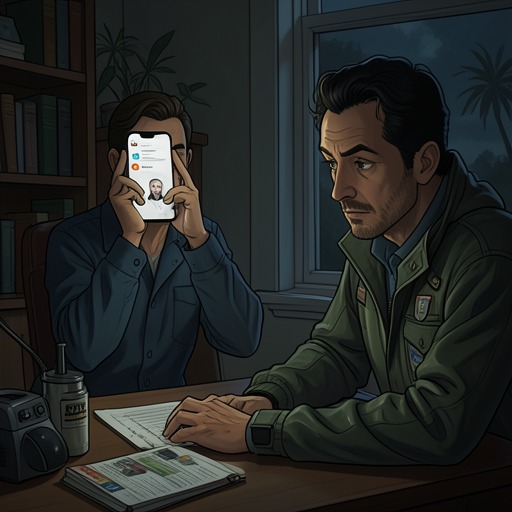
The timing places this intrusion beside the beginning of the narrator’s relationship with Jake. The narrator has already noticed how many small things can be learned about someone over a few weeks, while acknowledging how much remains unknown between them. The Caller is one such withheld fact: the narrator does not tell Jake when the calls begin. Later, the narrator recognizes that this silence was a mistake, but at the time the incident does not yet seem significant enough to share.
Repetition and the Own-Number Mystery
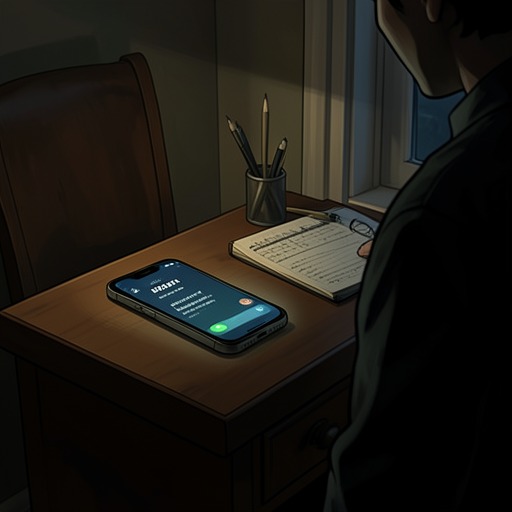
The next day, the narrator finds two missed calls, both received during the night. The listed number matches the number from the supposed wrong-number call, but the discovery that makes the calls inexplicable is that the number is the narrator’s own. The narrator checks the missed-calls list again, initially suspecting an error and nearly failing to recognize the number, then confirms that the calls are indeed listed as incoming. The screen supplies a concrete fact without an explanation: the Caller has apparently called from the very number he reached.
Three or four days later, the Caller leaves his first voice message. The narrator saves it, and keeps all seven messages that eventually accumulate. That preservation has no settled purpose. The narrator may be keeping them in case of telling Jake, but does not do so; the recordings become both a record of the calls and evidence of a secret the narrator continues to carry alone. The calls usually arrive in the middle of the night, often around 3:00 a.m., when the narrator is asleep and discovers them afterward.
The messages do not present themselves as straightforward threats. The Caller’s voice and words are not obviously aggressive, and the narrator hears sadness in them, perhaps frustration too. Their language seems nonsensical without quite becoming babble; the narrator cannot determine what it means. What can be determined is their exact repetition: the messages are the same word for word. Repetition offers no clarification, only a growing insistence. The narrator listens to the first message over and over, hoping to detect something familiar in the voice, but cannot.
The Message Changes
The pattern breaks when a later message repeats the familiar words but adds something at the end. The narrator describes this as the worst message and the point at which the calls have gone too far. Its new ending changes the meaning of the preceding repetitions: what could be treated as strange but contained now feels directed at the narrator personally. The narrator cannot sleep that night and feels frightened, foolish for not having stopped the calls earlier, and regretful about not telling Jake. The delayed disclosure matters because the narrator had already kept the recordings partly in the hope of eventually sharing them.
The added words claim intimate knowledge: “Now I’m going to say something that will upset you: I know what you look like. I know your feet and hands and your skin. I know your head and your hair and your heart. You shouldn’t bite your nails.” The sequence moves from a general assertion of recognition to a catalogue of bodily details, then ends on the familiar, specific habit of nail-biting. Its force lies not only in what the Caller claims to know but in the fact that the message delivers this claim after repeating the same words as before. The call has acquired a new ending, and with it the narrator’s sense that the Caller might know more than a stranger should.
The Confrontation
After hearing the altered message, the narrator decides to answer the next call and tell the Caller to stop. The decision is practical but uncertain: even if the Caller does not respond, saying it might be enough. When the phone rings, the narrator asks how the Caller got the number and why he keeps calling. Anger accompanies fear. The narrator no longer experiences the calls as a random person dialing without purpose, and wonders what the Caller wants and why the calls are directed at this particular recipient.
The narrator raises their voice and insists that the Caller is the one who called. His reply overturns that assumption: “But you called me,” he says. The narrator hangs up and throws the phone down, chest heaving. The exchange resolves neither the source of the calls nor the Caller’s meaning; instead, it introduces a contradiction at the center of their contact. The narrator has received the calls and confronted the person making them, yet the Caller identifies the narrator as the initiator.
Narrative Significance
The event develops through a change in how the same evidence is read. A single apology permits the wrong-number explanation; the calls from the narrator’s own number undermine it; the repeated messages prolong uncertainty; and the altered ending makes the threat feel personal. The final reversal does not explain the impossible-looking caller identification. It makes the uncertainty reciprocal, leaving the narrator and reader with incompatible accounts of who called whom.
The narrator’s handling of the calls also gives the episode a private, cumulative structure. Missed calls appear while the narrator sleeps; recordings preserve a voice that cannot be recognized; and the decision to keep the messages sits uneasily beside the decision not to tell Jake. By the time the narrator answers, the accumulated secrecy has become part of the fear. The confrontation produces no clear answer or reassurance: it ends with a physical reaction, a discarded phone, and the Caller’s claim that the narrator began the exchange.