The motif of being watched
I'm Thinking of Ending ThingsThe motif of being watched turns an uncertain childhood sighting into a recurring structure of fear. Across The narrator’s memories, night-time panic, and a later encounter at the Rural High School, the watcher is defined less by what can be verified than by the disturbing sense of being seen. The figure vanishes; the pressure of its gaze does not.
The childhood memory and the first watcher
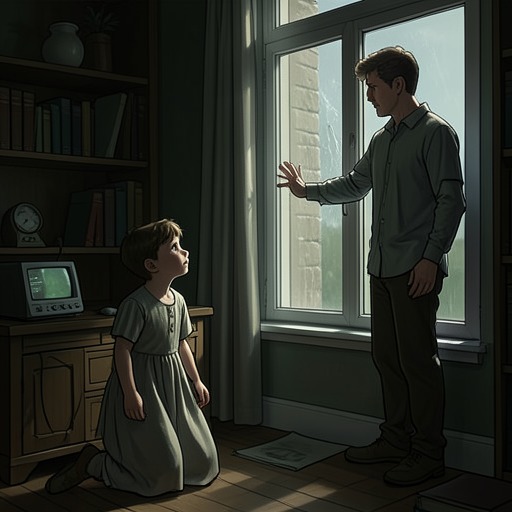
The motif takes shape in a memory from when The narrator was about six or seven. One night, The narrator woke unusually abruptly in a quiet room at the back of the house, the only ground-floor bedroom. A fast-spinning ceiling fan provided the room’s only clearly heard sound. Outside the relatively small window stood a man whose face and eyes were above the frame. The narrator could make out only part of his torso, but remembered his height and thinness, his slightly swaying body, and his hands rubbing together as if to warm them. A worn black belt hung loose at the front, its excess length resembling a tail.
The details are vivid, but the memory is also described as nebulous and patchy. That tension matters: The narrator does not present a complete account that settles what happened. Instead, particular images survive with unusual clarity, while the event as a whole remains difficult to interpret. The man stands close to the window for what may have been many minutes or as long as an hour. Soft music eventually becomes audible from outside, though The narrator cannot tell whether it was recorded or hummed. Such uncertain duration and sound make the scene resistant to a firm explanation without diminishing its emotional reality.
The decisive change occurs when the man makes a wave-like gesture. Until then, The narrator watches him without moving; after the gesture, the scene acquires what The narrator remembers as malice. It seems to promise that solitude is impossible and that the man will return. The narrator shuts their eyes rather than calling out, falls asleep, and finds the man gone in the morning. The expected return never happens at that window. Yet the gesture gives the encounter a continuing force: absence ends the sighting, not the sense of threat.
Memory, uncertainty, and persistent fear
The narrator recalls the incident only rarely, and cannot explain why it returns on the night the memory first comes to mind. Retelling is not neutral: each recollection seems to make the event worse and more sinister, leading The narrator to wonder whether memory is enlarging the threat. At the same time, the fear remains compelling. The narrator describes waking alone at night as frightening and insists that the remembered feeling, like the visual details, still feels real. The motif therefore holds two possibilities in suspension: an external presence may have been there, and repeated remembrance may alter the shape of what was seen.
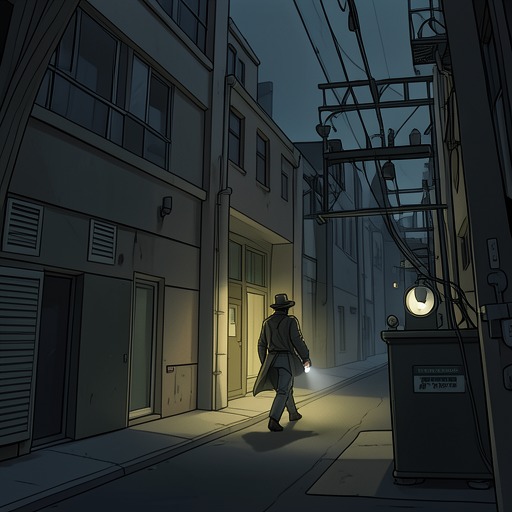
The man’s absence from the original window does not stop The narrator from sensing that he remains nearby. At times, usually while passing a window at night, The narrator thinks they see a tall man sitting outside on a bench, legs crossed and looking their way. These appearances are infrequent, and distance makes it difficult to see his face or know whether he is actually looking. The figure is not described doing anything threatening: he is simply there, sitting still, neither reading nor talking. That lack of an obvious action becomes part of the menace. The narrator cannot identify a reason for his presence or do anything about it, while also acknowledging that the sightings may be in their own head.
The motif also takes bodily form in later night-time episodes. After The Caller begins calling, sometimes around 3:00 a.m. and always from The narrator’s own number, The narrator has frightening dreams and wakes twice in a panic with the feeling that someone is standing close by in the corner of Narrator’s Apartment. For a few seconds, The narrator cannot move; after about a minute, full wakefulness returns. The surrounding quiet makes the running sink sound unusually loud, while a pounding heart and heavy sweating carry the fear into the body. On one occasion, the sweat is so extensive that The narrator changes pajamas. The calls and these episodes occur in the same period, but the account does not establish that the Caller and the watcher are the same presence. Their connection is instead a recurrence of the same unnerving condition: a private space no longer feels securely private.
The figure at the Rural High School
A later scene shifts the motif from childhood recollection and solitary panic to a shared setting. In a car near the Rural High School, Jake says that he saw a man standing at a window, staring directly at the car and its occupants. Jake insists the man could see them and describes him as enjoying the act of watching. The narrator turns toward the windows but sees no one. This difference in perception leaves the report unresolved rather than confirming it.
The narrator tries to calm Jake by proposing that the figure may have been a bored, older janitor who had never seen anyone at the Rural High School so late. The explanation gives the apparent watcher an ordinary possible identity, but does not remove the unease: Jake has already called the encounter wrong and says the man was staring at them. As in the childhood memory, a window frames the encounter, and the uncertainty about what the observer can see is central to its effect. Here, however, Jake is the one who reports being watched, while The narrator occupies the position of the person who cannot verify the figure.
Narrative significance
Across these episodes, watching is not simply a matter of a visible person looking at someone else. It is an unstable relation between an observer, a possible observer, and the person who feels observed. The childhood man’s face is hidden; the possible bench-sitter is too distant to identify; the figure at the Rural High School is visible to Jake but absent from The narrator’s view; and the presence felt during a night-time panic cannot be checked while The narrator is unable to move. Each scene limits what can be known while making the sensation of exposure difficult to dismiss.
The repeated windows and thresholds sharpen that instability. They divide an interior that ought to offer privacy from an exterior where a watcher might stand, but they do not provide certainty about who is looking or what that person can see. The childhood wave intensifies the fear by seeming to turn observation into a promise of continued presence. Later, even without a confirmed return to that window, The narrator feels that the man is always there. The motif thus gives uncertainty a recurring form: the figure may vanish, appear only in memory, or go unseen by someone else, while the experience of being watched continues to shape how safety and solitude feel.