The narrator watches the school surveillance recording
I'm Thinking of Ending ThingsThe narrator watches the school surveillance recording at a moment when objects in the room have already begun to unsettle her: a child’s shirt she recognizes as her own, an old video camera, and a television connected to it. Playback turns these things into parts of a single disturbing sequence. The camera appears to have recorded the room she occupies, then carried its unseen operator through the school to a window overlooking the old pickup. Its final image seems to show Jake, but never clearly enough to settle who is in the truck.
The Room and Its Objects
The recording follows the narrator’s discovery of a small shirt on a desk. At first she takes the soft, rumpled cloth for a rag; unfolded, it proves to be a child’s light-blue shirt with white polka dots. One sleeve is ripped, and a tiny paint stain marks its back. The details make the object unmistakable to her: she had the same shirt when she was a child. She concludes that this is her shirt, though she cannot explain how it has come to be in the room.
A small, old video camera sits on the other side of the desk, attached to the back of a television by two cables. The narrator turns on the television and sees static. She wants to leave and go home, and calls for Jake, but remains long enough to try the play button. The decision shifts the camera from an inert object into the means by which the room presents itself back to her. What seemed like a private discovery now has a recorded counterpart.
Playback in the Same Room
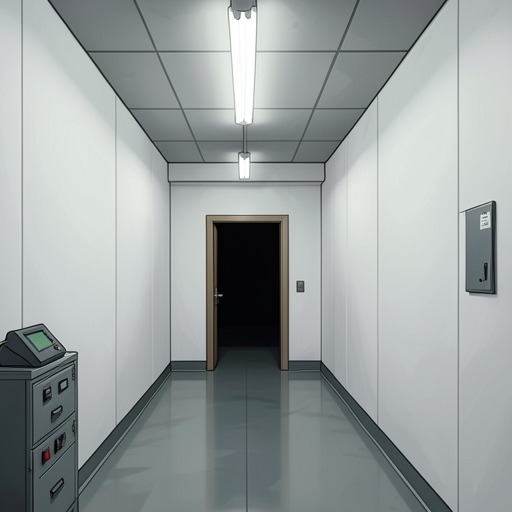
The image first shows a room and a wall. The narrator hears a sound like humming, then breathing, and recognizes the setting as the room where she is standing: the wall, photographs, and desk match what she can see around her. This correspondence gives the footage an immediate, unnerving intimacy. The television is not displaying an unrelated place; its image reproduces the narrator’s present surroundings, though the recording’s time and the identity of the person behind the camera remain unclear.
The picture moves down toward the floor and then out through the door. On the soundtrack, the filmer’s steps are slow and deliberate, like rubber boots on tile. The recording gives the unseen person a presence through pace and sound without showing who is walking. The narrator, watching from the recorded room, can follow the camera’s movement but cannot identify its operator or determine what the person intended. The methodical progress makes the playback feel less like a random fragment than a purposeful route, while withholding the explanation that might make that purpose legible.
Through the School to the Windows
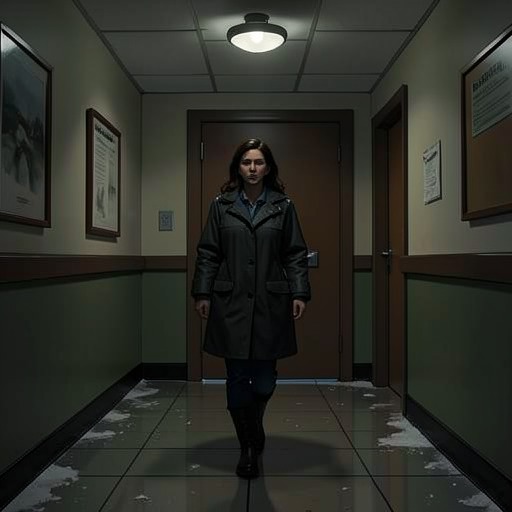
The camera enters a large room that appears to be the school library. It passes straight through rows of communal desks and between stacks and shelves of books, heading toward the windows at the back. These windows are long and fitted with horizontal blinds running from floor to ceiling. The camera stops there and stays still, continuing to record.
A hand, or something the narrator cannot identify, moves one blind slightly to the left; the slats jingle. The camera then tilts up to look outside. This small adjustment changes the recording’s position from movement through school corridors and rooms to observation from a concealed vantage. The footage does not establish who makes the gesture, but it shows that someone can control the view and choose what to watch. When the camera looks out, the vehicle it finds is the old pickup parked behind the school.
The Uncertain Figure in the Truck
The shot zooms toward the pickup and becomes shakier and less clear. Someone is seated in the driver’s seat. The narrator thinks the person almost looks like Jake, rejects the identification, then admits that the figure really does resemble him. The recording stops before she can resolve the likeness. Its abrupt return to loud, fitful static startles her, and she jumps.
The image offers a possible connection between Jake and the truck, not confirmation. That uncertainty matters: the narrator has an apparent clue, but the poor quality of the zoom and the sudden end prevent it from becoming reliable knowledge. The sequence has moved from an object she recognizes from childhood to a figure she may recognize in the present, linking intimate familiarity with a failure of certainty. After the static interrupts the scene, the narrator decides that she has to get out immediately. The recording therefore does more than show a route through the school: it changes the room from a place where she is examining troubling objects into a place from which she urgently wants to escape.