The narrator’s entanglement with the caller
I'm Thinking of Ending ThingsThe narrator’s entanglement with the caller turns an apparently ordinary wrong number into an intimate, unresolved intrusion: The Caller repeatedly contacts the narrator from the narrator’s own number, leaves messages that seem directed at the narrator, and provides no explanation that would make the pattern intelligible. The calls unsettle the narrator’s sleep and complicate the developing relationship with Jake, because the narrator keeps the calls secret even as they become harder to dismiss.
The First Calls and the Unexplained Number
The Caller first reaches the narrator on the same night the narrator meets Jake at the Pub. At first, the narrator treats the call as an ordinary mistake. The Caller sounds like an unfamiliar, older man, though his voice has a feminine-sounding quality; after the narrator explains that the number must be wrong, The Caller apologizes and ends the call. The narrator initially forgets the exchange, then listens to the first message repeatedly in an effort to recognize the voice. No familiarity emerges.
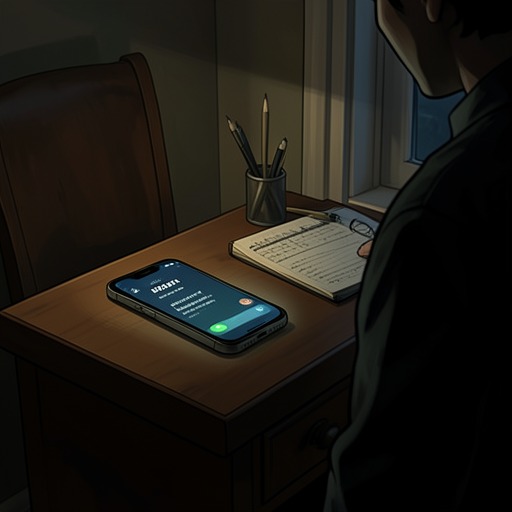
The next day, the narrator finds two missed calls from the same number. The unsettling detail is that the displayed number is the narrator’s own. The narrator checks the missed-call list again, initially supposing there has been an error, but confirms that the calls appear there. The text establishes the anomaly without offering a technical explanation for it, leaving the narrator with evidence of repeated contact but no account of how it is happening.
Several days later, The Caller leaves the first voice message. The narrator keeps that message and the later ones, eventually noting that there are seven. The messages are not straightforward threats: the narrator hears sadness and perhaps frustration in them, while finding their words cryptic rather than meaningless. They repeat word for word. The messages therefore occupy an unsettling middle ground: persistent and personal, yet not openly violent or easy to interpret.
Repetition, Secrecy, and Fear
The calls recur in the middle of the night, often around 3:00 a.m., and continue to appear as calls from the narrator’s number. On one night, The Caller rings twelve times without leaving a message. The narrator recognizes that most people might take action after such a sequence, but cannot identify a clear course of action: The Caller has not threatened harm, and the narrator does not see a basis for calling the police. When the narrator tries to answer, The Caller hangs up rather than converse. The Caller’s preference for leaving the same cryptic message makes contact feel both insistently directed at the narrator and resistant to any ordinary exchange.
The pattern changes the narrator’s experience of being alone. Since the calls began, the narrator has had frightening dreams and twice awakened in a panic, unable to move at first and feeling that someone is present in the apartment. After fully waking, the narrator goes to the bathroom, runs water in the unusually quiet apartment, and finds the fear accompanied by a pounding heart and heavy sweating. The narrator describes being more on edge than usual. These episodes do not explain who is calling; instead, they show the calls’ consequence spreading beyond the phone into sleep and the narrator’s sense of safety at home.
The narrator does not tell Jake when the calls begin, later recognizing that this would have been the time to tell him or someone else. During a movie in bed, the narrator sees a call from the narrator’s own number, pretends to be chewing, and hands the phone to Jake. Jake answers and is told that an old woman has called the wrong number; he seems unconcerned, and the movie continues. The narrator sleeps poorly that night. The incident establishes the contrast between Jake’s limited, misleading account of the call and the narrator’s private knowledge of the repeated pattern.
The Message Becomes Personal
The narrator’s choice to keep the messages also preserves the possibility of telling Jake later. That possibility grows more difficult as the silence continues: disclosure would require not only explaining The Caller, but admitting that the narrator has been lying about the calls. When the phone rings during time spent with Jake, the narrator describes the caller as a friend and later as a woman, while privately resolving to deal with the matter and tell someone when they return. The narrator is unsure why The Caller is doing this, but can no longer treat the secret as separate from the relationship with Jake.
The decisive change comes when the newest message adds a final statement to the otherwise repeated message. The Caller claims knowledge of the narrator’s appearance and hands, feet, skin, head, hair, and heart, and comments on the narrator’s nail-biting. The narrator regards this addition as the worst and most frightening message yet, cannot sleep that night, and feels foolish for not stopping the calls sooner or telling Jake. The information is presented as The Caller’s claim, not as independent proof of how The Caller obtained it; its force lies in turning an obscure sequence of calls into an explicitly personal intrusion.
Confrontation and Unresolved Entanglement
After the new message, the narrator decides to answer the next call and tell The Caller to stop. When the phone rings, the narrator asks why The Caller is calling, how the number was obtained, and insists that the calls cannot continue. The narrator is angry and frightened, no longer able to regard the contact as a random dialing mistake. The narrator also wonders what The Caller wants and why the narrator has been singled out, but receives no explanation.
The exchange deepens rather than resolves the mystery. The narrator yells that the situation concerns The Caller and that the narrator cannot help, while The Caller points out that the narrator called. This reversal unsettles the expected roles of pursuer and recipient: The Caller has repeatedly initiated contact, yet answers the narrator’s attempt to confront him by attributing the call to the narrator. The evidence does not clarify what The Caller means or establish the identity behind the voice.
Later, the calls intrude again while Jake and the narrator are together. The phone rings from the narrator’s number, and Jake suggests answering. The narrator hopes to seem casual, dismisses the call, and describes the caller as a friend. Jake observes that two calls in a row, without even a text, seem important. The narrator postpones the truth until they return, while acknowledging that the concealment itself must also be confessed. The relationship with The Caller thus remains unresolved in the available account: the repeated calls have become personal, fear has intensified, and the narrator has challenged The Caller directly, but neither the calls’ origin nor their purpose is settled.