The persistence and spread of fear
I'm Thinking of Ending ThingsThe persistence and spread of fear is presented as an accumulating condition that alters how the narrator experiences time, space, and safety. In the school, fear does not pass when its immediate cause is out of sight: it remains through repeated attempts to move, intensifies in isolation, and narrows the possibilities the narrator can imagine. The idea is crystallized in the phrase Fear is a rash, an image for an emotion that can linger and extend rather than simply flare and disappear.
Fear as a sustained condition
The narrator contrasts the present ordeal with the way people encounter other people’s suffering from a distance. Stories of stalking, captivity, and terror may provoke shock and sympathy, but the possibility seems easier to put aside when it is happening to someone else. That distinction collapses when the narrator becomes the target. Fear is no longer an abstract awareness of what people can do; it is an immediate condition from which there seems to be no reliable distance.
The narrator’s response is not a single burst of alarm. Even after standing and trying to continue, the narrator remains afraid and unsure how to interpret what is happening. The account emphasizes being watched, alone, and confined, while the narrator wonders how the situation began and why it has happened to her. Such questions do not produce an explanation that can restore control. Instead, their recurrence registers the distance between wanting a reason and having no dependable way to establish one.
Confinement and escalation
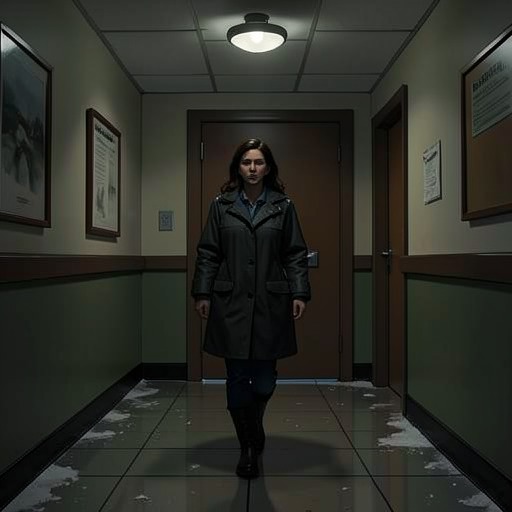
The school gives fear a physical setting that repeatedly frustrates escape. The narrator leaves a hiding place and tries doors, but they are locked. The corridors seem to repeat and fold back on themselves; the narrator has walked and crawled through the building for what feels like an immeasurable time. Movement continues, yet it does not create meaningful progress. The building’s familiar passages become part of the threat because they offer no clear route out.
That failure of movement is accompanied by a dwindling sense of practical possibility. The narrator looks through empty garbage cans for something useful, but finds only clean bags. Later, even the gym, considered as a possible route to an emergency exit, offers no assured escape. The narrator sits on its hard floor and concludes that there is no way out of the gym or the school. These changes matter: fear is intensified not only by the perceived pursuer, but by repeated evidence that the environment cannot be made to serve as refuge.
The writing on the floor sharpens the narrator’s sense of being pursued. It appears to address the narrator and refer to a question already occupying her thoughts. The narrator cannot understand how the writer could know what she has been thinking, and insists that another person cannot fully know someone else’s thoughts. This unresolved contradiction makes isolation more acute: the message seems intimate and threatening at once, while its apparent knowledge remains difficult to explain.
The fear of certainty
The narrator wishes the experience were supernatural, or otherwise less straightforwardly real. A ghost story would leave more room for doubt; the present situation, as the narrator understands it, involves a dangerous man in an empty school. The distinction is significant because uncertainty might provide a measure of distance, whereas the narrator’s belief in a real and immediate threat does not. The narrator also believes that the man has already done something to Jake, deepening the fear with concern for someone beyond herself.
The account stays close to the narrator’s perceptions rather than supplying an independent explanation for every sign. The writing, the apparent surveillance, and the belief that the man knows where the narrator will go are rendered as elements of an experience the narrator finds terrifying. This limited perspective sustains uncertainty about what can be known, but it does not make the fear feel less real to the person experiencing it. The narrator’s wish to wake from a nightmare instead emphasizes the failure of imagined alternatives to provide relief.
Repetition, memory, and persistence
The narrator describes fear and dread as emotions that may last and spread if they are not replaced by something else. The rash metaphor gives this claim a pattern: fear is not merely an event that occurs, but a condition that can extend beyond its first point of contact. The narrator’s report of walking and crawling around the school forever echoes that persistence in narrative form. Repeated movement and repeated questioning make time feel stalled rather than advancing toward safety.
Against this closed present, the narrator tries to picture a room elsewhere: a blue chair beside a bookshelf, a lamp, and blue shoes worn indoors. The remembered details offer something specific to attend to beyond the school. The narrator insists that the room still exists even when she is absent from it, using its continued existence as a point of orientation. Yet recollection does not open an exit or remove the threat. Its significance lies in the effort to hold onto a world beyond the immediate confinement while fear continues to occupy the present.