The tall man
I'm Thinking of Ending ThingsThe tall man is a figure The narrator remembers standing outside her childhood bedroom, too close to the window for his face to be seen. His stillness, a wavering gesture, and the possibility that he can see her turn an incomplete image into a lasting presence: although he disappears by morning, The narrator says the man is always there.
Identity and Appearance
The tall man first appears in a memory set in a bedroom at the back of an old house. It is the only bedroom on the ground floor, and its window is neither wide nor tall. The room’s ordinary nighttime sounds have fallen away: The narrator hears only an overhead fan spinning at high speed, its motor and blades making a steady, metronomic noise. Against that unusual quiet, the man outside becomes the scene’s central fact.
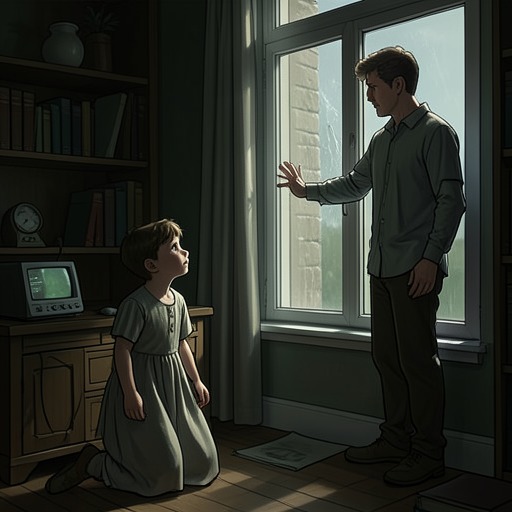
The window cuts off his face and most of his head. The narrator can see only part of his torso, yet remembers him vividly as exceptionally tall and very skinny. His worn black belt is fastened with its loose end hanging in front like a tail. His hands move against each other as if warming them, and his body sways slightly. These precise details make the figure sharply memorable even as his identity and expression remain unavailable.
The Window Encounter
The man stands directly outside the window while The narrator watches without moving. His posture suggests, to her, someone taking a break from physical work, but the scene provides no confirmation of who he is or why he is there. The uncertainty becomes more disturbing when she feels that he can see her despite his face and eyes being beyond the top of the window frame. Her perception exceeds what the visible evidence can explain: she cannot see his eyes, yet experiences herself as watched.
Soft music becomes audible from outside only after she has seen him. She cannot recall it clearly or determine whether it was recorded or hummed. The encounter stretches on for what may have been many minutes or as long as an hour, though even its duration is uncertain. The prolonged watching supplies no answer or action to break the impasse; the man stays in place, and The narrator remains alert and afraid.
At some point he raises a hand. The narrator cannot be sure that it is a wave rather than a movement that merely resembles one. What matters in the memory is its effect: the gesture seems malicious, as though it promises that she will never be entirely alone and that he will return. She closes her eyes, wants to call out but does not, and falls asleep. In the morning he is gone. The encounter is thus both visually specific and resistant to certainty: the gesture may not have been a wave, and the memory cannot settle whether the event was a dream.
Persistence and Later Sightings
The narrator expects the man to appear again at the bedroom window, but he does not return there. His absence from that particular place does not end his presence in her account. The fear remains, and she describes him as always there, a phrase that makes the lasting experience feel more certain than any single sighting.
At other times, usually at night, she thinks she sees him sitting outside her house on a bench. In these appearances he sits with his legs crossed, still and apparently looking her way. He is far enough off that she cannot make out his face or know for sure whether he is looking at her. The sightings are infrequent, and she remains unsure that the distant figure is the same man. Her aversion to seeing him, however, is unambiguous.
The later figure does nothing plainly threatening: he is not reading or talking, and the narrator notes that sitting on a bench is not in itself pernicious. His unsettling quality lies instead in unexplained presence and apparent attention. She can find nothing he is doing wrong, but cannot understand why he is there. The gap between harmless visible behavior and the fear it produces keeps the sightings unresolved rather than turning them into a confirmed pursuit.
Narrative Significance
The tall man’s force depends on the limits of what The narrator can establish. His face is cropped out; his eyes cannot be seen; the wave may only be a similar movement; the music has no identifiable source; and the later bench figure may be imagined. Yet the memory’s fear and visual details remain vivid to her. The account holds uncertainty and conviction together instead of resolving one into the other.
His appearance also reverses the expected relation between seeing and being seen. The narrator studies a figure whose features she cannot access, then feels that he can see her anyway. The bedroom window, meant to separate the private room from outside, becomes a boundary through which safety seems permeable. Later, the man’s possible presence beyond other windows extends that unease without supplying a new explanation. He is significant less as a character with a disclosed history than as the recurring shape of being watched: a presence that cannot be proved, dismissed, or confined to the first night.