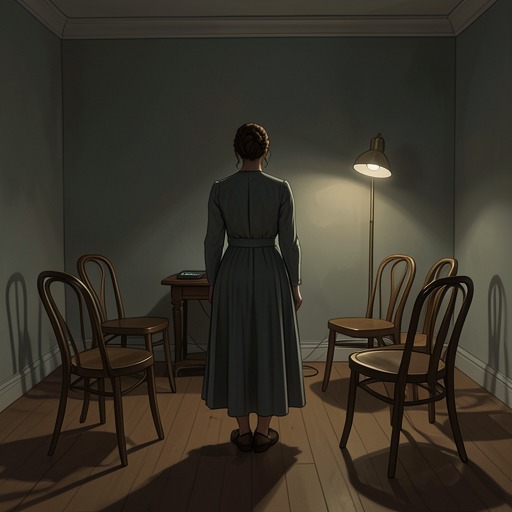
The tension between solitude and intimacy
I'm Thinking of Ending ThingsThe tension between solitude and intimacy is a central dilemma in the narrator’s reflections on her relationship with Jake: intimacy promises chosen closeness and the possibility of being deeply known, while solitude offers independence and a clearer encounter with the self. The conflict is not simply between romance and loneliness. It concerns what each way of living makes possible, what it demands, and whether the comforts of a relationship can justify the sacrifice of a life organized alone.
Independence and the appeal of being alone
The narrator suspects that many people marry or remain in unhappy relationships because they are uncomfortable being alone. From that perspective, coupling can become less a freely examined choice than a refuge from solitude. She considers what might be gained by keeping the routines each person already knows and by having many different relationships rather than exchanging them for one exclusive, enduring bond. She acknowledges that partnership has benefits, but doubts that another person’s company necessarily improves life or increases happiness. The question is not whether intimacy can bring pleasure; it is whether that pleasure makes partnership preferable to independence.
Solitude has a positive claim in this comparison. The narrator considers being alone closer to the truest version of the self, since another person’s presence and judgments can dilute the attention available for self-understanding. Friendships and family relationships matter, but she sees them as less binding than love; lovers need not be permanent for a person to have meaningful connections. In her reasoning, time alone is not merely the absence of a partner. It is a condition in which a person can focus on who they are without continually adjusting to another person. That ideal, however, remains in tension with her wish for a form of closeness that independence cannot provide.
What commitment promises
The narrator’s strongest argument for a lasting relationship is the prospect of being known. She imagines commitment as more than sexual partnership: its distinctive promise is that two people might come to understand each other with unusual depth, perhaps reaching a degree of knowledge that exceeds either person’s solitary self-understanding. Mutual reliance matters because the connection is chosen rather than supplied by biological kinship. For her, a relationship may feel real when someone previously unconnected can know another person in a way that once seemed impossible.
That hope makes intimacy valuable precisely because it is difficult to achieve. A shared life asks two people to live together, age and change together, encounter each other daily, and respond to each other’s needs and moods. The narrator sees this ongoing accommodation as a substantial sacrifice, not a natural or effortless state. Finding one person with whom to spend a lifetime seems improbable; the routines, needs, and changes of two lives must repeatedly be reconciled. Commitment therefore promises exceptional recognition while exposing its participants to an unusually sustained demand on their independence.
Small gestures and the weight of belief
A practical act complicates the narrator’s inclination to leave. When she has a bad headache, she asks Jake to bring painkillers and doubts he will remember. He does bring them, wrapped in a tissue. She does not tell him how much the care means to her, but the gesture makes her reconsider ending the relationship that night. Its significance lies less in the pills than in the attention implied by protecting them. A small act can alter the force of a larger conclusion without resolving the underlying doubts.
The narrator generalizes from this moment: small gestures can connect people and can make them feel better about themselves and one another. She compares such sustaining beliefs to religion—not as proof that lifelong partnership is an innate truth, but as a construct people may want to believe because it helps them understand life and offers comfort. The comparison preserves the uncertainty. The care Jake shows is real within the scene, but it does not establish that a lifelong couple is the right arrangement for everyone, or that one thoughtful action can settle the costs of shared life. Instead, the gesture shows why the decision is difficult: intimacy can become tangible in an ordinary act even when its larger promise remains uncertain.
An unresolved choice
The narrator’s reflections resist a verdict. She recognizes that people may choose partnership for many reasons, and that a chosen bond can offer a kind of knowledge unavailable through family ties. At the same time, she wonders whether being paired is worth giving up solitude, and whether she and Jake can sustain the daily work of sharing a life. Her recurring question about whether it is better to be paired or alone gathers these competing claims without making either one disappear.
The tension also shapes how she understands a relationship’s value. Being alone may support self-knowledge, but it cannot by itself provide the experience of being understood by someone who has deliberately come to know her. Partnership may offer that recognition, but it can also draw attention away from the self and require years of accommodation. The relationship’s small moments of care thus stand beside, rather than erase, the narrator’s doubts. The concept remains unresolved because intimacy and solitude answer different needs: neither the comfort of connection nor the freedom of independence can be treated as a complete substitute for the other.