Tinnitus
I'm Thinking of Ending ThingsTinnitus enters the story at the dinner table as a concrete but unsettling account of life with sound that will not stay in the background. Jake's mother describes buzzing in her ears and head, worsening hearing, and whispers that cannot be understood; her symptoms make sound an uncertain presence rather than a dependable means of communication. The narrative keeps her account distinct from its other mysterious noises, leaving the reader with an auditory motif, not a medical explanation for every sound.
Symptoms and Their Description
Jake's mother announces that she has been having problems with her ears, then names the condition as tinnitus. She describes a steady buzzing in her ears and in her head, present much of the time but not continuously. Her image of it as a background to life conveys both its persistence and its variation: the sound is not always at the forefront, but it remains liable to intrude.
The family has already considered a simple explanation. Jake's mother says that, at first, they thought the buzzing came from earwax, but that explanation proved insufficient. She adds that her hearing is generally getting worse and that the decline is related to the problem. The passage supplies no technical diagnosis beyond her use of the word tinnitus; its emphasis is on the sounds and changes she reports experiencing.
The account also includes what Jake's mother calls whispers. She says they are not voices like ordinary speech and do not say anything intelligible. Their presence therefore does not give her a message she can interpret: they are described as whispers, but not as understandable words. She says that this aspect of the condition is especially difficult at night, when she does not sleep much. The scene connects her hearing difficulties with disrupted rest without specifying a further cause or a treatment.
The Dinner-Table Disclosure
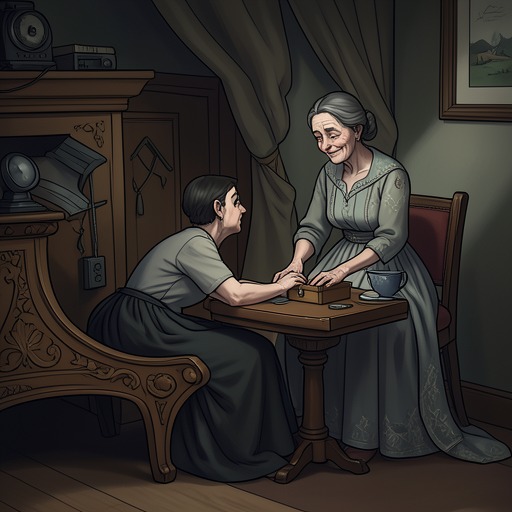
The symptoms emerge in conversation while the family is eating. Jake's mother looks directly at the narrator as she introduces the problem, smiling broadly; Jake's father responds that she has more than a problem. She places a hand on her husband's as she names tinnitus, and he later says that she asks him to repeat himself all the time. His remark makes the decline tangible within their everyday exchange: it affects not only what she hears but how the couple communicates.
The narrator turns to Jake for some sign of how to respond, first after hearing about the buzzing and then more insistently when Jake's mother mentions the whispers. Jake does not step in or explain. His silence leaves the narrator without a guide to the family’s way of discussing the symptoms, while his parents continue the conversation between themselves. Jake's father touches his wife's hand again and says the symptoms sound worse than they really are, a reassurance that sits beside the mother's own account of poor sleep and worsening hearing rather than replacing it.
A phone ringing interrupts the disclosure. The narrator's phone is in a purse beside the chair, and Jake's mother jumps when it rings; a message notification follows. The interruption shifts attention from the discussion but does not resolve it. The scene gives the audible disruption an immediate social consequence: the narrator is already uneasy about the incoming calls, and the ringtone cuts across a conversation about unwanted sounds.
Sound Beyond the Dinner Scene
Elsewhere, the book repeatedly makes sound difficult to classify, but it does not say that these sounds are caused by tinnitus. In a childhood recollection, the narrator hears faint music from outside after seeing a man at a window. The narrator cannot remember it clearly or determine whether it was recorded music or humming. Its uncertain source and timing resemble the book’s broader attention to unstable listening, but the recollection is not presented as Jake's mother's experience or as a symptom of her condition.
The same distinction matters when the narrator receives messages from The Caller. One contains running water; another includes more water, footsteps, what sounds like hinges, and a closing door. These noises are recorded and delivered by phone, whereas Jake's mother's buzzing and whispers are described as experiences of her hearing. The narrative places both kinds of sound in a world where listening can prompt fear or uncertainty, without equating a recorded message with tinnitus.
At school, the narrator hears an old country song over the public-address system: “Hey, Good Lookin’.” It is the same song that played on the car radio during the drive with Jake to the farm. It plays through once, pauses briefly, then starts again. Hidden behind a bench and unable to hold back tears, the narrator listens as the repetition continues. Here the source is identifiable, unlike the faint childhood music or the unintelligible whispers; repetition, rather than uncertain origin, gives the song its force.
Later Context and Narrative Significance
A later conversation gives related but separate information about Jake: he had cochlear implants, and his hearing had become pretty bad. This establishes hearing loss in Jake's history, but the account does not state that he had tinnitus. Keeping the two details distinct preserves the difference between Jake's reported hearing impairment and his mother's described buzzing, whispers, and worsening hearing.
Tinnitus contributes to the novel's attention to the limits of hearing and the uneasy space between sound and interpretation. Jake's mother distinguishes a steady buzz from the whispers she hears, while the surrounding narrative makes other sounds recur in forms that are faint, recorded, repeated, or menacing. The pattern invites comparison, not diagnosis: the book offers no claim that the different sounds share a cause. Instead, the dinner-table account grounds the motif in a specific person's daily experience, including the need for repeated speech and the difficulty of sleeping, while leaving the other sound events to retain their own contexts and uncertainties.