What are you waiting for
I'm Thinking of Ending ThingsWhat are you waiting for? is a question printed on a school dance banner that becomes one of the school’s most insistent refrains. First encountered as part of an ordinary invitation to gather, it later returns in capital letters and repeated without apparent end. The phrase’s movement from public cheerfulness to pressure mirrors the narrator’s passage through a school that is at once strangely empty and painfully familiar.
The Banner in the Science Wing
The phrase first appears when The narrator reaches what seems to be the science wing. Unsure whether this part of the school has been visited before, The narrator looks through doors at the lab stations. The corridor’s doors are heavier than those encountered elsewhere and painted sky blue; at its far end hangs a large, hand-painted advertisement for the winter formal. The banner promises dancing and gives a ticket price of $10 before asking, “What are you waiting for?”
Until this point, the school has offered few signs of ordinary student life. The narrator has searched clean, empty garbage cans for something useful, hoping to find anything that might help with escape. Against those vacant black bags, the banner is a sudden sign of a crowd: students will be together in the room, dancing. The question belongs to a familiar public invitation, aimed at prospective attendees rather than framed as private speech. Its placement makes an apparently ordinary school event feel startlingly vivid in a building where the students themselves have not been seen.
Invitation and Fear
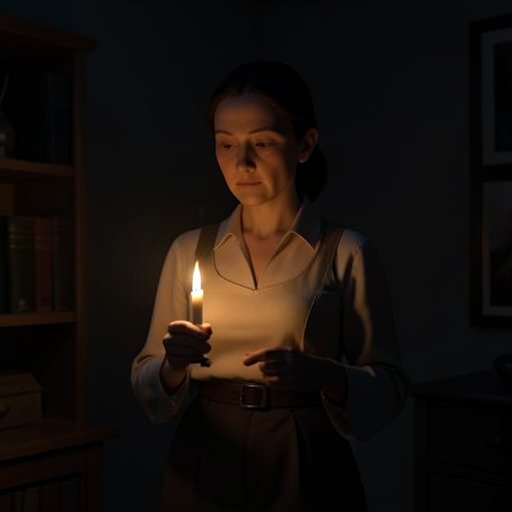
The banner’s promise of collective life sits beside immediate danger. The narrator hears what might be rubber boots and footsteps somewhere nearby, then becomes unable to move, overwhelmed by fear. The possibility that Jake is still in the school complicates that fear: if Jake is there too, The narrator would not be alone and might be safe. The dance invitation promises a room full of people; the corridor instead leaves The narrator listening for an approaching presence and unable to act.
In this setting, the question can carry more weight than its upbeat wording suggests. Its original context encourages movement toward a social event, but The narrator is frozen in place. The contrast does not establish that the banner is speaking directly to The narrator, or identify a speaker behind the later repetitions. It does, however, make the printed question available for a darker reading: it asks about delay and action at the same time that fear prevents movement.
From Slogan to Refrain
The phrase returns in capital letters, alongside the banner’s invitation to dance and its $10 ticket price. Then “WHAT ARE YOU WAITING FOR?” is repeated over and over. The shift in capitalization and sheer accumulation transform a short slogan into an extended textual refrain. What initially belonged to a painted advertisement now occupies the page as an insistence whose source is not specified.
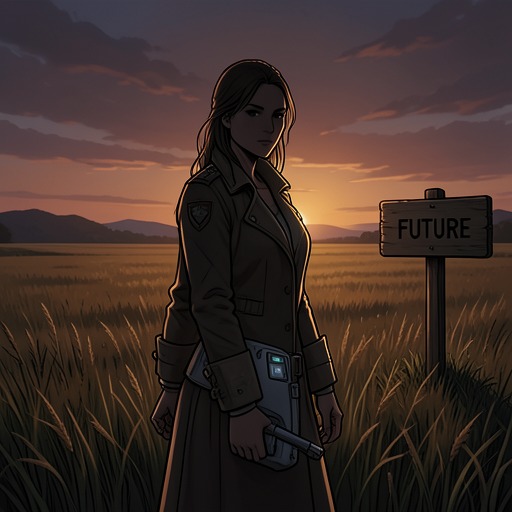
Repetition changes the question’s force without changing its words. On the banner, it is one line in a conventional appeal to attend a dance; in the later passage, it becomes difficult to treat as a passing detail. Its recurrence presses on the same uncertainty embedded in the original: whether waiting is a choice, an inability to act, or simply the condition The narrator is trapped in. The phrase supplies no answer and names no particular action. Instead, its persistence makes the interval before action feel longer, turning a familiar question into a measure of mounting pressure.
Return and Significance
After the refrain, the narration returns to the custodian’s room, describing that return as inevitable and as the only remaining option. The next account passes the woodworking and auto classrooms, the Dance Studio, Student Council, and the drama department. The rooms are not entered. The narrator says these corridors and floors have been traversed for years, and even the dust has become familiar. That accumulated familiarity contrasts with the banner’s first suggestion of an unseen student community: school spaces that might promise activity have become routes walked repeatedly, with doors left unopened.
The question’s recurrence therefore sits between an invitation to join others and the recognition of a narrowed path. The dance banner points toward people gathered in one room, while the final movement returns to a familiar room and familiar corridors without opening the other doors. The text does not resolve the question by naming a successful escape or a new destination. Its force comes instead from the reversal: a slogan about what might be done becomes an echo accompanying a return described as unavoidable.