Age-Sixteen First Transformation Rule
I'm the Werewolf in my ClassThe Age-Sixteen First Transformation Rule is the hereditary threshold governing Sebastian Wolfe’s emergence as a werewolf: at sixteen, the Wolfe family curse becomes physically active and initiates the first transformation. The rule is both a supernatural condition and a rite of passage, separating Sebastian’s former life as an apparently ordinary teenager from the unstable human-werewolf existence he must learn to control.
Definition and Family Knowledge
Sebastian’s parents explain that the Wolfe family curse is associated with a first transformation at sixteen. They had expected the possibility but delayed telling him, hoping that the curse might have skipped his generation or bypassed him altogether. Their tears and regret show that the rule is not treated as a curiosity within the family; it is an inherited danger whose arrival has been feared in advance.
The rule also carries a practical consequence. A first transformation is not presented as a controlled choice or a learned technique. Sebastian’s father warns that his initial changes will be unpredictable, although the family will help him learn control. The rule therefore marks the beginning of a period of vulnerability rather than the immediate acquisition of mastery.
Sebastian’s Sixteenth Birthday
The rule takes effect on Sebastian’s sixteenth birthday. His mother celebrates the occasion with chocolate chip pancakes and emphasizes his age, while his father watches him with an unsettling concern and asks how he feels. The apparently ordinary birthday scene becomes retrospectively charged: the family already knows that sixteen is the decisive age, but Sebastian does not yet understand why his father is studying him so carefully.
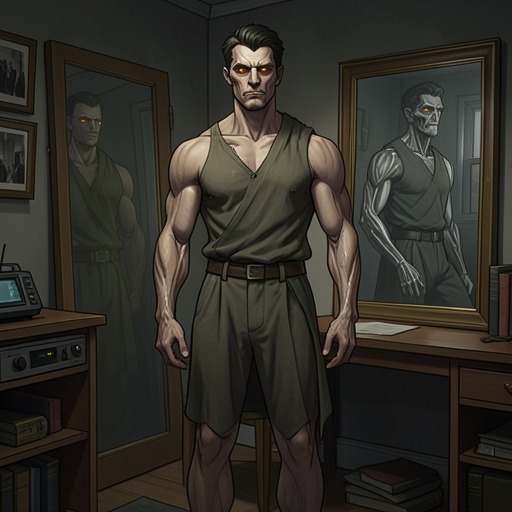
The first physical signs initially appear ambiguous. Sebastian has only recently begun growing facial hair, yet it is coming in faster than normal, and Sophia jokingly attributes his unusually hairy appearance to that change. This mundane explanation briefly disguises the supernatural one. The ordinary markers of puberty and the bodily signs of lycanthropy occupy the same surface, making the rule operate through a recognizable adolescent transition before revealing its monstrous dimension.
First Transformation
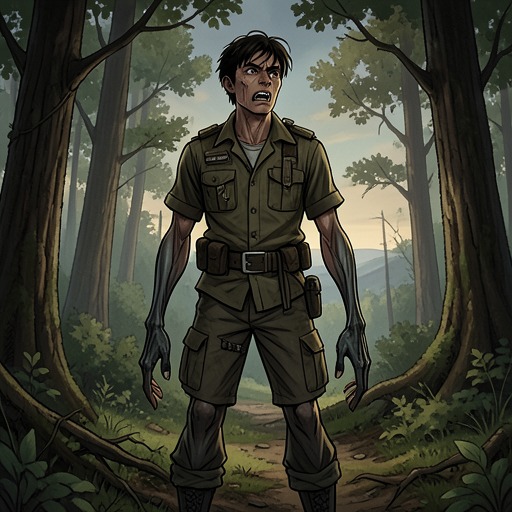
At school, Sebastian becomes nauseated and insists that he is fine even as his condition worsens. He escapes toward the woods behind the school, where his bones seem to shift, his skin crawls, and coarse dark hair begins sprouting from his hands. The transformation is experienced as bodily violation and disbelief before it becomes an expression of power; Sebastian rejects what is happening even while his body makes the rule undeniable.
The timing reinforces the rule’s connection with both age and lunar force. As the first bell rings, the full moon appears from behind a cloud, and Sebastian throws back his head to release a howl that is no longer human. His sixteenth birthday consequently becomes the exact point at which family inheritance, physical maturation, and the full moon converge. The event does not merely reveal that he is a werewolf; it changes the meaning of the day on which he believed he was simply growing older.
Disclosure and Adaptation
After the transformation, Sebastian’s parents connect the event to the family history and identify it as his first transformation. Their explanation gives a name and lineage to experiences that had previously seemed inexplicable, including the change in his room and the later episode in the woods. The rule turns isolated symptoms into evidence of a continuing family condition.
Sebastian immediately asks whether there are others like them. His parents confirm that other werewolf families exist but say that they keep to themselves for safety. This secrecy places the rule within a wider social system: turning sixteen does not simply make a young person physically different, but potentially brings him into a hidden network of families, dangers, and obligations.
The rule’s uncertainty is soon contrasted with the pack’s practices. On the night of the full moon, Sebastian follows the pull toward Crescent Hill Park, where Lily welcomes him to the pack and five other teenagers wait in the shadows. When Ethan and the others shift into wolves, Sebastian chooses to let the wolf inside him take over. His senses sharpen, and he can smell the others’ fear and excitement and hear their rapid heartbeats. The first transformation thus moves from involuntary crisis toward shared initiation, even though the initial change remains something he must learn to control.
Later Significance
The age-sixteen rule is the opening condition for Sebastian’s wider supernatural trajectory, but it does not define the limits of what he can become. Later, during the confrontation involving the artifact, the full moon, and the clock tower, Sebastian undergoes a transformation that is described as neither merely wolf nor merely human, but a synthesis of both. Ethan explains afterward that Sebastian is no longer shifting only between human and wolf and that the artifact appears to have unlocked abilities beyond what the pack believed possible.
That later development makes the first-transformation rule a beginning rather than a complete destiny. The rule explains when Sebastian enters werewolf life; it does not determine whether he will remain divided between his human and wolf selves, how he will relate to the pack, or what new form his powers may take. By the end, after the crisis and his recovery, Sebastian regards the future as uncertain but full of possibilities, and the feeling that he has come home gives the rule a final emotional counterpoint: the frightening threshold at sixteen ultimately leads toward belonging as well as danger.