Crescent Hill
I'm the Werewolf in my ClassCrescent Hill is the central setting of Sebastian Wolfe’s transformation, recruitment, and first major supernatural conflict. What begins as a familiar town of birthdays, school corridors, and ordinary friendships becomes a layered territory shaped by full-moon change, werewolf secrecy, pack belonging, and a centuries-old artifact hidden by the area’s first werewolf settlers. By the end of the story, Crescent Hill is no longer merely the place where Sebastian lives; it is the place where his divided identity is recognized and where danger, history, and belonging converge.
Definition and Setting
Crescent Hill is presented first through the routines of teenage life. Sebastian’s sixteenth birthday begins at home with his mother’s chocolate chip pancakes and her astonishment that he has reached sixteen, while his father watches him with an unexplained, uneasy expression. The town’s normality is reinforced at school, where Sebastian is expected to attend Algebra and explain away his physical distress as birthday jitters or a stomach ache. Yet this ordinary surface conceals a supernatural geography: woods lie behind the school, Crescent Hill Park serves as a meeting place for werewolves, and the old clock tower contains a hidden artifact connected to the town’s founders.
The setting therefore has two simultaneous identities. To Sebastian’s human acquaintances, Crescent Hill is a recognizable community of school, family, and friendship. To the werewolf groups who inhabit or enter it, it is a territory with boundaries, history, and strategic value. The contrast becomes visible when the rogues declare that they want territory in Crescent Hill and are searching for something specific hidden there. The town’s importance is not simply residential; its land preserves a legacy that can alter the balance of power in the wider werewolf world.
The Town and Sebastian’s First Transformation
Crescent Hill becomes the site of Sebastian’s first werewolf transformation on his sixteenth birthday. After experiencing nausea, burning in the back of his neck, blurred vision, and the sensation that his bones were shifting, he escapes toward the woods behind the school. There, with his skin crawling and coarse dark hair sprouting from his hands, he confronts the fact that his body is changing into something he does not understand. When the full moon appears from behind a cloud and the first school bell rings in the distance, he throws back his head and howls in a voice that is no longer human.
The location intensifies the threshold between ordinary and supernatural life. The school remains close enough for its bell to mark the moment, while the woods provide the concealment Sebastian needs to undergo a frightening bodily change. Crescent Hill’s human institutions do not disappear during the transformation; instead, their familiar sounds and schedules continue beside it. That overlap makes the town a place of concealment as well as revelation, forcing Sebastian to move through the same streets and classrooms while carrying an identity that cannot safely be disclosed.
After the transformation, even the school becomes a site of unstable perception. When Mia steadies Sebastian by touching his arm in a hallway, he hears her heartbeat and smells her shampoo with newly heightened senses, but he denies anything unusual and attributes his condition to low blood sugar and birthday jitters. Later, hiding in a bathroom stall, he again claims to Alex that he has a stomach ache. His excuses show how Crescent Hill’s everyday spaces pressure him to preserve a human explanation for an inhuman experience.
Pack Territory and Hidden History
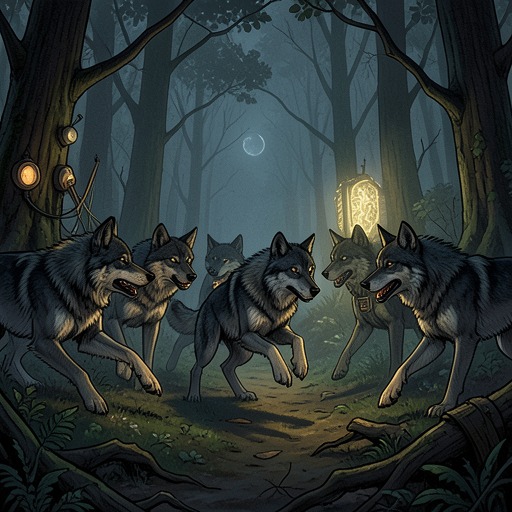
Crescent Hill Park is the place where Sebastian is introduced to the local teenage wolf pack. Drawn by the full moon, he leaves his room and walks to the park, where a group of figures waits in the shadows. Lily steps forward with glowing amber eyes and welcomes him to the pack. Five teenagers then emerge into the moonlight, some familiar from school and others strangers, and Sebastian experiences a sense of belonging he has never known before.
The park transforms Crescent Hill from a setting of isolation into a setting of collective identity. Sebastian has spent the day hiding symptoms and inventing explanations, but the figures in the park recognize the reality of what he is becoming. The meeting also connects the town’s youth culture to a hidden supernatural order: classmates and strangers occupy the same community, yet their moonlit identities reveal a second social structure beneath the visible one.
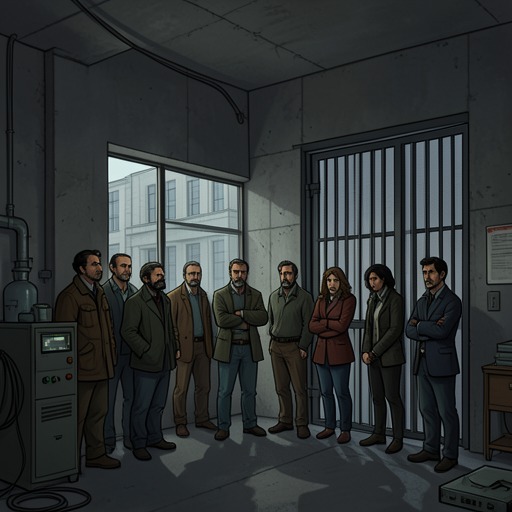
The town’s deeper history is tied to the artifact sought by the rogues. Ethan explains that the intruders are not merely passing through Crescent Hill; they want territory and are pursuing something specific. Lily identifies it as a powerful artifact that legends say was hidden centuries earlier by the first werewolves to settle in the area. Its exact nature is initially unknown, but its possible power is enough to threaten the balance of power in the werewolf world. Crescent Hill thus functions as an archive whose buried history remains politically active in the present.
Conflict at the School and Clock Tower
The hidden conflict breaks into Crescent Hill’s public life when Lily warns Sebastian that the rogues are at the school. She believes they have discovered his connection to the artifact, turning the town’s school from a place of concealment into an immediate danger zone. The pack tries to move Sebastian out through a side exit, showing that the protection of Crescent Hill’s human community depends on rapid separation between supernatural conflict and ordinary students.
The Halloween setting adds another layer of disguise. Ethan and Lily give Sebastian an intentionally exaggerated werewolf costume before first period, and the costume is so cheesy that Alex and Mia laugh when he emerges from the bathroom. The disguise allows a real werewolf identity to hide in plain sight within a town already filled with theatrical werewolf imagery. Crescent Hill’s public celebration therefore becomes an ironic camouflage: the monster is visible, but the truth remains concealed.
The decisive confrontation takes place in the clock tower, where Sebastian finally tells Mia that the artifact is a magical object hidden there and that the rogues want it. Mia realizes that his earlier questions about Crescent Hill’s founders and old families were connected to the history project, linking the town’s documented past to its supernatural present. When a rogue lunges at Mia as she holds a wooden box, Sebastian sees the full moon shining through the clock face. The moon, the artifact, and his blood come together in accordance with the prophecy, and he undergoes a new transformation that is neither simply wolf nor simply human.
Sebastian’s hybrid form gives the town’s central conflict a physical expression. He becomes a synthesis of both identities and strikes the rogue with enough force to send them crashing through the clock face. The fall from the tower turns Crescent Hill’s historic structure into the literal edge of Sebastian’s old life: his attempt to protect Mia carries him out of the enclosed tower and into the night air, where survival and the meaning of his new power remain uncertain.
Consequences and Narrative Significance
The aftermath confirms that Crescent Hill’s crisis has been contained without erasing its consequences. Sebastian wakes after the clock-tower plunge and immediately asks what happened to the rogues and whether everyone is safe. Mia tells him that Ethan and the others dealt with the rogues and that the artifact is safe, while Sebastian is the only one who took the dangerous leap from the building. The town survives the confrontation, but its hidden supernatural history can no longer remain entirely hidden from those closest to him.
Mia’s knowledge changes Sebastian’s relationship to Crescent Hill. He realizes that she now knows everything about his transformations and werewolf identity, and her softened response promises a conversation rather than rejection. The town has been the place where Sebastian repeatedly manages stigma through excuses, concealment, and even costume; it becomes, after the battle, the place where selective disclosure can lead to recognition. His final sense that it feels like coming home gives Crescent Hill its fullest significance. Home is no longer defined only by the family table or the school community, but by the possibility of inhabiting his human and wolf identities together among people who know the truth.
Crescent Hill consequently operates as more than a backdrop. Its school, woods, park, and clock tower organize the story’s passage from secrecy to belonging, while the artifact and the legends of the first werewolves make local space inseparable from supernatural power. The town contains the pressures that frighten Sebastian—public scrutiny, bodily change, territorial threat, and the risk of exposure—but it also contains the pack, Mia’s understanding, and the setting in which his divided nature becomes a source of connection rather than only fear.