Dual Nature
I'm the Werewolf in my ClassDual Nature names the human-werewolf condition at the center of Sebastian Wolfe’s transformation and the book’s central identity problem. It begins as an unexplained division between the ordinary teenager Sebastian believes himself to be and the animal power erupting through his body, but the prophecy later makes that division part of a larger mystery. At the clock tower, the human and wolf sides do not merely alternate: they combine into a new synthesis, allowing Sebastian to experience his divided nature as wholeness.
Definition and Prophetic Meaning
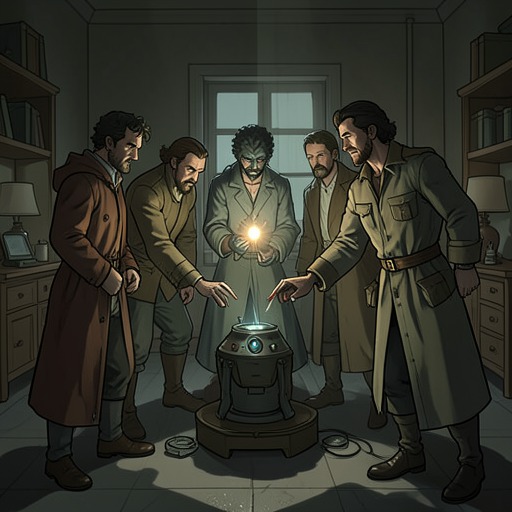
Dual Nature first appears in an ancient prophecy preserved by the young pack. Lily produces a worn copy whose lines speak of the moon and sun aligning, the shadow of the crescent hill, a key to power, and those who possess “dual nature’s will.” The prophecy is deliberately vague, but it links the condition to the revelation of power and to the artifact the pack is trying to find before the rogues can seize it. The wording therefore gives Sebastian’s bodily changes a significance beyond private illness or family secrecy: his divided identity may be the means through which the artifact’s power is revealed.
Sebastian immediately asks whether “dual nature” means the werewolves themselves, and Ethan confirms that this is the pack’s working interpretation. The explanation remains incomplete, however. The pack knows that its members move between human and wolf states, but it does not yet understand why Sebastian’s case matters or what the prophecy’s remaining images require. Dual Nature consequently functions both as a description and as an unanswered question: it identifies the werewolf condition while reserving a more exceptional meaning for Sebastian.
Bodily Division and Social Concealment
Before Sebastian understands the term, Dual Nature is experienced as an assault on the boundaries of his body. His bones seem to shift, his skin crawls, and coarse dark hair begins to grow from his hands. The first transformation occurs at the edge of the woods behind school as the full moon emerges, culminating in a howl that is no longer human. The scene turns adolescence into a literal loss of bodily certainty: the familiar human body becomes evidence of another presence that Sebastian cannot control or explain.
The divided condition also produces a divided social life. Sebastian leaves his parents abruptly after suspecting that a special family dinner concerns the strange events affecting him, including glowing eyes, excess hair, and sudden bursts of strength. At school he tries to contain the symptoms through ordinary excuses. When Mia notices that contact with her intensifies his senses, he attributes his condition to low blood sugar and birthday jitters. Later, after hiding in a bathroom stall while the transformation subsides, he tells Alex that he has a stomach ache caused by something he ate, even though he is considering the glowing eyes, transformations, and heightened senses that he cannot explain.
The concealment becomes especially visible during Halloween. Ethan and Lily give Sebastian an intentionally exaggerated werewolf costume, which he changes into in a bathroom before returning to Alex and Mia. The costume lets him display a version of the forbidden identity in public while passing it off as ordinary celebration. Its deliberately cheesy appearance contrasts with the real transformation beneath it: the human world can laugh at an imitation of a werewolf while remaining unaware that Sebastian is managing the genuine condition.
From Alternation to Synthesis
The pack offers Sebastian the first social framework in which Dual Nature is not solely a secret or a threat. Ethan introduces himself as the alpha of the small pack, and the other teenagers welcome Sebastian as someone they have been waiting for. Their belief in strength in numbers contrasts with the older generation’s practice of keeping werewolves apart. Within the pack, the human and wolf identities are understood as shared experience rather than isolated abnormality.
During the first confrontation with an approaching threat, Ethan and the others visibly shift into wolves. Sebastian feels the moon’s pull and the power surging through his veins before choosing to let the wolf inside take over. In wolf form, his perception changes: the world becomes sharper, and he can detect the fear and excitement of the others through smell and hear their rapid heartbeats. He also understands Ethan’s growl as meaningful instruction. Dual Nature therefore includes not only physical alteration but a changed mode of relation, one that connects Sebastian to pack communication, animal senses, and collective movement.
That new belonging does not erase conflict between his two lives. When Lily warns that the rogues have entered the school because they believe Sebastian is connected to the artifact, he hesitates to abandon his classmates and worries that the rogues may target them to reach him. He ultimately leaves with Lily, recognizing that the ordinary teenage existence he knew is no longer secure, while promising himself that he will protect Alex and Mia and prevent his two worlds from colliding. Dual Nature is thus presented as an obligation as well as a gift: Sebastian must negotiate school, friendship, and personal desire alongside pack danger and supernatural power.
The Clock Tower Realization
The prophecy becomes materially legible at the old clock tower during the full moon. Sebastian approaches in wolf form with Ethan, Lily, and the rest of the pack moving as a coordinated unit through Crescent Hill. Heightened hearing, scent, and sensitivity to vibrations make the environment itself part of his transformed awareness. The wolf body is not a costume or an external disguise; it changes how Sebastian occupies space and receives danger.
The decisive change occurs when Mia reaches for the wooden artifact while Sebastian fights a rogue. The rogue slashes Sebastian’s side, and the wound leaves blood on the floor as the full moon shines through the clock face. Sebastian experiences the moon, the artifact, and his blood as converging according to the prophecy. The resulting power is explicitly more than either familiar state. His body grows and changes into something “not just a wolf, not just a boy, but a perfect synthesis of both.”
This synthesis gives Dual Nature its strongest meaning. Sebastian does not defeat the rogue by choosing humanity over animality, nor by surrendering entirely to the wolf. He acts through a combined form and uses its force to protect Mia, driving the rogue through the clock face. Even while falling, he twists so that he will strike the ground first and spare the rogue the worst of the impact. The transformation therefore joins power to judgment: the new body is dangerous, but Sebastian’s decisive action remains oriented toward protection rather than indiscriminate destruction.
Consequences and Significance
The clock-tower plunge nearly ends the transformation in death. Sebastian loses consciousness after the impact, but his final awareness is of Mia’s moonlit face, no longer marked by fear but by wonder and possible love. When he awakens, he learns that Ethan and the others defeated the remaining rogues and that the artifact is safe. The immediate danger has passed, yet the consequences of Dual Nature have only expanded.
Mia now knows Sebastian’s secret, and her knowledge changes the emotional structure of his divided life. Sebastian realizes the implications with alarm, but Mia responds that they have much to discuss rather than treating him as a monster. Alex is also present when Ethan and Lily visit him, placing the revelation within a circle of friendship and pack solidarity instead of leaving it as a solitary burden.
Lily explains that the artifact reacted to Sebastian in a way the pack has never seen and seems to have bonded with him. Ethan adds that Sebastian has unlocked abilities beyond anything they thought possible for a werewolf: he is no longer merely shifting between human and wolf but has become something new. Dual Nature consequently moves from a label for division to a principle of transformation. Sebastian’s difference unsettles his future, his place in the pack, and his hope of remaining a normal teenager, but it also gives him a form of completeness he had never possessed since the first change. His realization that he feels truly whole establishes the concept’s decisive resolution: the apparent contradiction between boy and wolf becomes the source of a new identity rather than a wound that must be concealed or cured.