Pack Mentality
I'm the Werewolf in my ClassPack Mentality is the organizing principle behind the young werewolves’ community in Crescent Hill: unlike the older generation’s practice of keeping supernatural identities separate, this group believes that strength lies in numbers. For Sebastian Wolfe, the idea first offers belonging after his frightening transformations, then supplies practical protection and instruction, and finally becomes an emotional guarantee that his increasingly hybrid identity does not have to be faced alone.
Definition and Opposition
Pack Mentality takes shape as a deliberate alternative to isolation. When Sebastian asks his parents whether other werewolf families exist, his father confirms that there are, but explains that they generally keep to themselves because secrecy is safer. The teenage pack rejects that inherited caution. Lily states that the older generation may prefer solitude, while the younger werewolves believe in strength in numbers. The contrast establishes the concept as both a social philosophy and a generational disagreement: secrecy protects individual families, whereas solidarity gives young werewolves the resources to confront threats together.
The principle is also defined by action rather than by a formal doctrine. The pack offers Sebastian instruction in controlling his shifts and using his abilities, recognizing that a newly transformed werewolf cannot safely manage the change without guidance. Its members do not merely identify him as one of their kind; they create a place in which his frightening difference can be learned, witnessed, and given purpose.
Sebastian’s Recruitment and Belonging
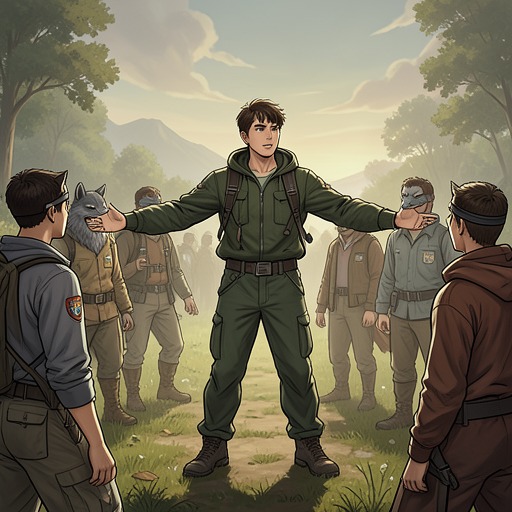
Sebastian encounters Pack Mentality at Crescent Hill Park under the full moon, where Lily welcomes him to the pack and five teenagers step from the shadows with glowing eyes. Some are familiar from school and others are strangers, but their shared presence produces in him a sense of belonging he has never experienced before. The scene turns a secret nighttime gathering into an alternative community, one that recognizes a part of Sebastian’s identity his ordinary school life cannot explain.
His acceptance is not entirely effortless. Sebastian hesitates before shaking Ethan’s hand and points out that his parents said werewolves kept to themselves. That hesitation preserves the conflict between family secrecy and peer solidarity, while his eventual handshake marks a choice to enter the younger group’s social world. Ethan identifies himself as the alpha of the small pack, giving the gathering a structure, but the invitation remains communal: Sebastian is welcomed, not simply commanded.
The pack’s recruitment is motivated by an approaching danger. Ethan warns that something significant is coming and that the group needs all the help it can get. Sebastian therefore enters the pack at the intersection of belonging and emergency. He is wanted because he is one of them, but also because the pack expects a collective response to a threat larger than any single member can manage.
Training, Concealment, and Collective Response
The pack’s first lesson arrives immediately when trouble is detected near the treeline. Ethan shifts into a massive silver-gray wolf, and the others follow him, transforming together rather than leaving Sebastian to confront the supernatural crisis alone. Their coordinated changes make the werewolf body a communal language: Sebastian sees what his companions can do and, responding to the moon’s pull, allows the wolf inside him to take over. His senses sharpen, and he can smell the fear and excitement among the others and hear their rapid heartbeats, experiencing transformation as something shared as well as bodily.
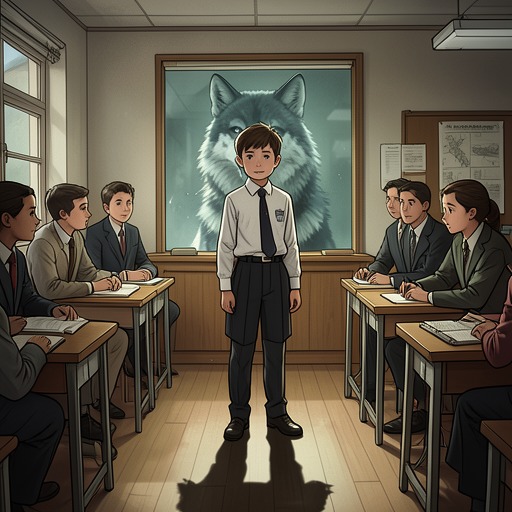
That collective identity exists alongside careful concealment. At school, Sebastian repeatedly protects the secret through ordinary explanations. When heightened sensations and physical distress overwhelm him, he tells Mia that the problem is low blood sugar and birthday jitters; later, in a bathroom stall, he tells Alex that he has a stomach ache caused by something he ate. These excuses show the pressure of maintaining a normal-student identity while the pack represents a hidden identity that requires recognition and trust.
The Halloween costume provides a more playful form of concealment. Ethan and Lily give Sebastian an intentionally exaggerated werewolf outfit before first period, allowing him to appear publicly as a werewolf while hiding the reality of his condition in plain sight. The costume is deliberately cheesy rather than realistic, and Alex and Mia laugh when they see it. The episode reveals the pack’s ability to use humor and improvisation as social protection: the disguise does not erase Sebastian’s difference, but turns it into an acceptable school performance.
Threat, Territory, and Mutual Protection
Pack Mentality becomes more urgent when the group learns that the rogues are not merely passing through Crescent Hill. Ethan explains that they want territory and are searching for something specific hidden in the town. The threat is therefore territorial and political as well as physical. The young pack must defend its home and protect the concealed artifact, making their alliance a response to an external group that challenges both their space and their inherited secrets.
The danger reaches Crescent Hill High when Lily warns Sebastian that the rogues are at the school. She believes they may have discovered his connection to the artifact and urges him to leave immediately. The warning shows the pack’s protective logic: Sebastian is not expected to remain behind and prove himself alone. His connection to the artifact makes him a target, so the group treats his safety as a collective concern.
This solidarity does not remove fear or confusion. Sebastian’s first transformation is painful and horrifying, and his later realization that Mia knows the truth leaves him tense even after learning that everyone survived the clock-tower confrontation. Yet the pack’s presence changes the meaning of those fears. The supernatural crisis is no longer an experience that Sebastian must conceal from everyone; it becomes a danger that others can recognize, interpret, and help him survive.
Disclosure and Continuing Significance
After the clock-tower battle, Ethan and the others explain that the artifact reacted to Sebastian in a way they had never seen before and appears to have bonded with him. Ethan says that Sebastian has unlocked abilities beyond what they believed possible for a werewolf and is no longer simply shifting between human and wolf. The discovery complicates Pack Mentality because Sebastian is both more fully included and more radically distinct: the group recognizes him as one of its members while acknowledging that he has become something new.
Mia’s response extends the pack’s support beyond the supernatural group. Once she knows the truth, she tells Sebastian that he is not alone and that everyone is there for him. Alex agrees, teasing him as a furry freak while still offering solidarity, and Sebastian laughs with affection. Their reaction transforms disclosure from a feared social catastrophe into an expansion of belonging. The secret once managed through excuses, escape, and disguise can now be held by trusted friends.
Pack Mentality therefore functions as the story’s answer to the dangers of divided identity. Sebastian begins as a sixteen-year-old trying to pass as an ordinary student while his body changes without explanation. Through the young pack, he receives a name for his condition, practical help with transformation, a collective defense against the rogues, and recognition after the artifact creates a hybrid state beyond ordinary werewolf categories. The pack does not resolve the uncertainty of his future, but it changes the conditions under which that future will be faced: Sebastian’s difference remains dangerous and unexplained, yet it is no longer solitary.