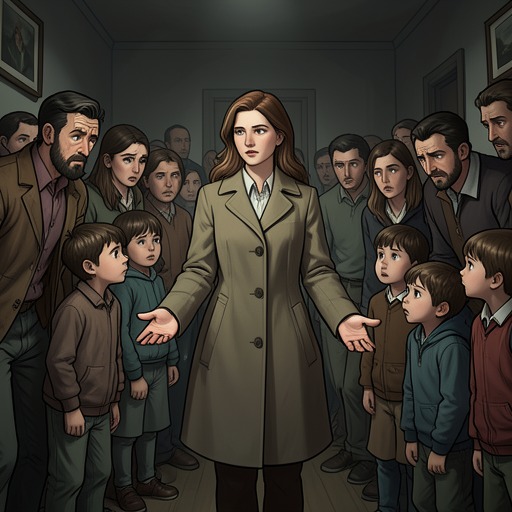
Dean Mum
I’m Very Happy After Marrying the CEO Husband According to the AgreementDean Mum is the longtime head and caregiver of the Orphanage, the woman who raised Shen Tang and served as the children’s substitute mother. Her decisive significance lies in the way she turns care into resistance: when the orphanage is threatened by a forced acquisition, she refuses to sign away the institution, protects the children’s interests, and accepts Shen Tang’s protection without surrendering her own judgment. Through her, the orphanage becomes more than a setting. It is a family built through sustained care, and a moral counterweight to relationships organized by money, status, or control.
Identity and Maternal Role
Dean Mum’s authority comes from responsibility rather than formal power. She raised Shen Tang, cared for the children of the Orphanage, and remained attentive to the ordinary rituals through which a vulnerable community is held together. Her work is visible in the children’s anticipation of receiving presents: after refusing the acquisition contract, she goes inside to call them out to queue and collect their gifts. For the children, this is the moment they have been waiting for most, and the scene places her administrative role beside her maternal one. She is not merely managing an institution; she is preserving a home in which children, including physically handicapped children, can experience happiness and dignity.
Her relationship with Shen Tang is intimate but not simple. Dean Mum has raised her as a daughter, yet Shen Tang’s behavior after entering the story’s altered circumstances becomes so capable and forceful that Dean Mum briefly feels as though the girl has become a stranger. She immediately dismisses that impression as the result of exhaustion, revealing both the depth of their bond and her reluctance to interpret Shen Tang’s transformation as a loss. The apparent distance is therefore not a rupture. It is the uneasy surface of a relationship adapting to Shen Tang’s new strength.
Resistance to the Acquisition Crisis
The clearest test of Dean Mum’s character comes when representatives arrive to secure the orphanage’s acquisition. Shen Tang tightly grasps her hand and asks her to trust her, but the final decision remains Dean Mum’s. After taking a breath, Dean Mum tells the person in charge that she will not sign the contract. Her refusal is direct, consequential, and grounded in her responsibility toward the children rather than in a desire for personal advantage.
The threat intensifies after the first confrontation. As dusk approaches, men in black suits appear at the orphanage gates, startling Dean Mum because the group has returned so soon. Shen Tang is surprised by the number of men, while Xiao Yu explains that Shen Tang had asked for additional manpower. The episode turns Dean Mum’s anxiety into a visible measure of the pressure placed on the orphanage: the institution is being approached not through an open negotiation but through intimidation and overwhelming force.
When police arrive and treat the bodyguards as possible gangsters, Dean Mum immediately intervenes. She insists that they are hired bodyguards and good people and pleads with the officer not to arrest them. The officer rejects her testimony and says that the men must be taken away for interrogation before their character can be determined. Shen Tang realizes that the police and the opposing group are probably cooperating. Dean Mum’s defense thus exposes the vulnerability of a caregiver whose moral knowledge of the people around her carries little weight before an official power structure acting in bad faith. Her voice does not command the police, but it makes the conflict’s ethical line unmistakable.
Care, Trust, and Shen Tang’s Protection
Dean Mum’s trust in Shen Tang is tested through action rather than explanation. She may not understand every change in Shen Tang, but she accepts the protection Shen Tang attempts to provide because that protection is directed toward the children and the survival of their home. Shen Tang, in turn, treats Dean Mum as someone to be defended rather than merely informed. Their clasped hands at the contract confrontation condense the relationship: Dean Mum represents the family Shen Tang came from, while Shen Tang supplies the force needed to defend it against external power.
The later resolution of the acquisition crisis confirms that Dean Mum’s resistance is not futile. Shen Tang is told that a man identified as her boyfriend sent many supplies, arranged for worn-down parts of the orphanage to be repaired, and resolved the acquisition. The man is Gu Huaian, although Dean Mum does not initially know the full extent of his involvement. She praises him as a genuinely good man and tells Shen Tang to treat him well. Her judgment is based on concrete acts of care: supplies, repairs, and the removal of the immediate threat. In this sense, Dean Mum evaluates Gu Huaian through the same ethical standard she applies to herself—whether a person materially protects vulnerable lives.
Relations with the Wider Family Order
Dean Mum’s role contrasts with the formal family structures surrounding Shen Tang. At a Gu family gathering, Old Madam Gu’s and Old Master Gu’s attitude toward Shen Tang determines how the other Gu family members regard her; Old Madam Gu introduces Shen Tang to important elders, and the younger people are then allowed to separate. Dean Mum has no comparable social rank, but her influence is more foundational. She does not confer status on Shen Tang through a family name. She gives Shen Tang belonging through years of care.
This contrast becomes especially meaningful as Shen Tang’s biological family history is reconstructed. In Shen Boyuan’s account, the Shen family is described as a scholarly family that doted on its only daughter, Shen Xiuxiu, before her relationship with Wei Xuan caused conflict and rebellion. Dean Mum belongs to a different kind of family order: one formed by caretaking rather than blood, and sustained by daily labor rather than pedigree. Her importance is therefore not erased when Shen Tang’s biological origins emerge. Instead, the narrative places inherited family and chosen or substitute family beside each other, allowing Dean Mum’s maternal claim to remain emotionally real.
Narrative Function and Lasting Significance
Dean Mum embodies the protective ethics of the Orphanage. Her most important actions are modest in form but decisive in consequence: she refuses the contract, organizes the children’s gift collection despite the danger, defends the bodyguards from wrongful detention, and receives the practical help that ultimately resolves the acquisition crisis. Each action joins care to judgment. She protects without becoming abstractly heroic; her fear, shock, and anxiety remain visible alongside her refusal to abandon the children.
Her characterization also clarifies what Shen Tang’s new identity must preserve. Shen Tang may become unusually capable, confront online abuse, expose manipulation, and act with physical and strategic confidence, but her connection to Dean Mum anchors those abilities in an earlier history of being cared for. The orphanage is the place where Shen Tang is still someone’s child, and Dean Mum is the person who makes that fact emotionally durable. Even when Dean Mum momentarily feels that Shen Tang has changed beyond recognition, the later pattern of mutual trust shows that transformation has not destroyed their bond. It has given the daughter the means to defend the mother and the family that raised her.