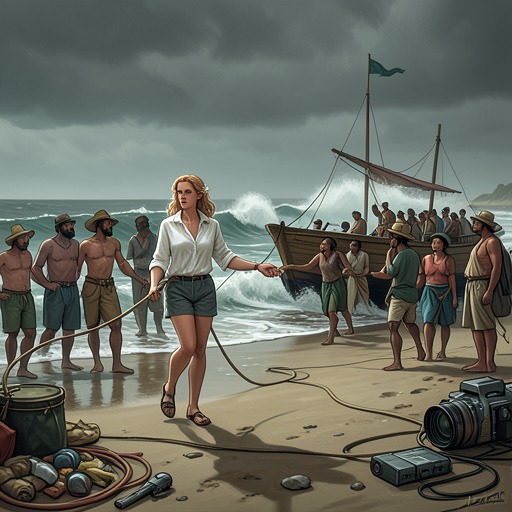
Deserted Island
I’m Very Happy After Marrying the CEO Husband According to the AgreementDeserted Island is the central survival setting of 13 Days on the Island, transformed from a television location into a precarious world of exposure, scarcity, and uncontrolled natural danger. The contestants arrive expecting a reality-show challenge, but the island’s extreme emptiness and sudden storms make it the place where entertainment, bodily survival, and public attention collide.
Setting and Arrival
The gathering point for 13 Days on the Island is a dock, where Shen Tang finds that most of the participants have already assembled. Six guests take part besides her: Huo Yingying, Zhao Zhe, Ao Ziping, He Yuan, and Zhou Hao. The arrangement establishes the island as both a destination and a controlled media environment: the contestants are transported there together, observed by staff, and divided among separate livestreams once filming begins.
The boat soon reaches the small island, and the staff leave the guests there before departing by boat. That departure is the first decisive change in the island’s meaning. While the program initially appears to be an organized production with equipment and personnel behind it, the retreating boat removes the most immediate connection to ordinary society. Shen Tang even asks whether wild animals live there, revealing that the contestants cannot assume the landscape is merely scenic or harmless.
Emptiness and Survival Conditions
The island is exceptionally large and almost completely undeveloped. Shen Tang initially suspects that the program team has exaggerated its lack of facilities, but discovers that the claim is accurate: there is essentially nothing on the island. There are no designated places for eating, drinking, urinating, or defecating. The absence is comic in its bluntness, yet it also establishes the island’s governing condition. Modern routines and institutional support have been stripped away, leaving the contestants to negotiate basic needs directly.
This emptiness creates a sharp contrast between the polished format of a reality show and the material demands of survival. The livestream can multiply spectators, but it cannot provide shelter, food, sanitation, or rescue. Shen Tang has the largest audience in her livestream, yet the viewers are initially there to scold her, making attention an unstable resource rather than protection. The island therefore functions simultaneously as a physical wilderness and a platform-mediated spectacle in which suffering itself can become viewable content.
Weather, Shelter, and Uncertainty
The island’s danger becomes more immediate when Shen Tang and Zhao Zhe leave to follow He Yuan and the others. Not long after their departure, the sky darkens with unusual speed. Zhao Zhe notices how quickly the light disappears, while Shen Tang warns that a violent storm may be approaching and urges them to return quickly. The island’s scale, combined with the sudden weather shift, turns distance into a practical threat: a short excursion can become dangerous when shelter and daylight are limited.
The group eventually faces the possibility of being trapped and starving. Zhou Hao fears that they may die of hunger, while Shen Tang recalls that the book only briefly says the reality show became popular without explaining why. She wonders whether the crisis occurring on the island is the reason for that later success. Her recollection introduces a narrative tension between known plot outcome and unknown immediate cause: the island is already famous within the story’s larger design, but its fame may be produced by an ordeal that the original account deliberately leaves unexplained.
Shen Tang tries to stabilize the group by pointing out that their cave is located high enough to avoid flooding even if the water level rises. She calculates that their remaining food and water can last two or three days if rationed carefully and trusts that the program team will eventually send rescuers. The cave thus offers temporary security rather than resolution. It protects the contestants from rising water, but not from hunger, weather, animals, or the uncertainty created by the staff’s absence.
Wildlife and Escalating Danger
The island’s lack of development does not mean a lack of life. After an injury is examined, Shen Tang searches the surrounding area and discovers a snake nest deeper inside the cave, filled with densely writhing small snakes. The discovery changes the cave from a reassuring refuge into a potentially occupied habitat. What had seemed to be shelter may itself contain a hidden hazard, and the contestants’ fear is intensified by the realization that they have wandered into the animals’ territory rather than simply entered an empty human space.
The threat later becomes more visibly violent when a boar is struck by large rocks thrown by Shen Tang. The hit is accurate, but it also awakens the animal. When the boar opens its eyes, it sees the group holding lamps; angered by the attack, it snorts, scrapes its hooves twice, and charges. The scene turns the island’s wildlife into an active force with its own responses rather than passive scenery. The contestants’ lights, movement, and attempts at defense become part of an encounter in which their control over the environment is abruptly exposed as fragile.
Narrative Significance
Deserted Island is important because it converts a supposedly entertaining survival program into a test of what the contestants can do without the conveniences and protections that normally remain invisible. The boat’s departure, the absence of facilities, the approaching storm, the limited two-to-three-day supply, the snake nest, and the charging boar form a chain of escalating value shifts: leisure becomes labor, shelter becomes uncertainty, and spectacle becomes genuine danger.
The location also links natural exposure to the economics of attention. The contestants are continuously mediated through livestreams, and Shen Tang’s large but hostile audience demonstrates how the platform can turn isolation into public spectacle. Yet the island repeatedly resists that mediation. Viewers may watch, criticize, and increase the show’s popularity, but they cannot stop the sky from darkening, replenish food and water, remove snakes from the cave, or halt a charging boar. In that tension between broadcast visibility and material helplessness, Deserted Island becomes more than a backdrop: it is the setting that reveals the cost of making survival into entertainment.