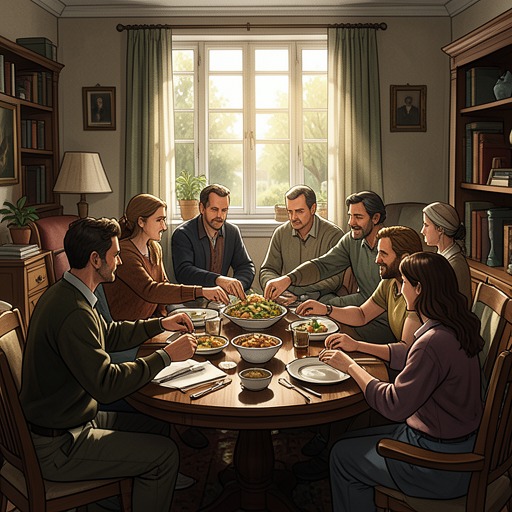
Gu Huaian's mother
I’m Very Happy After Marrying the CEO Husband According to the AgreementGu Huaian's mother, commonly called Old Madam Gu, is the senior woman in the Gu family whose personal attitude toward Shen Tang carries consequences far beyond private affection. At the Gu Family Ancestral Home, she opposes the attempt to manage Gu Huaian's marriage through family pressure and becomes one of Shen Tang's strongest sources of acceptance within the household. Her role combines domestic authority, emotional judgment, and a practical defense of individual choice.
Identity and Position
Old Madam Gu appears as the wife of Old Master Gu and the mother of Gu Huaian. She is not presented as a passive elder who merely observes family disputes. Her exchanges with Old Master Gu show that she can interrupt his anger, challenge his reasoning, and impose consequences of her own. Although she speaks from within the family structure, she does not treat family reputation or the expectation that Gu Huaian should marry as sufficient grounds for controlling his personal life.
Her position is especially important because the Gu family's internal hierarchy is socially visible. At a later formal banquet, Old Madam Gu and Old Master Gu's attitude toward Shen Tang determines how other Gu family members respond to her. Their approval functions as a public signal: once Old Madam Gu treats Shen Tang with intimacy and introduces her to important elders, other relatives take note and adjust their own view of the new wife. The matriarch therefore converts private acceptance into family-wide recognition.
Defense of Gu Huaian's Choice
At the ancestral home, Old Master Gu angrily denounces Gu Huaian as an unfilial son and complains about what he sees as his son's disobedience. Old Madam Gu answers by asking whether he has nothing better to do than interfere without reason. Her objection is not simply that his anger is excessive; she rejects the assumption that an adult son loses the right to choose someone he likes merely because his parents have expectations for him.
She explicitly argues that the blessings of descendants come from the descendants themselves and that Gu Huaian is no longer a child. In her view, he retains the right to choose the person he loves. She also speaks favorably of Shen Tang, calling her a good and attractive girl and imagining that children born to Shen Tang and Gu Huaian would be even more handsome. The remark carries both traditional family-mindedness and personal support: she still values marriage and descendants, but she directs those hopes toward the couple Gu Huaian has actually chosen rather than toward an arrangement imposed from outside.
Old Madam Gu also punctures Old Master Gu's justification that he is acting for their son's benefit. When he points out that Gu Huaian is already married, she responds that married couples can divorce. Old Master Gu's own logic immediately threatens his marriage, and when he protests, she turns the argument back on him. If marriage is to be used as a tool for providing care or managing another person's life, she tells him to marry Shen Tang himself. Her retort exposes the absurdity of treating Gu Huaian's marriage as a family instrument while pretending that the arrangement has no emotional or moral limits.
Confrontation and Household Authority
The conflict reaches its clearest point when Old Madam Gu tells Old Master Gu that if he interferes with Gu Huaian again, she will divorce him. Old Master Gu dismisses the threat as inappropriate for an elderly couple, citing embarrassment and the uselessness of divorce at their age. Old Madam Gu answers that he was the one who claimed married couples could divorce. The exchange turns his attempt to pressure the younger generation into a standard that applies to his own marriage as well.
This scene establishes her authority through both intimacy and contradiction. She does not leave the family or reject marriage as an institution; instead, she insists that marriage cannot justify coercion. Her willingness to invoke divorce gives her defense of Shen Tang a concrete force. She can oppose Old Master Gu because she is not merely asking him to be kinder. She is reminding him that the same freedom and dignity he denies to Gu Huaian belong to every spouse, including herself.
Relationship with Shen Tang and Narrative Significance
Old Madam Gu's acceptance gives Shen Tang a stable place inside a family that might otherwise treat her as a contractual outsider. Shen Tang's marriage to Gu Huaian begins as an agreement requiring appearances at family dinners and the presentation of a loving relationship, but Old Madam Gu's response helps transform that public performance into a socially acknowledged bond. At the formal banquet, she receives Shen Tang warmly, introduces her to several important elders, and then allows the younger people to leave together. Her conduct makes Shen Tang's role as Gu Huaian's wife legible to the wider family.
The contrast between the marriage agreement's transactional terms and Old Madam Gu's behavior is significant. The agreement promises Shen Tang a monthly payment, living expenses charged to her husband's card, and a large settlement after two years, while public family life requires the appearance of affection. Old Madam Gu does not appear to investigate those contractual terms in the cited scenes. Instead, she responds to the visible relationship and treats Shen Tang as someone worthy of welcome. Her approval thus occupies an intermediate space between formal kinship and emotional kinship: she recognizes Shen Tang through the marriage, then reinforces that recognition through personal warmth.
Her stance also echoes the broader family questions surrounding Shen Tang. Shen Tang's care for a sick eight-year-old child from her orphanage shows that family can be created through responsibility rather than blood, while later blood testing confirms her biological relationship to the Shen family. Against that background, Old Madam Gu represents a different but related form of belonging: the in-law who can choose whether a new member is treated as an intruder or as family. By choosing acceptance and defending Gu Huaian's autonomy, she helps make the Gu household a place where Shen Tang's position is not defined solely by money, scandal, or the temporary duration of a contract.
Later Domestic Continuity
Old Madam Gu's influence remains visible when the question of a wedding is raised. Someone asks when Shen Tang and Gu Huaian plan to hold their wedding, and Shen Tang can only answer that she is unsure. She had imagined walking down the aisle with someone she loved, but transmigration led her to marry directly, without that ceremony, leaving uncertain whether a wedding would ever follow. The question places Old Madam Gu's family world beside Shen Tang's unresolved emotional future: the family already recognizes the marriage, while Shen Tang still wonders whether its public ritual and inner meaning will eventually coincide.
Old Madam Gu's narrative importance therefore lies less in a single act of matchmaking than in the kind of family authority she models. She values descendants, family continuity, and public acknowledgment, yet refuses to confuse those values with the right to dominate an adult child's choices. She supports Shen Tang in the family arena, challenges Old Master Gu with his own principles, and turns elder approval into protection rather than surveillance. Through her, the Gu family is shown not as a single system of pressure, but as a contested household in which affection and autonomy can also be defended.