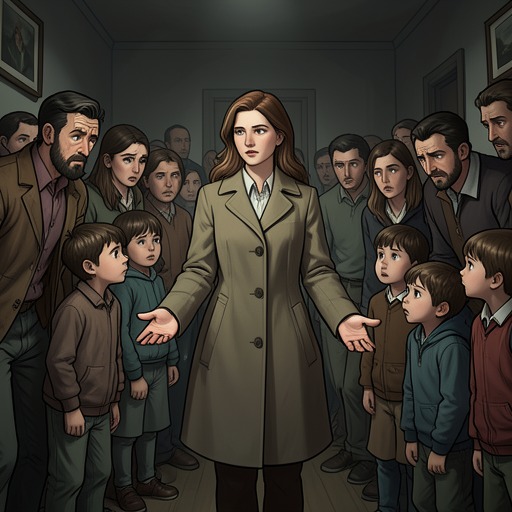
Orphanage Demolition Plot and Night Raid
I’m Very Happy After Marrying the CEO Husband According to the AgreementThe Orphanage Demolition Plot and Night Raid is the point at which the Orphanage’s threatened acquisition stops being a bureaucratic dispute and becomes open violence. Dean Mum’s refusal to sign the contract places the institution, its disabled children, and the elderly woman caring for them in direct danger. Shen Tang’s decision to stay behind transforms her concern for the orphanage into active protection, while the nighttime attack reveals the coercive force behind the proposed redevelopment.
Causes and Stakes
The immediate cause of the confrontation is Dean Mum’s refusal to surrender the Orphanage. With Shen Tang holding her hand and urging her to trust her, Dean Mum faces the person in charge, gathers her courage, and states that she will not sign the contract. The opposing side accepts the refusal without negotiation and leaves, but the unresolved tension remains: the contract has not been signed, yet the pressure has plainly not ended.
The human stakes are made concrete through the children rather than through the contract alone. Dean Mum calls them out to queue for presents, and Shen Tang sees the physically disabled children happily embracing their gifts. The sight gives her a decisive objective: to protect their smiles. This scene frames the acquisition crisis as more than a property conflict. The threatened institution is also a home, a source of care, and a fragile space in which the children’s ordinary happiness can continue.
Shen Tang therefore does not plan to return home that night. She worries that the people who have already attempted to force the issue will come back to cause trouble, and she chooses to remain at the Orphanage as a visible safeguard. The decision links her public life to her private ethics: the same Shen Tang who can maintain a professional smile while hostile viewers insult her now refuses to treat the children’s safety as another problem that someone else should handle.
The Night Attack
At dusk, a large group of men in black suits appears at the Orphanage gates, startling both Dean Mum and Shen Tang. Their return so soon confirms that the earlier refusal has produced retaliation rather than acceptance. Once night falls, more than a dozen loafers stand outside the Orphanage holding baseball bats. A yellow-haired man proposes entering together, and the crew-cut man agrees, reasoning that the Orphanage contains only a few people, a group of disabled children, and an old woman, so the job should be quick.
Their language reduces the residents to easy targets and exposes the attack’s intended power dynamic. The men expect fear because they believe the Orphanage is defenseless. They do not approach as negotiators or officials; they arrive as street enforcers, carrying weapons and relying on numerical advantage. Their plan is to enter, damage the property, and make the refusal to sell impossible to maintain.
The gangsters climb over the wall with ease. Finding little of value in the yard beyond recreational facilities, they move toward the building. At a window, the yellow-haired man raises a baseball bat and smashes the glass, shattering it immediately. The broken window is the attack’s first unmistakable act of destruction: the men have crossed from pressure into demolition by force, and the Orphanage’s vulnerable residents are now exposed to an assault inside their own home.
Xiao Yu’s Counterattack
The attackers’ confidence collapses when Xiao Yu confronts them. One man turns to run, but Xiao Yu grabs him by the collar and pulls him down, leaving him to fall on the ground. Another member of the gang recoils and protests that Xiao Yu cannot hit him after hitting the first man, a complaint that makes the reversal almost absurd: the intruders have come armed with baseball bats, yet they expect protection from the consequences of their own violence.
The fight ends decisively. The dozen or so attackers are beaten, each left with a swollen face, and forced to squat against the wall. Xiao Yu remains dissatisfied, having expected tougher opponents and discovering that the supposed assault force consists only of petty street punks. Her response changes the meaning of the raid. What was intended as an intimidating show of strength becomes a failed operation, and the men’s weapons and numbers prove useless against prepared resistance.
The counterattack also protects the children without turning them into combatants. Their presence establishes what is at risk, while Xiao Yu supplies the physical defense that Shen Tang and Dean Mum need. The division of roles is significant: Dean Mum refuses the contract, Shen Tang commits herself to staying, and Xiao Yu prevents the refusal from being punished through immediate violence.
Consequences and Aftermath
The raid confirms that the Orphanage’s acquisition threat is coercive in practice, even if it first appears in the form of a contract and an official demand. The attackers’ choice to arrive at night, jump the wall, carry bats, and smash a window demonstrates that the institution is being pressured through fear and property damage rather than legitimate consent. Dean Mum’s signature would not represent a free agreement if refusal invites this kind of retaliation.
For Shen Tang, the confrontation turns protective feeling into a concrete commitment. She has already experienced an entertainment industry that converts scandal into publicity and expects her to keep smiling because attention can be monetized. The Orphanage crisis presents a different economy of value. The children’s smiles cannot be treated as promotional material or as collateral in a transaction; they become the moral measure by which Shen Tang judges what must be defended.
The failed night raid also strengthens the Orphanage’s immediate position while leaving the larger acquisition danger unresolved. The gang is defeated, but the people behind the contract have not been brought to account in this episode. The damaged window and the presence of children who had been targeted ensure that the conflict cannot be dismissed as a routine disagreement. The attack makes the next stage of the struggle unavoidable: protecting the Orphanage will require confronting not only hired thugs but the forces capable of sending them.
Narrative Significance
The episode combines a forced acquisition confrontation with a night raid, moving the plot from institutional vulnerability to collective resistance. Its structure is built on reversal. The Orphanage first appears to be powerless: an old woman, disabled children, and a small group of defenders face men who arrive in large numbers with bats. Yet the apparent imbalance is overturned when Xiao Yu pulls down the first fleeing attacker and defeats the entire group.
The contrast between the children receiving presents and the gang breaking windows gives the event its sharpest emotional shape. One image represents care, routine, and protected joy; the other represents the attempt to replace those things with fear. Shen Tang’s resolve grows from witnessing the first image, while Xiao Yu’s intervention answers the second. Together, these moments establish the Orphanage as a space worth defending not because it is powerful, but because its residents are vulnerable and their ordinary happiness has been placed in the path of organized coercion.