Orphanage Purchase Contract
I’m Very Happy After Marrying the CEO Husband According to the AgreementThe Orphanage Purchase Contract is the document at the center of the orphanage acquisition confrontation. Presented as a guarantee that the children will receive better treatment, it initially appears to offer a practical solution to the orphanage’s financial and medical difficulties. Once Dean Mum reads it, however, the document reveals that the proposed arrangement is not merely a closure or charitable rescue: it is an acquisition that would transfer control of the orphanage to another party. That distinction transforms an apparently compassionate negotiation into a conflict over who has the right to decide the institution’s future.
Definition and Immediate Purpose
The contract is a purchasing agreement brought by the person in charge of the proposed acquisition. He frames it as a safeguard for the children, telling Dean Mum that, if she signs, they will be appropriately taken care of. The offer is therefore built around a morally powerful promise: better treatment for children who have varying degrees of illness. Dean Mum is shaken by the argument because proper medical care could genuinely improve their lives, and even she is momentarily persuaded that closing the orphanage might be acceptable if it guarantees that outcome.
The contract’s stated practical function is to formalize the transfer. The person in charge presents signing as the condition for the promised care, making the children’s welfare appear inseparable from surrendering the orphanage. This structure gives the document coercive force even before any questionable clause is identified. The decision is no longer presented as a free choice between several forms of assistance; it is narrowed into a choice between accepting the purchaser’s terms or risking the children’s continued hardship.
Discovery of the Acquisition
Dean Mum’s reaction changes the meaning of the document. After taking it and skimming through its contents, she realizes that the other party wants to buy the orphanage itself. Her pupils constrict violently, and she immediately distinguishes closure from acquisition. Closing the place would mean that it still belonged to its existing custodians, whereas being bought would mean that it became someone else’s property. The contract thus makes ownership, rather than medical care alone, the decisive issue.
That distinction carries particular emotional weight for Dean Mum. The orphanage is the place where she grew up. After her husband died and she had no children, she converted the place into an orphanage, filling it with the memories she valued most. The proposed purchase therefore threatens more than an address or an operating institution. It places her personal history and the children’s home within a commercial transaction, where the promise of improved care may conceal the permanent loss of the place’s identity and independence.
Dean Mum finally refuses in direct terms, declaring that she does not agree. Her refusal rejects the contract’s attempt to make acquisition appear equivalent to protection. It also establishes that the document is not a neutral administrative form: it is the physical focus of a struggle between the purchaser’s authority and Dean Mum’s claim to preserve the orphanage.
Shen Tang’s Examination and the Standoff
Shen Tang takes the contract and reads it herself, but she is not a professional and cannot determine whether it contains problems. Her uncertainty is important because it prevents the scene from becoming a simple discovery of an obviously fraudulent clause. The danger lies partly in the unequal distribution of expertise. The person in charge controls the legal document and insists on its confidentiality, while Shen Tang must seek outside assistance to understand what Dean Mum is being asked to sign.
Shen Tang takes out her phone, intending to photograph the contract and send it to professionals for review. The person in charge immediately reaches out to stop her. He says that the contract cannot be leaked, and when Shen Tang explains that she only wants a friend to examine it, he refuses to allow even that. His prohibition blocks independent scrutiny at the precise moment when independent scrutiny is most necessary. The document becomes inaccessible not because Shen Tang has accepted its terms, but because the person presenting it tries to control who may interpret them.
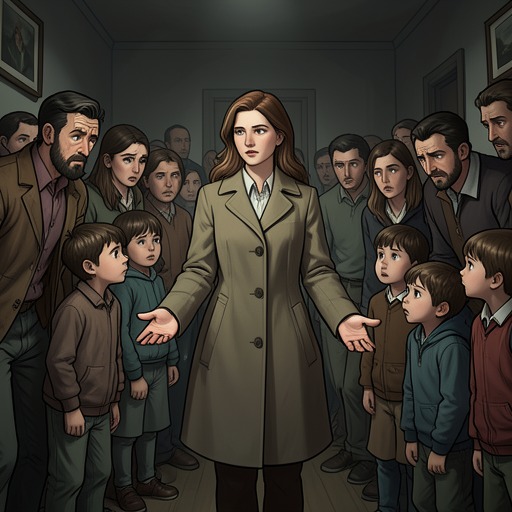
The physical handling of the contract makes the power struggle visible. Shen Tang and the person in charge each hold one corner, neither willing to release it, and the scene reaches an impasse. The paper is ordinarily a transparent tool of administration; here it becomes an obstacle, a contested object that cannot move forward because neither side accepts the other’s authority. Its material presence exposes the conflict between a polished promise and the people whose lives would be reorganized by its signature.
Consequences and Narrative Significance
The contract converts the orphanage’s crisis into a question of consent and control. Medical treatment remains a real need, but the document shows how that need can be used to pressure the institution’s guardian. The purchaser’s promise that the children will be appropriately cared for is not treated as sufficient evidence of good faith. Because the offer is tied to ownership and because the terms cannot be examined freely, the contract makes the acquisition itself the central danger.
For Shen Tang, handling the document is an act of resistance as much as a legal precaution. She does not claim to understand the contract fully; instead, she recognizes the need to place it before people with the relevant expertise. Her attempt to photograph it challenges the person in charge’s control over information. The refusal to permit even a private review intensifies suspicion and turns the contract’s secrecy into part of the confrontation.
The Orphanage Purchase Contract also gives material form to the broader theme of institutional vulnerability. The orphanage can be presented as an inefficient or replaceable site, while its residents’ illnesses provide the emotional leverage for an acquisition. Yet Dean Mum’s memories and Shen Tang’s intervention insist that the institution cannot be reduced to a commodity. The contract stands at the point where care, property, legality, and personal history collide: a promise of rescue becomes a demand for surrender, and a sheet of paper becomes the object around which the orphanage’s defenders draw their line.