Private Orphanage
I’m Very Happy After Marrying the CEO Husband According to the AgreementThe Private Orphanage is the place where the original Shen Tang grew up, and it becomes one of the clearest tests of what the present-day Shen Tang is willing to protect. At first, she hesitates to return because she fears that the people who knew the original child will see through her disguise. When she finally goes, she finds not a sentimental refuge preserved unchanged, but a struggling institution facing closure, coercive acquisition, and an uncertain future for the children who depend on it.
Origins and Decline
The Private Orphanage was once the only private orphanage in the surrounding area. Decades earlier, donations had been more plentiful, and the institution had enough importance to serve as a major local refuge. Its fortunes changed about ten years before the confrontation at its gates, when a larger orphanage opened nearby. The newer institution had better facilities and an environment that attracted more attention, while its children were described as more obedient and adorable. As resources and public favor shifted elsewhere, the older orphanage gradually declined.
The decline is also reflected in the children who remain. Those considered adoptable had already found homes, leaving more than a dozen children, all with varying degrees of physical disability or illness. The little girl held by Dean Mum had lost both legs in an accident. The orphanage therefore does not merely represent an old building in need of modernization; it is a home for children whom the surrounding system has already treated as difficult to place, less visible, or less desirable.
Shen Tang’s Return
Shen Tang had wanted to visit earlier, but the orphanage was also the place in which the original Shen Tang had lived from childhood. Her fear of being recognized made the visit psychologically dangerous: entering the institution meant approaching the most intimate evidence of the identity she had inherited. She eventually chooses to go, changes into casual clothes, and buys clothes, snacks, school materials, toys, and other supplies. The quantity is so great that she arranges for everything to be delivered by truck.
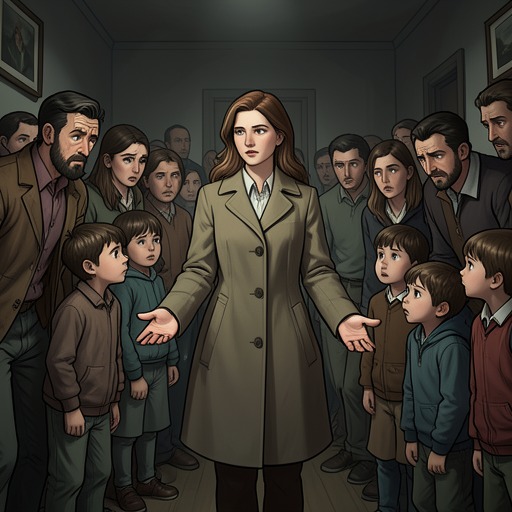
Her arrival is deliberately expansive rather than discreet. She comes swaggering in with a truckload of goods, only to discover a crowd gathered outside the gates. The scene immediately turns her intended act of private care into a public confrontation. Dean Mum is sitting on the ground, crying as she holds a child, and Shen Tang hears that officials are demanding the orphanage’s closure. The child recognizes her warmly and tells her that she has been missed; Shen Tang answers with equal affection and strokes the girl’s head. That brief exchange reconnects her to the institution not through exposition, but through a living bond with one of its children.
The Closure and Purchase Conflict
Dean Mum explains that the children will have nowhere safe to go if the orphanage shuts down. She fears that they will be bullied elsewhere, a concern made more urgent by their disabilities and illnesses. The official representative presents the proposed merger as a practical improvement: the neighboring orphanage is larger, better equipped, and supposedly capable of providing better care. Several people repeat that the Private Orphanage lacks helpers and that merging is the sensible solution.
The argument momentarily shakes even Dean Mum because the children genuinely need treatment and support. She says she will agree to closure if better care can be guaranteed. The representative then produces a purchasing contract and claims that signing it will ensure appropriate care. When Dean Mum skims the document, however, she realizes that the proposal is not simply closure or a protective merger. It is an attempt to buy the orphanage itself.
That distinction transforms the stakes. Closure would leave the institution’s identity and ownership in its own hands while ending its operation; a purchase would transfer the place to someone else. For Dean Mum, the difference is inseparable from her life history. She grew up there, and after her husband died, she had no children, so she turned the place into an orphanage. The institution contains her most precious memories and has become the form through which she continued caring for children. She therefore refuses the purchase outright.
Shen Tang reads the contract but cannot determine whether it contains hidden problems because she is not a professional. When she tries to photograph it and send it to experts, the representative stops her, insisting that the contract cannot be leaked. The demand for secrecy deepens the suspicion surrounding the proposed acquisition: the language of improved care is placed alongside a restriction on independent scrutiny, leaving Dean Mum and Shen Tang to confront an imbalance of information and authority.
Function in the Story
The Private Orphanage joins Shen Tang’s personal history to a concrete social crisis. Her initial fear that the place might expose her identity is overtaken by the immediate needs of children who have been left behind by adoption patterns, charitable attention, and institutional competition. The orphanage’s deterioration is not presented as proof that it has no value; rather, its weakness makes it easier for better-funded interests to redefine dispossession as benevolence.
The institution also clarifies Shen Tang’s developing priorities. Her entertainment career is dominated by rumors, opportunistic pairings, public abuse, and the demand that she maintain a professional smile even while being attacked. At the orphanage, her money, presence, and willingness to question the contract serve a different purpose. The truck of supplies is an act of material assistance, but her more consequential intervention is her refusal to accept an official promise without examining who will control the place afterward.
As a setting, the Private Orphanage is therefore both a remembered home and a contested social space. It shelters children with bodies and needs that the larger system has difficulty accommodating, preserves Dean Mum’s family and caregiving history, and forces Shen Tang to distinguish genuine protection from institutional takeover. Its threatened loss gives the narrative one of its sharpest contrasts: a place can be poor, small, and imperfect while still belonging to the people whose lives are rooted in it.