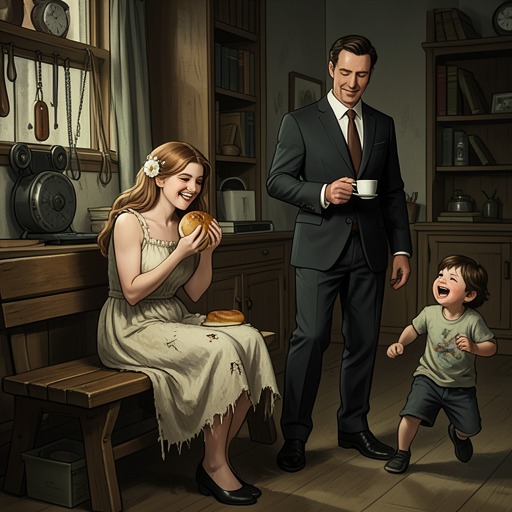
Shen Family
I’m Very Happy After Marrying the CEO Husband According to the AgreementThe Shen Family is a scholarly, extended family organized around a powerful main branch and less influential collateral branches. Its importance lies not simply in bloodline or social status, but in the way family membership repeatedly becomes a matter of recognition, protection, obligation, and personal choice. When Shen Tang is reunited with the family, the reunion exposes a household capable of warmth and care, yet also marked by unequal power, transactional marriage arrangements, concealed histories, and sharp differences between relatives who treat kinship as responsibility and those who treat it as leverage.
Structure and Internal Hierarchy
The family is not politically or economically uniform. Shen Tang’s branch is described as relatively obscure and without real power in the company; it receives only a small annual dividend. Her uncle and aunt are considered poorly suited to workplace maneuvering, so their distance from the center of corporate authority is presented as both a limitation and, in Shen Tang’s view, a relief. The family’s main branch, by contrast, carries enough influence that its banquet becomes a significant occasion for introducing Shen Tang to relatives and establishing her place within the wider lineage.
The main branch’s authority is also social rather than merely financial. At the banquet hosted by the main branch, Shen Tang’s relatives explain that the gathering is intended to let her meet the family, while assuring her that she need not maintain contact if she does not wish to do so. This cautious reassurance reveals a family whose formal unity conceals emotional distance. The relatives are not presented as a single harmonious bloc: some are regarded as decent and trustworthy, while others are intensely self-interested and willing to use family members for advantage.
Reunion and Family Recognition
The Shen Family’s banquet is Shen Tang’s first direct encounter with many members of the lineage after her identity is confirmed. She chooses a lotus-pink dress and travels there with her relatives, feeling more nervous than at previous banquets because the occasion concerns not business or entertainment, but belonging. Her aunt gently pats her hand and frames the meeting as an introduction rather than a binding obligation, while Shen Yu speaks more bluntly about the family’s darker practices.
The reunion gains an unsettling resonance when Shen Yu mentions that some relatives focus on their own interests and prepare to sell their daughters, with one such daughter ultimately failing to return home. Shen Tang initially feels that the story sounds strangely familiar, then discovers at the banquet that the world is indeed that small. The family gathering therefore functions as both homecoming and revelation: it reconnects Shen Tang to her blood relatives while placing her inside a history of coercion and unresolved harm.
Marriage Politics and Conflict
The family’s internal conflicts are most clearly expressed through Shen Lan’s arranged engagement. At the banquet, Young Master Zhou approaches Shen Lan and refers to their engagement as an established fact. Shen Lan rejects that assumption, stating that she never agreed to it, while Shen Lan positions herself between him and Shen Tang to protect her younger sister from his attention. The confrontation makes marriage a visible instrument of family power rather than a private romantic choice.
Shen Yu explains that Shen Lan is the daughter of the main branch and that her father engaged in shady dealings while avoiding consequences through powerful connections. This background helps explain why the proposed marriage carries such pressure: Shen Lan’s personal future is entangled with the main branch’s influence, reputation, and interests. Shen Tang reacts with alarm at the possibility that Shen Lan might be married off like merchandise, showing that her reunion with the family immediately becomes an ethical challenge rather than a passive celebration.
The contrast is especially striking because Shen Tang herself entered a marriage agreement with Gu Huaian that was explicitly contractual. That agreement promised monthly payments of five million, living expenses charged to her husband’s card, and a settlement of two hundred million after two years and divorce, while requiring only occasional family dinners and the public appearance of a loving couple. The Shen Family’s marriage politics thus echo the broader novel’s concern with marriage as an economic and social arrangement, while Shen Tang’s own contract gives her a degree of negotiated autonomy that Shen Lan’s imposed engagement lacks.
Care, Reputation, and Public Performance
The family’s behavior also contrasts with the institutions governing Shen Tang’s public life. In the entertainment industry, her company’s public-relations team pairs her with every male celebrity she has worked with in order to exploit attention, leaving her branded by relentless rumors and scandal. During a livestream, she maintains a professional smile despite hostile comments because the broadcast will still generate income through the company split. These scenes establish her familiarity with performing an acceptable identity for an audience.
At the Shen Family banquet, that performance changes its meaning. Shen Tang dresses carefully, travels with relatives, and is introduced into a network where appearance affects status and acceptance, but her family also provides direct protection. Shen Yu turns away men who approach her, and Shen Lan shields her from Young Master Zhou. The family therefore operates as both a site of surveillance and a source of defense. Its members can attempt to control women through marriage, yet individual relatives also intervene physically and emotionally when outsiders threaten them.
The family’s more caring side becomes visible through its elders’ treatment of Shen Tang. At a Gu family gathering, Old Madam Gu and Old Master Gu’s attitude toward her determines how other members of the Gu Family respond; Old Madam Gu treats her with intimacy and introduces her to important elders. This parallel shows how elite families convert elder approval into collective recognition. For Shen Tang, acceptance is not merely sentimental: the public acknowledgment of a woman’s place within a family alters how the surrounding network treats her.
History, Secrecy, and Narrative Significance
The Shen Family’s history is rooted in the tragedy of Shen Xiuxiu, the family’s only cherished daughter. According to Shen Boyuan’s account, the family was scholarly and deeply doted on Shen Xiuxiu. After entering college, she met Wei Xuan and became rebellious, insisting on remaining with him despite her family’s opposition. Her story supplies the emotional and historical background for the family’s distrust, its harsh judgments about marriage, and the warning that one daughter never returned home.
This inherited history gives the reunion a double structure. Shen Tang is welcomed into a lineage that has preserved affection, education, and kinship memory, but she also encounters the consequences of relatives attempting to control women’s relationships. The family’s past is not an ornamental genealogy; it actively shapes present decisions, particularly the pressure placed on Shen Lan and the unease surrounding the main branch.
By the later stages of the story, Shen Tang’s place in the Shen Family has become secure enough that family members discuss her future with Gu Huaian in the language of a conventional wedding. When someone asks when she and Gu Huaian plan to hold the ceremony, she cannot provide a clear answer because she entered marriage directly after transmigrating and missed the imagined experience of walking down the aisle with a beloved. The question marks the distance between legal or contractual marriage and emotionally fulfilled family life. The Shen Family’s significance ultimately rests in that tension: it is the institution that restores Shen Tang’s blood identity, but it cannot by itself guarantee safety, freedom, or love. Those meanings must be negotiated through the conduct of individual relatives and through Shen Tang’s own refusal to accept family obligation as an excuse for treating people as property.