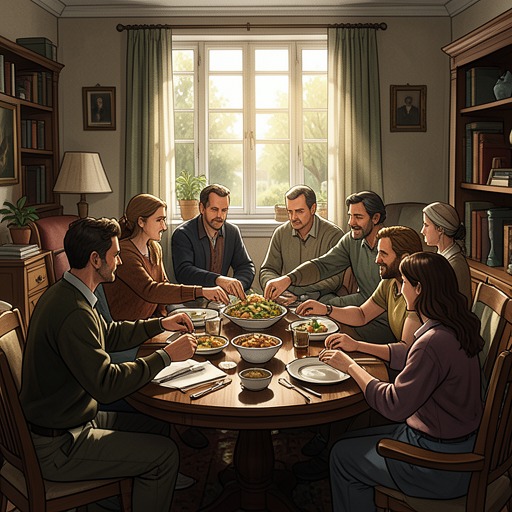
Shen Family Main Residence
I’m Very Happy After Marrying the CEO Husband According to the AgreementShen Family Main Residence is the principal domestic space associated with Shen Tang’s reunion with the Shen family. Its significance lies in the way it turns an abstract discovery of blood relationship into repeated, sometimes awkward, physical encounters: Shen Tang returns there with tear-swollen eyes, attends a formal banquet with relatives, protects Shen Lan in its garden, investigates a threat to her sister, and is finally met by the family as someone whose movements and feelings matter. The residence therefore functions as both refuge and pressure chamber, exposing the difference between being recognized as family and learning how to live within a family.
A House Entered Through Reunion
Shen Tang’s connection with Shen Family Main Residence belongs to the later movement of the story in which her separated family relationship is confirmed. When Gu Huaian’s phone rings with the hospital results, he and the others hurry to the hospital and receive confirmation that Shen Tang and the Shen family do share a blood relationship. That discovery gives the residence a new meaning. It is no longer simply the home of people connected to a hidden past; it becomes a place Shen Tang can enter as a daughter and sister, even though the emotional habits of strangers cannot be erased at once.
The first visits are marked by ceremonial preparation rather than ease. Shen Tang chooses a lotus-pink dress that is neither too plain nor too conspicuous, then travels with the family to a banquet. She has attended banquets before, but this occasion makes her unusually nervous because the social setting is also an introduction to relatives whose relationship with one another is described as less than close. Her aunt reassures her that most members of the Shen family are good people and that the purpose is simply to meet them; Shen Tang will not be forced to maintain contact with anyone she does not wish to see. The house and the banquet surrounding it thus present kinship as an invitation, but not yet as a settled emotional home.
Private Care and Emotional Exposure
The residence also reveals the family’s protective intimacy. After Shen Tang cries, Shen Yu accompanies her home. She wipes her tears and forces a smile, asking him not to tell the others because she does not want them to worry. She proposes that they quietly go upstairs so he can help her prepare a cooked egg for her swollen eyes. The plan fails almost immediately: after entering the living room, they encounter Shen Boyuan, who is coming downstairs for tea and notices that Shen Tang has been crying. The living room turns a concealed private injury into a family matter, not through surveillance or accusation, but through the ordinary attentiveness of someone who knows her well enough to see what the smile is hiding.
This domestic scene contrasts sharply with Shen Tang’s public work. In livestreams she maintains a professional smile while hostile viewers insult her, converting abuse into visibility and a share of the revenue. At the residence, however, the performance cannot fully control the audience. Shen Yu sees the redness around her eyes, and Shen Boyuan asks directly about it. The house therefore relocates emotional labor from the public arena into a setting where concern, embarrassment, and responsibility circulate among relatives rather than fans, companies, and anonymous commenters.
The Garden and the Threat to Shen Lan
The residence becomes more dangerous when Shen Tang and Shen Lan wait in the small garden. A butler soon leads several men in black directly toward them. Shen Tang instinctively suspects that the men have come for her and Shen Lan with hostile intentions, and she steps forward to shield Shen Lan behind her. Her response defines the house as a contested family space: the garden may be part of a protected home, but protection is not guaranteed merely because the women are inside it.
After the men leave and disperse, Shen Tang immediately seeks Shen Yu to learn more about Shen Lan’s family. Her concern is practical and urgent rather than ceremonial. She wants to know whether the danger can be dealt with and whether helping Shen Lan will be difficult. Although she privately recognizes that she may need Gu Huaian’s assistance if she cannot handle the opponents herself, she still sends Shen Lan home before leaving. The residence thus becomes a staging ground for sisterly loyalty, where the newly recognized bond between Shen Tang and Shen Lan is tested by the possibility of coercion and intrusion.
Family, Obligation, and the Meaning of Home
Shen Tang’s conduct at Shen Family Main Residence reflects the novel’s broader distinction between legal or biological kinship and lived care. Before the blood relationship is confirmed, she has already treated children from the orphanage as family: one eight-year-old boy develops leukemia, and Shen Tang has spent her savings supporting the orphanage and trying to fund his surgery. Her determination to earn money originally served both her own future and the children’s living conditions. The residence places that practice of chosen care beside newly verified blood ties, allowing the story to ask whether family is created by origin, by protection, or by sustained responsibility.
Her relationship with Shen Lan makes that question especially visible. Shen Tang shields her in the garden, searches for information after the threat, and, before departing, accepts Shen Lan’s invitation to meet her girlfriend. The invitation extends the household’s emotional world beyond conventional introductions: Shen Tang is not only being presented to relatives but is also being admitted into the intimate circumstances of Shen Lan’s life. The residence becomes a network of doors between generations, siblings, partners, and protectors, each encounter enlarging what Shen Tang must understand by the word family.
Narrative Function and Development
As a recurring setting, Shen Family Main Residence alternates between public formality and unguarded domestic interruption. The banquet demands clothing, composure, and polite introduction; the living room catches tears that Shen Tang hoped to conceal; the garden converts an ordinary wait into a defensive confrontation; and the return home at dusk ends with the family sitting on the sofa awaiting her explanation. In that final image, the residence acts less like a stage for a single revelation than like a continuing household whose members expect accountability from Shen Tang because they have begun to include her in their daily concerns.
The house’s importance consequently lies in its gradual domestication of reunion. Shen Tang does not instantly become comfortable merely because a doctor confirms the blood relationship. She remains nervous at the banquet, wary when strangers approach, embarrassed when her crying is noticed, and cautious about the family’s reaction when she comes home late. Yet each episode gives the residence another layer: formal entry, emotional shelter, defensive solidarity, and familiar scrutiny. Shen Family Main Residence is where the story’s idea of family moves from genealogy into practice, making Shen Tang’s return not a single triumph but an ongoing process of being seen, protected, questioned, and loved.