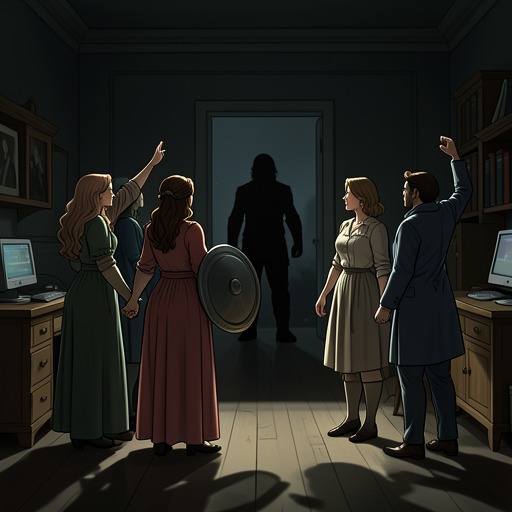
Shen Lan and Her Lover’s Family Persecution Tragedy
I’m Very Happy After Marrying the CEO Husband According to the AgreementShen Lan and Her Lover’s Family Persecution Tragedy is the formative catastrophe behind Shen Lan’s withdrawn identity and her enduring devotion to the woman she loved. What begins as a university romance is crushed by a family that treats lineage and social convention as stronger than either woman’s will. Shen Lan is imprisoned, her girlfriend is gravely injured while trying to rescue her, and the aftermath turns a family name into a source of hatred and guilt rather than belonging.
Origins of the Relationship
Shen Lan, whose original name was Shen Lan, came from a scholarly family governed by strict, old-fashioned rules. She had never previously fallen in love with anyone, and the story does not present her attraction to women as something she had always consciously understood about herself. At college, she was admired for her appearance and personality, and it was there that she met the girlfriend who pursued her.
Shen Lan initially felt repelled by that pursuit, but the relationship changed through familiarity. Without any single announced turning point, she became accustomed to her girlfriend’s presence, and the two eventually lived happily together for a period of time. Their happiness is important to the tragedy because it establishes that the relationship was not merely an act of rebellion against Shen Lan’s family: it was a real bond that gradually became central to her life.
Family Intervention and Confinement
The Shen family discovered the relationship and refused to accept a homosexual partnership. Rather than treating Shen Lan as an adult capable of choosing her own future, the family attempted to enforce separation. Both women resisted the demand to break up, so Shen Lan’s family escalated from disapproval to confinement, imprisoning her at home in the belief that physical isolation would force the couple apart.
The confinement reveals the family’s method of control. Its authority operates through custody, surveillance, and the denial of choice, turning the household into a prison while still claiming to act for family order. Shen Lan’s relationship is therefore persecuted not because it has harmed anyone, but because it contradicts the family’s rules about sexuality, marriage, and lineage.
The Failed Elopement and Violent Assault
While Shen Lan was being held at home, her girlfriend secretly went to the house intending to elope with her. The attempt failed when the family discovered them. Shen Lan’s father then ordered people to bring in the man he had selected as Shen Lan’s husband and forced him to have sex with Shen Lan in front of her girlfriend. The assault converts the family’s attempt to arrange marriage into an instrument of public humiliation and psychological violence, using Shen Lan’s body to punish both women for refusing obedience.
The girlfriend tried desperately to save Shen Lan and struggled against what was happening. During that struggle, she fell onto shards from a broken teacup that Shen Lan’s father had smashed earlier. The injuries left her in a vegetative state. Her condition is described as one in which a person may still move or smile and appear outwardly ordinary while remaining without consciousness, making the loss especially cruel: the body remains present, but the mutual life the couple shared is no longer accessible.
Severed Family and Continuing Care
After the assault and injury, Shen Lan cut ties with the Shen family. She came to hate the Shen surname and loathe her own lineage, rarely using her surname when dealing with people outside the family and breaking off contact with her relatives. The name that should have signified origin and protection instead became a permanent reminder of the violence committed in the family’s name.
Shen Lan nevertheless refused to abandon the people left to her. For years, she cared for her girlfriend and her girlfriend’s grandmother. The grandmother did not blame Shen Lan, but that mercy intensified Shen Lan’s guilt rather than relieving it. Her continuing care is thus both an expression of love and a form of self-imposed responsibility: she cannot restore her girlfriend’s consciousness, yet she can remain faithful to the life they intended to build.
The Unfinished Home
The small villa Shen Lan maintained was meant to be the happy future home she and her girlfriend had imagined together. Shen Lan succeeded in making that future materially real, but her partner never lived to experience it consciously. The home consequently embodies both achievement and absence. It preserves the couple’s shared promise while registering the fact that family violence made its fulfillment impossible.
Gu Huaian knows the details of Shen Lan’s history and appears to have helped her when she lacked the means to establish this life. His involvement connects the tragedy to the wider network of care surrounding Shen Lan, while also showing why the account reaches Shen Tang through Gu Huaian rather than through Shen Lan’s own public disclosure. Shen Tang learns that the cheerful woman she knows has built her present life around a past that remains devastatingly unresolved.
Disclosure and Witnessing
The tragedy is disclosed to Shen Tang through Gu Huaian, who presents it as the history behind Shen Lan’s cheerful surface. Shen Tang’s shock is not merely a reaction to an unhappy romance; it is a recognition that the household claiming to defend respectability used confinement, arranged marriage, and sexual violence to destroy the autonomy of its own daughter. The account also changes the meaning of Shen Lan’s chosen distance from her surname. Her refusal to identify herself publicly by that name is not affectation but a deliberate separation from the family structure that made her home unsafe.
Gu Huaian’s knowledge suggests that Shen Lan’s survival was not entirely solitary. Shen Tang realizes that he must have helped Shen Lan establish the small villa and maintain a life of care, because Shen Lan had not originally possessed the means to do so. His assistance does not erase the family’s violence or replace the absent girlfriend, but it gives the aftermath a practical dimension: recovery is represented through housing, caregiving, and the preservation of an imagined future rather than through a clean emotional resolution.
Continuing Consequences
The girlfriend’s vegetative state makes the tragedy ongoing rather than concluded. Shen Lan continues to care for her and for her grandmother over the years, living with the consequences of the failed escape and the injury sustained during the struggle. The grandmother’s refusal to blame Shen Lan offers compassion, yet it also deepens Shen Lan’s guilt, because forgiveness cannot restore consciousness or undo the circumstances that produced the injury. Care therefore becomes the form her loyalty takes after ordinary partnership has been made impossible.
This history also explains why Shen Lan’s present identity contains such a sharp contrast. She can appear cheerful while carrying a life organized around grief, responsibility, and an absent future. The villa is not simply a residence: it is the concrete remainder of a promise made before the family intervened. Shen Lan achieved the home she and her girlfriend had envisioned, but the person for whom it was built cannot consciously share it, leaving the setting to hold both devotion and loss.
Narrative Significance
Shen Lan and Her Lover’s Family Persecution Tragedy broadens the novel’s treatment of family beyond blood, inheritance, and socially approved marriage. The Shen family possesses the authority of lineage but abandons the obligations normally associated with kinship; Shen Lan’s girlfriend and her grandmother, by contrast, become the people toward whom Shen Lan directs sustained protection and care. The tragedy thus makes lived responsibility more meaningful than a surname, while exposing how familial power can turn the language of order into an excuse for coercion.
The episode also gives Shen Tang a concrete example of the costs of enforced conformity. Shen Lan’s relationship begins through mutual attachment, but the family transforms a private choice into a crisis involving imprisonment, a forced sexual act, permanent injury, estrangement, and years of caregiving. Its consequences remain visible in Shen Lan’s hidden surname, her carefully built villa, and the life she continues to maintain for her incapacitated lover. The tragedy is therefore not only a backstory explaining Shen Lan’s behavior; it is a lasting structure of absence that shapes how she belongs, whom she trusts, and what she understands as family.